
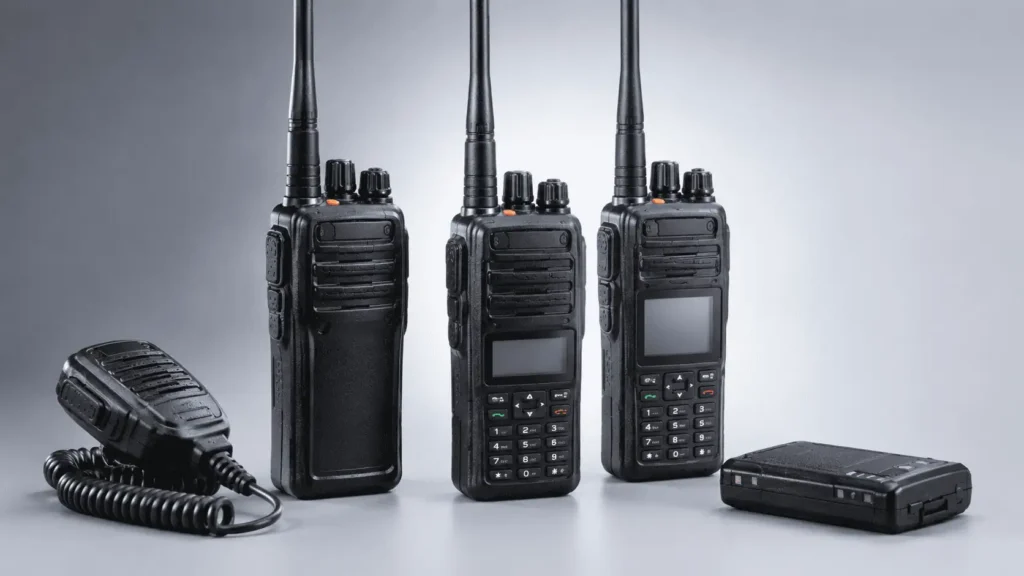
[B2B Sourcing Summary] Analog vs. DMR vs. PoC: Which radio technology fits your market?
Choosing the correct communication protocol depends on your target industry, range requirements, and encryption needs:
- Analog Radios (VHF/UHF): Cost-effective, simple deployment, short-to-medium range (1–5 km). Ideal for hospitality, retail, and basic commercial promotions.
- DMR Digital Radios (Tier II/III): Crystal-clear digital audio, doubled channel capacity via TDMA, AES-256 encryption, and extended battery life. Essential for security, construction, and heavy industry.
- PoC (Push-to-Talk Over Cellular 4G/LTE): Nationwide or global range over cellular networks with GPS tracking and zero spectrum licensing hurdles. Perfect for logistics fleets and multi-city operations.
For a complete breakdown of unit pricing across quantity tiers, consult our 2026 Custom Walkie Talkie Wholesale Pricing Guide.
1. Technical Deep-Dive: Analog, DMR, and PoC Protocols
Understanding the fundamental differences between analog, digital (DMR), and cellular (PoC) platforms prevents inventory mismatch and ensures your radios meet local frequency regulations.
A. Analog Two-Way Radios (Legacy Frequency Modulation)
Analog radios transmit voice signals using standard FM waves across frequency bands like VHF (136–174MHz) or UHF (400–470MHz).
- Pros: Lowest unit manufacturing cost, simple operation, zero latency, compatible with older equipment.
- Cons: Audio quality degrades as range limits are reached; prone to static interference; vulnerable to eavesdropping without CTCSS/DCS privacy tones.
- Best Use Cases: Schools, restaurants, event management, and consumer outdoor recreational brands.
B. DMR (Digital Mobile Radio) Radios (ETSI Standard)
DMR uses 2-slot Time Division Multiple Access (TDMA) technology to split a single 12.5kHz channel into two independent communication paths, effectively doubling spectrum efficiency.
- Pros: Superior audio clarity with background noise cancellation; longer battery runtime (up to 40% improvement over analog); advanced voice encryption (ARC4 / AES-256); repeater compatibility for extended site coverage.
- Cons: Higher component cost; requires frequency licensing in professional bands.
- Best Use Cases: Construction sites, oil & gas plants, security agencies, and emergency response teams requiring heavy duty long-range two-way radios.
C. PoC (Push-to-Talk Over Cellular) Radios
PoC technology leverages existing 4G LTE, 3G, and Wi-Fi networks to transmit digitized voice packets over cloud servers (like RealPTT, SmartPTT, or PocStars).
- Pros: Infinite communication distance (city-to-city or international); real-time GPS fleet tracking; individual, group, and dispatch console video calling; no spectrum license application required.
- Cons: Depends on mobile network coverage; requires a small annual SIM card or server platform subscription fee.
- Best Use Cases: Long-haul trucking, city logistics, regional security guards, and multi-branch facilities.
2. B2B Technology & Feature Comparison Matrix
Compare physical and operational performance criteria across all three radio categories:
| Feature / Specification | Analog Radios | DMR Digital Radios | PoC 4G / LTE Radios |
|---|---|---|---|
| Effective Range | 1 – 5 km (Line-of-Sight) | 3 – 10 km (Up to 30km with Repeater) | Nationwide / Worldwide (Cellular Coverage) |
| Audio Clarity | Standard (Static increases with distance) | HD Audio with DSP Noise Suppression | High Definition Digital Audio |
| Voice Encryption | Basic Scrambler / CTCSS | AES-256 Bit Encryption | SSL / TLS Cloud Data Encryption |
| GPS / Fleet Management | Not Available | Optional (Hardware Module) | Built-in Real-Time GPS Tracking |
| Spectrum Licensing | License-Free (PMR446/FRS) or Licensed | Commercial Frequency License Required | No Spectrum License Needed |
| Est. Wholesale Unit Price | $4.50 – $12.00 | $18.50 – $38.00 | $28.00 – $65.00 |
3. Hardware Customization & Frequency Programming Parameters
Before launching an OEM/ODM two-way radio project, work with our engineering team to define hardware build specs:
- VHF vs. UHF Antenna Tuning:
- VHF (136–174MHz): Longer waves that travel farther outdoors across open fields and rural areas.
- UHF (400–470MHz): Shorter waves that penetrate steel, concrete, and building structures effectively for indoor urban operations.
- IP Rating & Environmental Ruggedness: High-risk industrial buyers require IP67 or IP68 dust-tight and submersible waterproof enclosures with polycarbonate shock-proof housing.
- Frequency Pre-Programming: We can pre-program channels, privacy tones, and button functions according to your regional frequency allocations. Learn more in our Custom Radio Ordering & Technical Guide.
4. Regulatory Certification Compliance for Sourcing
Importers must ensure radios comply with regional wireless communication laws to clear customs smoothly:
- United States (FCC ID): Radios must pass FCC Part 15 / Part 90 testing for spurious emissions and SAR safety.
- European Union (CE RED): Must comply with the Radio Equipment Directive (RED), EN 300 086, and RoHS environmental standards.
- Battery Safety (UN38.3 & MSDS): All Lithium-ion battery packs must hold certified lab reports for air or sea shipment. Review our Walkie Talkie Factory Audit Checklist for verification procedures.
Ready to source? See our OEM DMR radios page for models, OEM options and quotation details.
Planning a DMR project in Africa or Asia? See our market pages for South Africa and the Philippines.
Decision Matrix by Use Case
Most buyers do not need the “best” technology, but the one that fits how their teams actually work. The matrix below shows typical starting points for common use cases. Final choices depend on site size, licensing, budget and existing equipment.
| Use case | Analog | DMR | PoC / LTE | Typical recommendation |
|---|---|---|---|---|
| Small shop, café or single-floor site | Good fit | More than needed | Possible but adds data costs | Analog or license-free radios |
| Hotel or resort | Workable | Good fit, clearer audio and private calls | Useful for multi-property groups | DMR; see radios for hotels |
| Factory or warehouse | Workable for simple sites | Good fit, especially in noise | Useful for staff moving between sites | DMR with noise-cancelling accessories |
| Construction site | Good fit for short projects | Good fit for large or long projects | Useful for regional supervisors | Analog or DMR, with PoC for managers |
| Security patrols across a city | Limited by range | Needs repeaters or multi-site systems | Good fit with GPS and dispatch | PoC / LTE |
| Logistics fleet between depots | Limited to each site | Site coverage only unless networked | Good fit | DMR on site plus PoC for drivers |
| Events and festivals | Good for short hire periods | Good for large crews | Useful for dispersed teams | Depends on duration and crowd size |
How to use the matrix
Start by listing each user group separately rather than choosing one technology for the whole company. A hotel may run DMR for housekeeping and engineering while giving a few PoC radios to managers who travel between properties. A factory may keep analog radios in a quiet storeroom and use DMR on a noisy production line. Then check three practical limits: the licensing options in your country, the mobile coverage at your sites and the budget split between upfront and recurring costs. If two options still look equal, test samples of both on site for a week before deciding.
Relative Total Cost Comparison
Purchase price is only part of the cost. Each technology shifts spending between upfront hardware, infrastructure and ongoing fees. The comparison below is relative, not a price list; actual costs depend on model, quantity, licensing and country.
| Cost element | Analog | DMR | PoC / LTE |
|---|---|---|---|
| Radio hardware | Lowest | Moderate | Moderate, varies with features |
| Infrastructure | Optional repeaters | Repeaters or multi-site systems for larger areas | Usually none; uses mobile networks |
| Licensing | Depends on market and frequencies | Depends on market and frequencies | Usually none for the user; SIM plans needed |
| Recurring fees | Low | Low, plus any licence renewals | SIM data and platform subscriptions per user |
| Programming and setup | Simple | More planning for talk groups and IDs | Platform setup and user management |
| Upgrade flexibility | Limited | Firmware features, may run analog too | Updates through the platform |
For a detailed look at ongoing costs, see our total cost of ownership guide and PoC radio cost questions.
Migration Path: Analog to DMR to PoC
Few organisations replace a whole fleet at once. A staged migration spreads cost and lets teams keep talking during the change.
- Audit the current fleet: record radio models, frequencies, licences, channels, accessories and the condition of batteries.
- Choose dual-mode DMR radios: many DMR radios can also operate in analog mode, so new radios can talk to the existing fleet on analog channels.
- Replace by team or area: start with the teams that benefit most from digital features, such as security or maintenance.
- Move channels to digital: once most radios are DMR, switch shared channels to digital and retire old analog-only units.
- Add PoC where coverage ends: give PoC radios to drivers, managers or remote staff who leave the site, and connect them through a gateway if the platform supports it.
- Review licences: check whether licence conditions need updating when moving from analog to digital emissions, depending on the market.
Plan accessories at each stage, because batteries, chargers and audio accessories are often model-specific.
Mixed-Fleet Interoperability
Mixed fleets are normal during migrations and in companies that grow through acquisitions. Interoperability depends on the technologies and settings involved.
- Analog to analog: radios from different brands usually talk if frequency, bandwidth and CTCSS/DCS tones match.
- DMR to DMR: DMR is an open ETSI standard, so different brands can often communicate on basic voice calls when colour codes, time slots, talk groups and IDs match. Proprietary features such as some encryption or data functions may not work across brands.
- DMR to analog: dual-mode radios can use analog channels, and some offer mixed-mode channels that detect both.
- PoC to DMR or analog: this usually requires a gateway or bridging solution supported by the platform.
Mixed fleets also need clear administration. Keep a master record of frequencies, colour codes, talk groups, radio IDs and encryption keys, and share it only with the people who programme radios. Encryption is a common stumbling block: basic privacy features often differ between brands, so an encrypted group may only work between radios of the same make or with specific settings. Label radios by type and group so staff know which unit to collect, and train users on what they will and will not hear during the transition period.
Always test interoperability on samples before ordering. Our guide on whether different walkie talkie brands can work together explains the settings to check.
Frequently Asked Questions (FAQ)
Q1: Can DMR digital radios communicate with legacy analog radios?
A1: Yes! Our DMR models feature a dual-mode (Analog + Digital) switchable function. A single radio can operate on analog channels when talking to older models and switch to digital mode for encrypted channels.
Q2: What is the minimum order quantity (MOQ) for custom logo housing and color cases?
A2: Silk-screen logo branding on standard black housings starts at 300 pieces. Custom plastic color injection (e.g., safety yellow or orange) has an MOQ of 1,000 pieces.
Q3: How do we handle firmware updates or customization for PoC LTE radios?
A3: We provide OTA (Over-The-Air) remote firmware updates and can flash customized Android-based OS or client-specific PTT apps prior to shipment.
Consult with Our Radio Engineering Team Today
Unsure whether Analog, DMR, or PoC best suits your project? Contact our engineers today for a Free Technical Consultation, Custom Frequency Plan & Direct Factory Quote within 2 Hours!
Which is cheaper over time: analog, DMR or PoC?
It depends on how the radios are used. Analog usually has the lowest hardware cost, DMR adds moderate hardware cost with few recurring fees, and PoC avoids infrastructure but adds SIM and platform fees per user. Compare total cost over several years using your own fleet size and coverage needs.
Can DMR radios talk to our existing analog radios?
Many DMR radios are dual-mode and can operate on analog channels, so they can talk to an existing analog fleet if frequencies and tones match. This lets businesses migrate in stages. Confirm dual-mode support and mixed-mode channel options for the specific model with the manufacturer.
Can PoC radios communicate with DMR radios?
Not directly, because PoC uses mobile data while DMR uses radio frequencies. Some platforms support gateways that bridge PoC talk groups with DMR or analog channels. Check whether the chosen platform and radios support a gateway, and test the setup before rolling it out.
Related Guides
Planning a PoC or 4G radio fleet?
Tell us the countries, network needs and fleet size. We will recommend suitable PoC/LTE models, explain platform options and arrange samples for testing before you order.
Get a Quote →View PoC & 4G Radios