
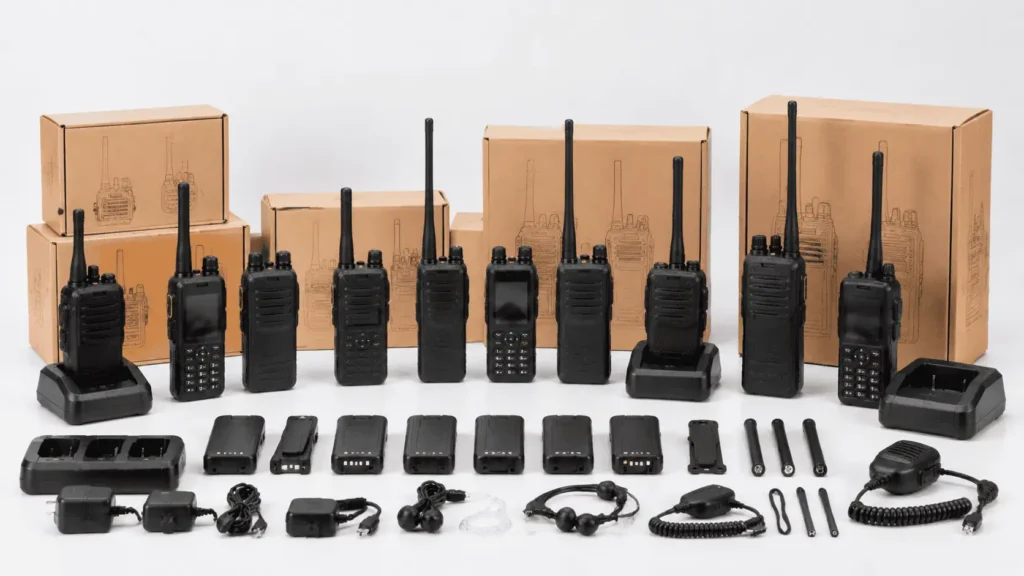
[B2B Sourcing Summary] How much do custom walkie talkies cost wholesale in 2026?
Wholesale unit prices for custom two-way radios range from $4.50 to $65.00+ per unit, depending on frequency tech (Analog vs. DMR Digital vs. PoC 4G/LTE), RF output power (0.5W to 10W), IP waterproof ratings, and compliance certifications:
- Commercial Analog Radios (0.5W–2W): $4.50 – $9.80 / unit (MOQ: 500 pcs)
- Professional DMR Digital Radios (5W Tier II): $18.50 – $38.00 / unit (MOQ: 300 pcs)
- PoC (Push-to-Talk Over Cellular) 4G Radios: $28.00 – $65.00 / unit (MOQ: 200 pcs)
Need technical guidance on selecting frequencies and protocols? Check our DMR vs. Analog vs. PoC Two-Way Radio Selection Guide.
Key Cost Drivers in Custom Walkie Talkie Manufacturing
Understanding factory cost structures allows procurement officers and brand managers to optimize custom specifications without sacrificing audio clarity or transmission range.
1. Chipsets & Internal Radio Frequency (RF) Architecture
The core circuit board (PCB) and RF power module determine transmission reliability and manufacturing costs:
- Analog Single-Chip ICs: Highly cost-effective for short-range indoor use (hotels, retail, catering).
- DMR (Digital Mobile Radio) Microprocessors: Utilizes TDMA technology for crystal-clear voice encryption, noise cancellation, and double-channel capacity.
- PoC (4G / LTE / Wi-Fi) Modules: Integrates cellular baseband modules for nationwide/global range with zero frequency licensing constraints.
2. RF Power Output & Battery Capacity
Higher wattage output increases communication range through dense structures but requires larger batteries and thermal management:
- 0.5W – 2W (PMR446 / FRS License-Free): 1000mAh – 1500mAh Li-ion battery; 1–3 km line-of-sight range.
- 5W – 10W Long-Range Industrial: 2000mAh – 4000mAh high-capacity battery packs; 5–10 km range. Requires heat-sink aluminum chassis.
3. Enclosure Tooling, IP Ratings & Custom Branding
Mechanical design dictates durability in harsh outdoor environments:
- Standard ABS Plastic Housing: Suitable for everyday commercial use.
- IP67 / IP68 Waterproof Housings: Features precision silicone gaskets, waterproof acoustic mesh, and polycarbonate (PC) drop-proof materials.
- OEM Mold Tooling: Custom plastic injection molds for unique radio body ergonomics range from $3,000 to $8,000 (one-time tooling fee).
2026 Custom Two-Way Radio Pricing & MOQ Matrix
The table below provides volume pricing estimates for common OEM/ODM walkie talkie configurations:
| Radio Type & Tech | Standard MOQ | Est. Price (300 pcs) | Est. Price (1,000 pcs) | Lead Time |
|---|---|---|---|---|
| License-Free PMR446 / FRS Analog | 500 pcs | $6.80 – $9.50 | $4.50 – $6.20 | 12 – 15 Days |
| 5W Professional VHF/UHF Analog | 300 pcs | $14.50 – $19.00 | $9.80 – $13.50 | 15 – 18 Days |
| DMR Tier II Digital Radio (IP67) | 300 pcs | $28.00 – $38.00 | $18.50 – $25.00 | 20 – 25 Days |
| 4G / LTE PoC National Range Radio | 200 pcs | $45.00 – $65.00 | $28.00 – $42.00 | 18 – 22 Days |
Preventing Compliance & Technical Delays in OEM Sourcing
When manufacturing two-way radios overseas, safeguard your import logistics by addressing these critical specifications up front:
- International Regulatory Certifications: Ensure units destined for North America have FCC ID compliance, and European orders carry CE (RED directive) and RoHS lab testing.
- Battery Safety Standards: Lithium-ion battery shipments strictly require UN38.3, MSDS, and 1.2m Drop Test reports for air or ocean freight acceptance. Learn how to verify these in our Walkie Talkie Factory Audit Checklist.
- Frequency Pre-Programming & Firmware: Custom CTCSS/DCS privacy tones, frequency channel tables, and custom bootup screens should be locked in during prototype development. Review our Custom Radio Ordering & Technical Guide.
Relative Price Tiers by Platform
Wholesale prices for walkie talkies cover a wide range, and the platform is the biggest single factor. The table below shows relative price positions rather than figures, because actual prices depend on model, specification, quantity, customization and market version. Ask for current quotes on the exact configuration you need.
| Platform | Relative unit price | What drives the price within the tier | Typical buyers |
|---|---|---|---|
| Basic analog / license-free | Lowest | Housing quality, battery capacity, display and charger type | Retail, hospitality, small businesses |
| Commercial analog | Low to moderate | Power level, IP rating, channel count, accessories | Warehouses, construction, events |
| Entry DMR | Moderate | Dual-mode analog/DMR, display, keypad, audio quality | Upgrading commercial fleets |
| Professional DMR | Moderate to high | Rugged build, GPS, Bluetooth, man-down, higher IP ratings | Security, manufacturing, logistics |
| PoC / 4G LTE radios | Moderate to high, plus recurring fees | Network bands, GPS, screen, platform compatibility | Multi-site fleets, security, field service |
| Specialised radios | Highest | Intrinsic-safety or other specialised certification, where available | Oil, gas, mining and chemical sites |
Price tiers often overlap. A well-specified analog radio can cost more than a basic DMR model, so compare features rather than labels. Our DMR vs analog vs PoC guide explains which features justify moving up a tier.
Accessories and fleet bundles
Accessory pricing also varies by tier. Professional radios often use more expensive batteries, rugged speaker mics and multi-unit chargers, which can add noticeably to the cost per user. When comparing platforms, price a complete user kit (radio, battery, charger slot and audio accessory) rather than the radio alone. Our accessories supplier page shows the typical items included in a fleet bundle.
How Volume and Customization Affect Unit Cost
Unit cost falls with volume because fixed costs are spread over more units, but customization adds its own fixed costs. Understanding both helps buyers decide where to spend.
- Volume breaks: factories usually price in bands, so ordering just above a break can lower the unit price. Ask where the breaks fall for each model.
- Logo printing: screen printing or laser marking usually adds little per unit once set up.
- Custom housing colours: may require separate material batches and a higher minimum quantity.
- New moulds or tooling: changing housing shapes adds significant one-off cost and time.
- Firmware and programming: channel programming is usually simple; custom firmware features take more development work.
- Packaging and manuals: custom boxes and printed manuals have their own minimum print runs.
- Market versions: separate versions for different regions may be priced as separate SKUs.
Minimum quantities and pricing for each option depend on the model and supplier, so request a clear breakdown in the quote. The private label MOQ and sample checklist lists the questions to ask.
Timing affects price as well. Orders placed during factory peak seasons, or with rushed delivery dates, can cost more than orders planned in advance. Sharing a forecast with your supplier helps them secure components and may improve pricing on repeat orders.
Landed-Cost Worksheet
The factory price is only the starting point. Landed cost is what each radio really costs when it reaches your warehouse, ready to sell. Use the line items below, and fill in actual figures from your forwarder, customs broker and supplier.
| Cost line | What to include | Where to get the figure |
|---|---|---|
| Product cost | Radios at the quoted Incoterm (e.g. EXW, FOB) | Supplier quotation |
| Accessories | Extra batteries, chargers, earpieces, speaker mics | Supplier quotation |
| Customization | Logo, colours, packaging, programming, manuals | Supplier quotation |
| Samples | Sample units and courier costs | Supplier and courier |
| Certification and testing | Market-specific testing, documents, local representation | Supplier, test laboratory or consultant |
| Freight | Sea or air freight, including dangerous goods handling for lithium batteries | Freight forwarder |
| Insurance | Cargo insurance for the shipment value | Forwarder or insurer |
| Duties and taxes | Import duty and VAT/GST based on tariff classification | Customs broker |
| Local charges | Port, handling, customs clearance and delivery | Forwarder and broker |
| Inspection | Pre-shipment inspection fees | Inspection company |
| Warranty reserve | Spare units or budget for returns | Your own estimate |
Divide the total by the number of sellable units to get the landed cost per radio. Recalculate for each shipment, because freight rates and exchange rates change.
Exchange rates and freight costs move between quotation and payment, so build a small contingency into the worksheet. Many importers also keep a simple spreadsheet per model, updated after each shipment, so future price negotiations start from actual landed costs rather than estimates.
Comparing Quotes Like-for-Like
Two quotes for “the same” radio can hide very different contents. Before comparing prices, align the details:
- Same Incoterm: convert every quote to the same basis, such as FOB, before comparing.
- Same configuration: check frequency band, power, channel count, battery capacity, IP rating and display.
- Same package contents: confirm whether batteries, chargers, antennas, belt clips and earpieces are included.
- Same market version: a certified version for your market may cost more than a generic version.
- Same documents: check which compliance and battery transport documents are included.
- Same after-sales terms: compare warranty terms, spare parts and repair support.
- Same quote validity: note how long each price is valid and what may change it.
A slightly higher price from a manufacturer with clear documentation and after-sales support often costs less over the life of the fleet. Our manufacturer vs trading company guide explains how supplier type affects quotes.
Frequently Asked Questions (FAQ)
Q1: What is the lead time for a physical custom walkie talkie sample?
A1: Once frequency specifications and housing artwork are confirmed, physical pre-production samples take 5 to 7 business days.
Q2: Can you customize the firmware language and bootup logo on LCD display models?
A2: Yes! We provide custom firmware flashing including client logos on display startup, localized menu languages, and custom button mapping.
Q3: Do you support custom packaging, desktop chargers, and accessories?
A3: Absolutely. We manufacture matching rapid desktop chargers, belt clips, earpieces, customized gift boxes, and user manuals with your branding.
Request Your Custom Walkie Talkie Quote Today
Looking for a reliable OEM/ODM radio manufacturer? Send us your technical specs, frequency requirements, or reference design for a Free Engineering Feasibility Review & Direct Factory Price Quote within 2 Hours!
Why do walkie talkie prices vary so much between suppliers?
Prices vary with platform, specification, battery, accessories, customization, market certification and the Incoterm used. Supplier type also matters, as factories and trading companies price differently. To compare fairly, align configuration, package contents, documents and terms before looking at the unit price.
What is included in the landed cost of imported walkie talkies?
Landed cost includes the product price, accessories, customization, samples, certification and testing, freight with dangerous goods handling for batteries, insurance, duties and taxes, local port and clearance charges, inspection and a warranty reserve. Divide the total by sellable units to get the real cost per radio.
Does customization always increase walkie talkie unit prices?
Not always by much. Logo printing and channel programming usually add little per unit once set up. Custom colours, packaging and manuals have their own minimum runs, and new moulds or custom firmware add larger one-off costs. Ask the supplier for a separate breakdown of each customization option.
Related Guides
Sourcing radios for your brand or distribution business?
We support OEM and private label orders: logo, housing color, packaging, firmware and channel programming. Send your target market and quantities for a quote and samples.
Get a Quote →Browse Our Radios