
Two Way Radio Manufacturer vs Trading Company: How to Choose
Short answer: A two way radio manufacturer is usually better for buyers who need OEM branding, stable models, technical support, accessories and repeat orders. A trading company may be useful for mixed sourcing or small trial orders. The right choice depends on your quantity, product type, customization needs, certificates and long-term supply plan.
This guide is written for importers, distributors and project buyers comparing supplier types. It focuses on practical sourcing checks instead of making broad claims that every factory is better or every trading company is worse.
Who This Guide Is For
- Importers searching for a two way radio manufacturer in China.
- Distributors planning OEM walkie talkie or private label radio orders.
- Project buyers sourcing DMR radios, PoC radios, analog radios or repeaters.
- Business buyers comparing factory pricing, product quality and after-sales support.
What Is a Two Way Radio Manufacturer?
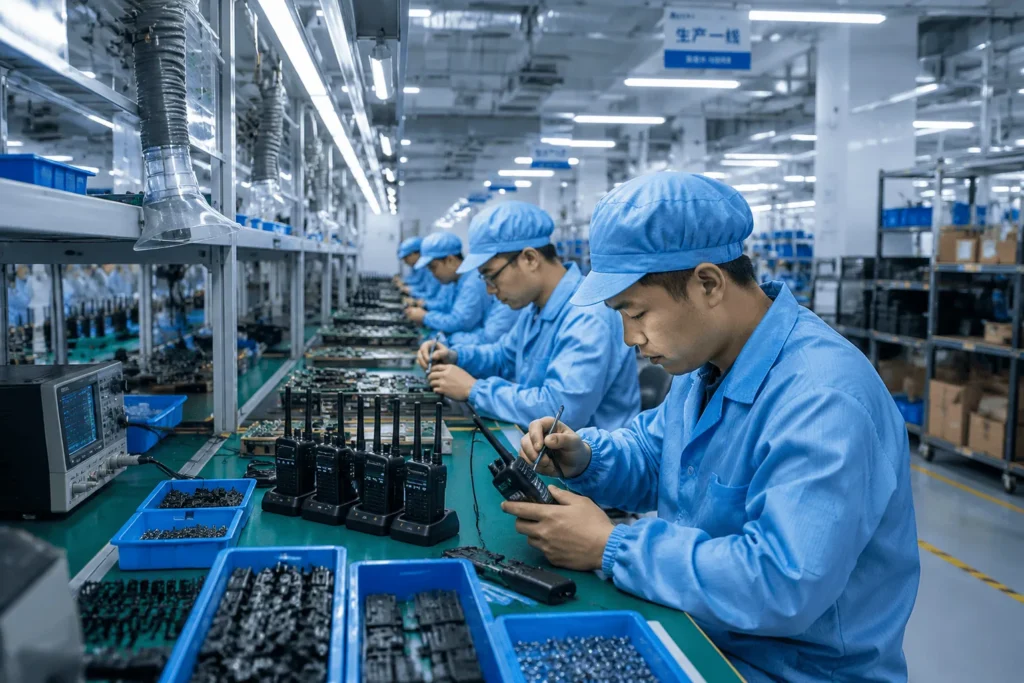
A two way radio manufacturer is a supplier involved in producing, assembling, configuring or factory-directly supplying radio products. Manufacturers usually have stronger control over product models, OEM logo, packaging, production schedule, spare parts, accessories and repeat order stability.
For buyers who want analog radios, DMR radios, PoC radios, LTE walkie talkies, repeaters or accessories under their own brand, working with a manufacturer or factory-backed supplier can make the sourcing process more stable.
What Is a Trading Company?
A trading company sources products from factories and sells them to buyers. A good trading company can be useful when you need multiple product categories, low initial quantity or sourcing support across different factories. However, product control, OEM flexibility and repeat order consistency may depend on the factories behind them.
Manufacturer vs Trading Company Comparison
| Item | Two Way Radio Manufacturer | Trading Company |
|---|---|---|
| OEM logo and packaging | Usually stronger support | Depends on factory partners |
| Product knowledge | Usually deeper for own radio models | May vary by product category |
| Price for bulk order | Often better for volume purchase | May include extra sourcing margin |
| Mixed sourcing | May focus on radio products | Can help source many categories |
| Repeat order stability | Usually more stable if model is factory-owned | Depends on supplier network |
| Technical support | Often better for radio configuration and accessories | Depends on team experience |
When to Choose a Two Way Radio Manufacturer
- You need OEM logo, private label packaging or branded accessories.
- You plan to place repeat orders for the same radio models.
- You need DMR radios, PoC radios, repeaters or technical product recommendations.
- You want stable spare batteries, chargers, antennas and earpieces.
- You need clearer answers about certificates, frequency range and product configuration.
When a Trading Company May Be Useful
A trading company may be useful if you are buying many unrelated product categories, testing a very small quantity, or need someone to consolidate products from different factories. Some trading companies also have strong sourcing experience and can be helpful for buyers who are not ready for direct factory orders.
| Buyer Situation | Possible Better Choice | Reason |
|---|---|---|
| Private label radio business | Manufacturer | Better OEM and repeat order support |
| Large DMR or PoC radio order | Manufacturer | Better technical and accessory support |
| Mixed product sourcing | Trading company | Can combine different categories |
| Very small trial order | Either option | Depends on supplier flexibility |
| Long-term distributor product line | Manufacturer | Model stability and after-sales support matter |
How to Verify Supplier Capability
Instead of asking only “Are you a factory?”, buyers should ask questions that reveal actual capability. The goal is to understand whether the supplier can support your business model, not only what label they use.
| Check Point | Question to Ask | Good Sign |
|---|---|---|
| Product knowledge | Which model do you recommend for my industry? | Supplier asks about use case before recommending |
| OEM support | Can you provide logo, packaging and manual options? | Supplier explains MOQ and process clearly |
| Certificates | Which models have CE, FCC or RoHS documents? | Documents match exact model |
| Accessories | Can you supply spare batteries and chargers later? | Supplier supports repeat accessory orders |
| Sample order | Can I test samples before bulk purchase? | Supplier supports sample testing |
| Repeat order | Will this model be available in future orders? | Supplier can explain model stability |
Important Questions for Radio Buyers
- Do you supply analog radios, DMR radios, PoC radios, LTE walkie talkies and accessories?
- Which models are suitable for my country and industry?
- Can you provide sample units before bulk order?
- Can you support OEM logo and packaging?
- Can you supply spare batteries, chargers, antennas and earpieces?
- Do you have certification documents for the selected model?
- How do you support after-sales issues or replacement parts?
Price Is Not the Only Difference
Many buyers focus only on unit price, but two way radio sourcing also depends on battery quality, charger type, accessory availability, packaging, certifications, model stability and support. A low price can become expensive if the product has weak battery life, missing accessories or poor repeat supply.
For distributors, a slightly better product line with stable repeat orders can be more valuable than the lowest price model. For project buyers, reliable communication and suitable accessories are usually more important than saving a small amount per unit.
OEM Buyers Should Prefer Stable Supply
If you print your own logo and packaging, changing models later can create problems. Manuals, cartons, labels, marketing materials and customer support all depend on product stability. For this reason, OEM buyers should ask whether the selected model will be available for future repeat orders.
Sample Testing Before Supplier Decision
Samples help buyers compare real product quality before deciding whether to work with a manufacturer or trading company. Sample testing should include audio, range, battery life, charger plug, accessory fit, packaging quality and user feedback.
- Test radios in the real working environment.
- Compare battery life across a normal shift.
- Check if accessories fit securely.
- Confirm packaging and labels before OEM printing.
- Ask users whether audio and operation are acceptable.
Red Flags When Choosing a Supplier
- The supplier gives the same recommendation for every buyer without asking about application.
- The quotation does not clearly list radio, battery, charger, antenna and packaging.
- The supplier cannot explain analog, DMR and PoC radio differences.
- The supplier promises unrealistic range without discussing site conditions.
- The supplier avoids questions about certificates, samples or repeat orders.
Recommended Sourcing Decision
| Your Goal | Recommended Supplier Type | Reason |
|---|---|---|
| Build a branded radio product line | Manufacturer | OEM and repeat order stability are important |
| Buy project radios for one site | Manufacturer or experienced supplier | Product recommendation and accessories matter |
| Source many unrelated products | Trading company | Mixed sourcing may be easier |
| Buy PoC or DMR radios in volume | Manufacturer | Technical support and model stability matter |
| Test market with small order | Either | Choose based on sample quality and communication |
FAQs
Is it better to buy two way radios from a manufacturer or trading company?
A manufacturer is usually better for OEM branding, repeat orders, technical support and stable product lines. A trading company may be useful for mixed sourcing or small trial orders.
How can I tell if a supplier understands two way radios?
A knowledgeable supplier should ask about your application, country, quantity, range, accessories and whether you need analog, DMR, PoC or repeater solutions before recommending a model.
Can a trading company still be a good supplier?
Yes. Some trading companies provide good sourcing service, especially for mixed products or small orders. Buyers should judge by product knowledge, documentation, samples, communication and after-sales support.
What should OEM radio buyers check first?
OEM buyers should check product stability, logo options, packaging MOQ, certificates, accessories, sample quality and whether the model can be supplied again for future orders.
Related Guides
- How to Choose a Walkie Talkie Manufacturer in China
- OEM Walkie Talkie Buying Guide for Distributors
- DMR Radio Manufacturer Buying Guide
- Two Way Radio Product Categories
Need a Two Way Radio Manufacturer?
We supply analog radios, DMR radios, PoC radios, LTE walkie talkies, 4G walkie talkies, repeaters and accessories for distributors, importers and project buyers. Send your country, quantity, application and OEM needs. We can recommend suitable models and accessory bundles.