
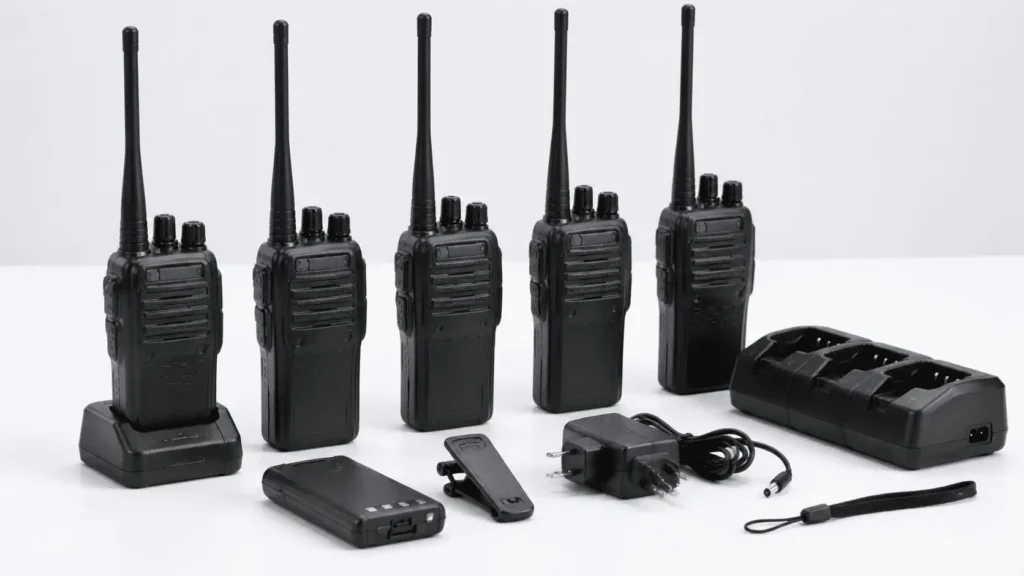
How Do Walkie Talkies Work?
Short answer: Walkie talkies work by sending and receiving voice signals over radio frequencies. When a user presses the push-to-talk button, the radio transmits voice to other radios on the same channel. When the button is released, the radio returns to receiving mode.
Walkie talkie communication is simple, fast and reliable for teams that need instant voice contact. Unlike mobile phones, traditional walkie talkies do not need dialing, apps or cellular networks for local communication. This makes them useful for security teams, construction workers, hotel staff, warehouse operators, manufacturing plants and event crews.
This guide is written for buyers and team managers who need a practical explanation before choosing radios. It focuses on how push-to-talk communication works in real job sites, what affects range, and when a traditional walkie talkie may or may not be the right solution.
Who This Guide Is For
- Factory, warehouse, hotel, security and construction buyers comparing walkie talkie systems.
- Importers and distributors preparing product training content for customers.
- Project managers deciding between analog radios, DMR radios, PoC radios and repeaters.
What Is Walkie Talkie Communication?
Walkie talkie communication is a two-way radio communication method. Radios are tuned to the same frequency or channel. When one person speaks, other radios on the same channel can hear the message almost instantly.
Most walkie talkies use half-duplex communication. This means users cannot speak and listen at the same time. One person talks while others listen. This is why the push-to-talk button is important.
How Does Push to Talk Work?
Push to talk, often called PTT, is the basic operating method of a walkie talkie. The user presses and holds the PTT button to transmit voice. After speaking, the user releases the button so the radio can receive messages from others.
| Action | What Happens | User Result |
|---|---|---|
| Press PTT button | The radio switches to transmit mode | Your voice is sent to the channel |
| Speak into microphone | Voice is converted into a radio signal | Other radios hear your message |
| Release PTT button | The radio returns to receive mode | You can hear replies |
| Other user presses PTT | Their radio transmits back | You receive their message |
Ready to source? See our analog UHF/VHF radios page for models, OEM options and quotation details.
Main Parts of a Walkie Talkie System
- Transmitter: Sends your voice as a radio signal.
- Receiver: Receives radio signals from other walkie talkies.
- Antenna: Helps send and receive signals.
- Channel: A shared communication path for radios in the same group.
- Battery: Powers the radio during shifts or field work.
- Speaker and microphone: Allow users to listen and speak.
Analog, Digital, PoC and LTE Walkie Talkies
| Radio Type | How It Works | Best For |
|---|---|---|
| Analog walkie talkie | Uses analog radio frequency signals | Simple local team communication |
| DMR radio | Uses digital radio technology | Professional fleets, clearer audio, privacy |
| PoC radio | Uses cellular networks for push-to-talk | Wide-area and multi-site teams |
| LTE walkie talkie | Uses LTE network and data service | Security, logistics and mobile teams |
Do Walkie Talkies Need Cell Towers?
Traditional analog and DMR walkie talkies do not need cell towers for local communication. They communicate directly by radio frequency. However, PoC radios, LTE walkie talkies and cellular walkie talkies use mobile networks, so they need network coverage and usually a SIM card or data service.
When Do You Need a Repeater?
A repeater receives a radio signal and retransmits it to extend coverage. Repeaters are useful for large buildings, factories, warehouses, construction sites, hotels, campuses and industrial areas where handheld radios alone cannot cover the full working area.
The Signal Path, Step by Step
Every walkie talkie call follows the same basic path, from the speaker’s voice to the listener’s ear. Understanding each step makes it easier to explain range, audio quality and interference to users.
- Press PTT: the radio switches from receive mode to transmit mode.
- Voice to electrical signal: the microphone turns sound into an audio signal.
- Processing: an analog radio shapes the audio directly; a digital radio converts it into digital data using a voice codec.
- Modulation: the audio or data is placed onto a radio carrier wave at the channel frequency.
- Amplification: the power amplifier boosts the signal.
- Transmission: the antenna radiates the signal as radio waves.
- Reception: other radios on the same channel pick up the signal with their antennas.
- Filtering and squelch: the receiver checks the signal is strong enough and, if tones or codes are used, that they match.
- Demodulation: the radio extracts the audio or digital data and converts it back to sound.
- Speaker output: the listener hears the message.
Because most radios share one channel for sending and receiving, only one person can talk at a time. This is called half-duplex communication.
On receive, squelch keeps the speaker silent until a real signal arrives, so users do not hear constant background hiss. CTCSS or DCS tones on analog radios, and color codes or talk groups on DMR radios, add a further filter so users only hear their own group.
Common Walkie Talkie Frequency Bands
Walkie talkies operate in different frequency bands depending on their type and the country’s rules. The table gives a general overview; always check the local regulations for your market.
| Band or service | General frequency range | Where used | Licensing (general) |
|---|---|---|---|
| VHF | Roughly 136–174 MHz | Worldwide for business, marine and outdoor use | Business use usually requires a license |
| UHF | Roughly 400–470 MHz (some up to 520 MHz) | Worldwide for business, buildings and industry | Business use usually requires a license |
| PMR446 | 446 MHz | European Union and many other countries | License-free for approved radios |
| FRS | 462–467 MHz | United States | License-free personal service |
| GMRS | 462–467 MHz | United States | Requires an FCC license |
VHF often travels further over open land, while UHF usually performs better inside buildings. See UHF vs VHF for warehouses and industrial sites and licensed vs license-free walkie talkies for detail.
Simplex vs Repeater Operation and Range
In simplex mode, radios talk directly to each other on one frequency. It is simple and needs no infrastructure, but range is limited to what each handheld can reach.
In repeater mode, radios transmit to a repeater, usually placed high with a good antenna. The repeater receives on one frequency and retransmits on another at the same time, so radios that cannot reach each other directly can still communicate through it. Repeaters are common in factories, campuses, ports and hotels. PoC radios work differently again, using mobile networks instead of radio channels.
| Mode | How it works | Typical use |
|---|---|---|
| Simplex | Radios talk directly on one frequency | Small teams in one area, events, retail |
| Repeater | Radios talk through a fixed repeater on paired frequencies | Factories, campuses, hotels, ports |
| PoC / network | Radios talk through a mobile network and server | Fleets across cities or regions |
What affects walkie talkie range
No walkie talkie has a fixed range. The same radio can reach far across open water and struggle between two floors of a concrete building.
- Obstacles: walls, steel, hills and buildings absorb or reflect signals
- Antenna height and quality: higher and better-matched antennas reach further
- Transmit power: higher power helps, within legal limits
- Frequency band: VHF and UHF behave differently in open and built-up areas
- Interference: other radios and electrical equipment raise background noise
- Battery level: a weak battery may reduce transmit performance
For realistic expectations, read our long-range walkie talkie guide.
Practical tips help users get more range from the same radio: stand in the open rather than behind vehicles or machinery, move near a window or doorway inside buildings, hold the radio upright with the antenna vertical, and keep batteries charged. If these steps are not enough for a site, the next options are a repeater, a better antenna or a PoC radio.
Range claims on packaging are usually measured in ideal conditions, so test radios on your own site before buying for a whole team.
Digital vs Analog, in Plain Terms
An analog radio sends your voice as a continuous wave, like a traditional FM broadcast. As the signal weakens, audio becomes noisier but may still be partly understood. A digital radio, such as DMR, turns your voice into data. Audio stays clear across most of the coverage area and noise is reduced, but at the very edge the signal can drop out rather than fade. Digital radios also add features like caller IDs, text messages and two calls on one channel. Our DMR radio range covers digital models.
FAQs
How do walkie talkies work without cell service?
Traditional walkie talkies use radio frequencies, so they can communicate directly with each other without cell service.
How does push to talk work?
Push to talk works by switching the radio from receive mode to transmit mode while the user holds the PTT button.
Can two walkie talkies talk to each other?
Yes, if they are compatible and set to the same frequency or channel.
Why can only one person talk at a time on a walkie talkie?
Most walkie talkies use half-duplex communication, meaning they send and receive on the same channel but not at the same time. While one radio transmits, others on that channel switch to listening. When the speaker releases the PTT button, the channel becomes free for someone else to reply.
What is the difference between simplex and repeater mode?
In simplex mode, radios talk directly to each other on one frequency, with range limited by each handheld. In repeater mode, radios send to a repeater, usually mounted high, which retransmits the signal on another frequency so radios far apart or blocked by buildings can still communicate.
Is a digital walkie talkie better than analog?
Digital radios such as DMR usually give clearer audio across most of the coverage area, reduce background noise and add features such as caller IDs and text. Analog radios are simpler, usually cheaper and compatible with older fleets. The better choice depends on your site, fleet and budget.
Related Guides
- Best Walkie Talkies for Manufacturing
- PoC Radio vs Traditional Walkie Talkie
- Two Way Radio Product Categories
Still Comparing Radio Types?
Talk to our team — we’ll help you match the right technology (Analog, DMR or PoC) to your use case, no obligation.
Email: lorabanzhitao@gmail.com | WhatsApp: +86 173 1689 5054