
Walkie Talkie Distributor Philippines
OEM walkie talkies, DMR radios, PoC radios, LTE radios and accessories for Philippines distributors, wholesalers, security suppliers and project buyers. Export documentation, CE/FCC/RoHS certificates and OEM packaging provided to support smooth customs clearance in the Philippines.
Short answer: A walkie talkie distributor in the Philippines should source radios that are easy to sell, easy to support and available with stable accessories. The best supplier should offer analog radios, DMR radios, PoC radios, private label packaging, sample orders and repeat wholesale supply.
Philippines distributors often serve security companies, hotels, construction sites, schools, warehouses, retail teams, events and local business users. A complete product line helps you cover different budgets and applications.Best Product Mix for Philippines Distributors
| Product Type | Buyer Segment | Why Stock It |
|---|---|---|
| Analog radios | Small businesses, hotels, schools, retail | Easy to sell, lower price, simple operation. |
| DMR radios | Security, warehouses, construction, industrial users | Higher value, clearer audio, professional positioning. |
| PoC radios | Logistics, delivery, mobile patrol, multi-site companies | Wide-area push-to-talk with cellular network support. |
| Accessories | All radio buyers | Improves repeat sales through batteries, chargers and earpieces. |
| OEM radio kits | Brand owners and wholesalers | Supports private label packaging and distributor margin. |
Analog Radios for Entry-Level Sales
Analog radios are practical for local business buyers that need simple communication. They are suitable for small shops, schools, hotels, retail teams, events and basic security use. For distributors, analog radios can be used as entry-level products, while DMR radios and PoC radios can serve higher-value project buyers.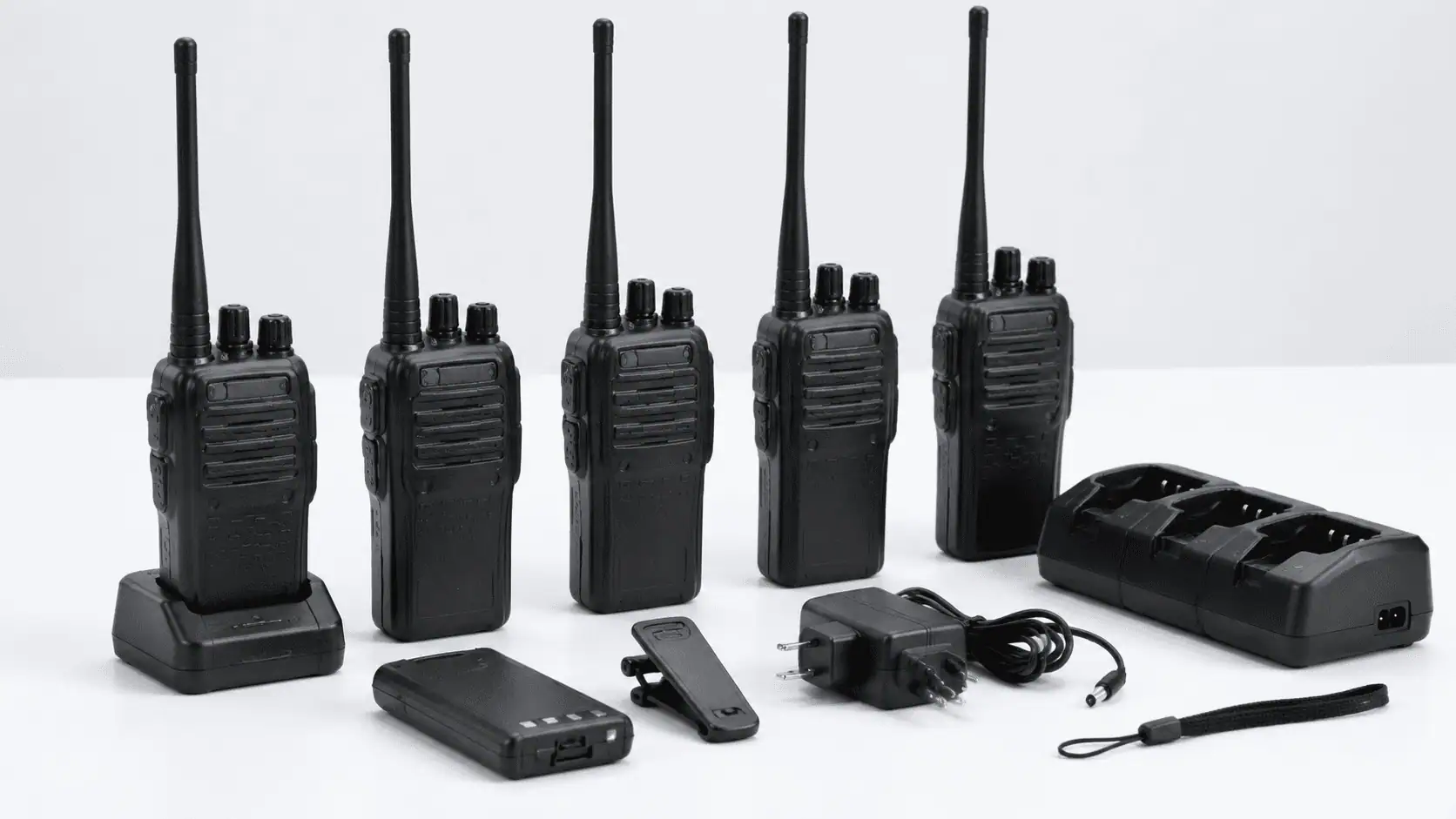
Distributor RFQ Checklist
| Product categories | Analog, DMR, PoC, LTE, accessories or mixed radio kits. |
| Estimated quantity | Affects MOQ, unit price and packaging options. |
| Target buyers | Security, hotel, warehouse, construction or retail buyers need different models. |
| OEM brand needs | Logo, packaging, labels and manuals affect quotation. |
| Accessory bundle | Batteries, chargers, earpieces and microphones improve resale value. |
Import & Compliance Notes for Philippines
Two-way radios imported into the Philippines are regulated by the National Telecommunications Commission (NTC). Before a bulk order, confirm who will hold the local type approval for the exact model, and which frequencies the radios may be programmed to use. CE, FCC and RoHS test reports support an application, but they do not replace NTC approval.
| Item to Confirm | Why It Matters |
|---|---|
| NTC type approval for the exact model | Customs and resellers may ask for proof that the radio model is approved for the market. |
| Frequency band and channel programming | Radios should be programmed only to frequencies the end user is permitted to use. |
| Frequency licence for business or DMR systems | Licensed UHF/VHF and repeater systems usually need a spectrum licence held by the operator. |
| Test reports and labels | We supply CE/FCC/RoHS reports, model labels and manuals to support the importer’s application. |
Requirements change, so check the latest rules on the NTC website or with your customs broker before shipping.
Radio Demand Across Philippine Market Segments
Philippine distributors sell to a wide mix of customers, from security agencies and resorts to building management and disaster-response teams. Stocking the right mix of models reduces slow-moving inventory.
| Customer segment | Typical needs | Suggested radio direction |
|---|---|---|
| Retail buyers and small businesses | Simple use, affordable, easy to replace | Basic analog UHF radios with desktop chargers |
| Security agencies | Guards across malls, subdivisions and offices | Durable analog or DMR radios with emergency button and spare batteries |
| Resorts and hotels | Beach humidity, guest areas, wide grounds | Water-resistant UHF radios with covert earpieces |
| BPO offices and building security | High-rise towers, basements, parking levels | UHF DMR for building coverage; PoC for multi-site facilities teams |
| Disaster preparedness and LGUs | Typhoons, floods, power and network outages | Radios with high IP ratings, spare batteries and non-network analog/DMR backup to PoC |
For typhoon and flood planning, remember that PoC radios depend on mobile networks, which can fail in a disaster. Many teams keep analog or DMR radios as a backup. Our IP65 vs IP67 vs IP68 guide explains water protection levels.
Shipping, Documents and NTC Requirements
Most shipments arrive by sea into Manila or Cebu, with urgent samples by air. Radios with lithium batteries need proper battery documents for both routes.
| Document or item | What it covers | Buyer note |
|---|---|---|
| Commercial invoice | Model numbers, quantities, unit values, HS code proposal, Incoterms | Match descriptions to the conformity documents so customs sees one consistent product name |
| Packing list | Carton count, net and gross weights, carton dimensions, serial or batch ranges | Serial ranges help later warranty and spare-part tracking |
| Battery UN38.3 test summary | Lithium battery transport testing for the battery model shipped | Air and sea forwarders typically ask for it; confirm it matches the actual battery part number |
| Safety data sheet (SDS/MSDS) | Handling information for lithium batteries | Often requested together with UN38.3 documents |
| Conformity documents | Test reports and technical files that may support NTC type approval or acceptance | Coverage depends on the selected model and destination market; confirm with your importer or broker |
| Bill of lading or air waybill | Shipment evidence for customs clearance | Check consignee details match the importer of record |
In the Philippines, the National Telecommunications Commission (NTC) typically regulates radio equipment. Importers and dealers usually need NTC permits, such as dealer or import permits, and many radio models require type approval or type acceptance before sale. End users may also need licences depending on the frequency and service. Rules and categories change, so confirm the current requirements with the NTC or an experienced local importer. A manufacturer can generally supply test reports to support applications, depending on the model.
Consolidating several models into one shipment can reduce freight cost per unit, but each model still needs matching documents. Ask the manufacturer to label cartons clearly by model and battery type so customs inspection and warehouse receiving go smoothly, and keep digital copies of every document for future permit renewals.
After-Sales and Spare Parts Planning
Distributors earn repeat business through reliable after-sales service. Humidity, salt air and heavy daily use mean accessories and batteries need regular replacement.
- Batteries: stock spares for security agencies running 12-hour shifts.
- Earpieces and speaker mics: best-selling add-ons for resorts and security teams.
- Antennas, belt clips and chargers: keep counter stock for walk-in replacements.
- Programming kit: keep cables, software and standard channel files so your shop can reprogram units.
- Warranty handling: agree with the factory how faulty units are replaced or repaired and how claims are documented.
Our walkie talkie accessories range can be bundled with radios to simplify spare-part orders.
Island logistics also matter. Distributors serving Visayas and Mindanao customers often keep regional stock of fast-moving spares, because shipping a single battery or earpiece from Manila can take longer than the customer is willing to wait. A simple reorder level for each accessory helps avoid stock-outs before the typhoon season.
Building a Distributor Range in the Philippines
A focused range with clear price tiers is easier to sell and support than many similar models. Many distributors start with two or three core radios and expand once demand is clear.
| Range tier | Target customer | What to confirm with the manufacturer |
|---|---|---|
| Entry analog | Retail and small businesses | Packaging, manual language, approval status for the market |
| Professional analog or DMR | Security agencies, resorts, buildings | Durability, IP rating, accessory compatibility |
| PoC/LTE radios | Multi-site operators, logistics | Supported network bands, SIM and platform arrangements |
Private-label options such as logo, packaging and pre-programmed channels help distributors build their own brand. For pricing structures and margins, see our walkie talkie wholesale pricing guide.
Related Buying Guides
- Walkie Talkie Wholesale Pricing Guide
- Custom Walkie Talkie Ordering Guide
- Licensed vs License-Free Walkie Talkies
- Manufacturer vs Trading Company
- Security Guard Radios: Bulk Buying Guide
Other markets we supply: UAE · Saudi Arabia · South Africa
Walkie Talkie Distributor Philippines FAQ
What products should a Philippines walkie talkie distributor stock?
A balanced product line can include analog radios, DMR radios, PoC radios, LTE walkie talkies and accessories such as batteries, chargers and earpieces.Can you support private label radio packaging?
Yes. We can support logo printing, packaging, labels, manuals, carton marks and accessory kits depending on quantity and product type.Can distributors order samples first?
Yes. Sample orders help test radio quality, accessories, packaging and market fit before bulk purchasing.Do Philippine distributors need an NTC permit to sell radios?
Radio equipment in the Philippines is regulated by the National Telecommunications Commission (NTC). Dealers typically need NTC permits, and radio models need NTC type approval or acceptance before sale. Confirm the current requirements with NTC or your customs broker; we provide test reports and product documents to support the process.
Which radios suit the rainy and typhoon season?
Choose radios with a suitable water-resistance rating for outdoor teams such as security, construction and events, and stock spare batteries and chargers. Our IP rating guide explains which level fits each use.
What is the MOQ for private label radios?
MOQ depends on the model and how much you customize. Logo printing usually needs a lower quantity than custom packaging, manuals and accessory bundles. Send your target models and quantities and we will quote options. See the wholesale pricing guide for how pricing tiers work.
Do I need NTC permits to sell walkie talkies in the Philippines?
Importers and dealers typically need permits from the National Telecommunications Commission, and many radio models require type approval or acceptance before sale. End users may also need licences depending on frequency and use. Requirements change, so confirm the current rules with the NTC or an experienced local importer before ordering stock.
Are PoC radios reliable during typhoons?
PoC radios depend on mobile networks and power, which can be disrupted during typhoons and floods. They work well in normal conditions, but many disaster-preparedness teams keep analog or DMR radios as a direct backup because they can work without network infrastructure. Plan spare batteries and charging options for outages too.
Which radios should a Philippine distributor stock first?
Many distributors begin with an entry analog radio for retail buyers, a rugged professional model for security agencies and resorts, and a PoC option for multi-site customers. A small, focused range is easier to support with spares and programming. Confirm approval status for each model before building stock.