
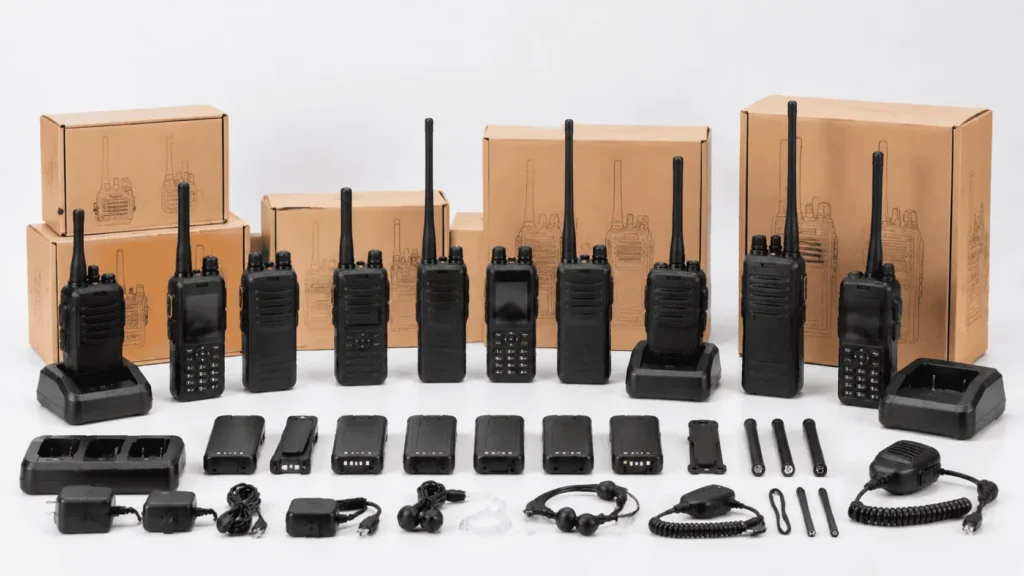
Short answer: An OEM walkie talkie is a two-way radio built on a manufacturer’s existing, tested hardware platform and sold under your brand. The factory keeps the core electronics, while you customize the logo, housing color, labels, packaging, manual, channel programming and accessory bundle. ODM projects go further and change the housing, features or firmware.
OEM vs ODM vs Private Label Walkie Talkies at a Glance
| Private label | OEM | ODM | |
|---|---|---|---|
| What you change | Logo, labels and gift box only | Branding plus color, programming, manual and accessory kit | Housing, features, firmware or a new model |
| Radio hardware | Existing model, unchanged | Existing platform, unchanged electronics | Modified or newly developed |
| Compliance documents | Based on the original model; confirm they cover your market | Confirm reports match the exact model and your brand listing | New testing is usually needed for the changed design |
| Relative MOQ | Lowest | Moderate | Highest |
| Relative lead time | Shortest | Moderate | Longest (tooling and testing) |
| Best for | Testing a new market or a small range | Distributors building their own radio line | Brands that need a unique product |
This guide explains how to compare OEM two-way radio suppliers, evaluate samples and prepare a complete RFQ without relying on an unverified universal MOQ, lead time or certification claim.
What Is an OEM Walkie Talkie?
An OEM walkie talkie is a two-way radio produced on a supplier’s established hardware platform and customized for another company’s brand or project. Private-label work commonly starts with branding and packaging. More extensive ODM development may involve changes to the enclosure, electronics or software, but the available scope, engineering cost and order requirement must be confirmed for the chosen platform.
| Project type | Typical scope to discuss | Best suited to | What to confirm |
|---|---|---|---|
| Neutral product | Existing model and standard packaging | Market testing and project supply | Available stock, labels, manual and charger plug |
| Private label | Logo, model label, carton mark and manual | Distributors launching a branded range | Artwork format, placement and labeling rules |
| Packaging program | Color box, inserts, warranty card and bundled accessories | Retail and wholesale brands | Packaging quantity, language and barcode data |
| Configured fleet | Channel plan, compatible accessories and project packaging | Security, factory, warehouse and contractor projects | Frequency authorization, programming file and system compatibility |
| ODM development | Potential housing, electronics or firmware changes | Established buyers with a defined specification | Feasibility, tooling, validation, ownership and lifecycle support |
Choose the Radio Platform Before Customizing the Brand
A sound OEM program starts with the operating environment, not the logo. A radio that fits a local retail team may not fit a multi-floor warehouse or a mobile workforce. Compare the following platform categories before approving packaging.
| Radio category | Common buyer scenario | Questions for the supplier |
|---|---|---|
| Analog two-way radio | Simple local team communication | Which frequency variants are available, and what accessories are compatible? |
| DMR radio | Organized digital fleets and repeater-based systems | Which DMR features, channel settings and repeater configurations does the exact model support? |
| PoC / LTE radio | Teams communicating through supported cellular or Wi-Fi networks | Which networks, SIM arrangements, platform services and recurring costs apply in the destination country? |
| Mobile radio or repeater | Vehicle, control-room or wider-site communication | What power, antenna, installation and compatibility information is required? |
| Accessories | Batteries, chargers, earpieces and speaker microphones | Are the connector, electrical specification and model compatibility documented? |
For platform-specific purchasing considerations, review the OEM DMR radio options, 4G network radio options and two-way radio accessories guide.
Which Walkie Talkie Customizations Should Buyers Confirm?
Customization availability varies by model, production method and quantity. Ask for a written scope covering each required item rather than assuming every platform supports the same options.
- Branding: logo method, print position, product label, model name and serial-number format.
- Packaging: neutral or printed box, inserts, carton marks, barcode and packaging language.
- Documentation: user manual, programming instructions, warranty information and required market documents.
- Programming: channel list, tones, scan settings and other supported configuration items.
- Accessories: charger plug, charging base, battery, belt clip, earpiece, speaker microphone and programming cable.
- Appearance: available housing colors and label treatments for the selected model.
What Determines OEM Walkie Talkie MOQ and Price?
There is no reliable single MOQ or unit price for every private-label radio project. The quotation depends on the hardware model, quantity, branding method, packaging, accessories, programming, testing, documentation and destination. A basic logo project and a new ODM platform should therefore be quoted separately.
| Cost or MOQ factor | Why it matters | Buyer action |
|---|---|---|
| Hardware platform | Analog, DMR, PoC/LTE and system equipment have different component and service requirements. | Request a model comparison for the actual use case. |
| Branding method | Labels, printing and engraving use different setup processes. | Send vector artwork and specify placement. |
| Printed packaging | Box production may have its own economic quantity. | Confirm box quantity separately from radio quantity. |
| Accessory bundle | Batteries, chargers and audio accessories change the complete set price. | Provide the required quantity per radio. |
| Market documentation | Documents must match the exact model and intended market. | List the destination country and document requirements before ordering. |
| ODM engineering | Tooling, software and validation add project-specific cost and time. | Separate development cost from production pricing. |
Verify Compliance for the Exact Model and Market
Radio requirements differ by country, frequency use and product configuration. Do not accept a general statement that a factory or another model is “certified.” Ask for documents tied to the exact model number and verify that the labeling, frequency range, hardware version and intended use match your order.
For the United States, the FCC states that RF devices must follow the appropriate equipment-authorization procedure before marketing or importation; buyers can also check the FCC ID search resources. For the European Union, determine which obligations apply under the Radio Equipment Directive 2014/53/EU. Requirements for other markets should be checked with the relevant local authority or qualified compliance adviser.
- Request the model name shown on each report or certificate.
- Compare the listed frequency range and hardware version with the ordered product.
- Check the certificate holder and applicable market.
- Confirm product and carton labeling before printing bulk packaging.
- Request the applicable battery transport documents for the shipment.
- Record any buyer-side licensing, programming or network obligations.
How to Evaluate an OEM Radio Sample
A sample should be tested against the buyer’s real environment and acceptance criteria. A desk test alone cannot confirm coverage, audio usability or accessory fit for a factory, warehouse, construction site or security fleet.
- Coverage: test the planned indoor and outdoor routes, floors, walls and known dead zones.
- Audio: check transmit and receive clarity in the actual noise conditions.
- Battery: test the expected shift pattern and charging routine; compare results with the agreed specification.
- Controls: confirm channel selection, emergency or programmable buttons and screen behavior where applicable.
- Accessories: verify connector fit, charging, audio operation and replacement compatibility.
- Programming: confirm that the approved configuration can be reproduced for the bulk order.
- Branding: approve logo position, label data, manual and packaging artwork with a signed sample or proof.
OEM Walkie Talkie Production Checklist
- Define the destination market, application, coverage environment and user count.
- Select the radio category and shortlist compatible hardware models.
- Confirm frequency, programming, charger, accessories and required documents.
- Agree on the OEM scope, artwork files, labeling and packaging.
- Test the sample and record measurable acceptance criteria.
- Approve the final specification, packaging proof and commercial quotation.
- Confirm the production inspection plan and shipment documents.
- Retain the approved sample and configuration for repeat orders.
Information to Send for an Accurate OEM Quotation
A complete RFQ reduces unnecessary model recommendations and makes quotations easier to compare. Send the following information:
- Destination country and sales channel
- Application and operating environment
- Estimated quantity and expected reorder plan
- Preferred technology: analog, DMR, PoC/LTE, mobile radio or repeater
- Coverage area, building layout or fleet arrangement
- Logo, label, manual and packaging requirements
- Required batteries, chargers and audio accessories
- Frequency, programming and compatibility requirements
- Documents or testing required for the target market
- Required delivery destination and target schedule
Request an OEM Two-Way Radio Comparison
Send your country, quantity, application, preferred radio type, branding scope, accessory list and required documents. We can use those details to discuss suitable models and prepare a project-specific quotation.
Step-by-Step Custom Walkie Talkie Order Timeline
Custom orders move through the same stages whether you order a small private-label batch or a large branded fleet. Time at each stage depends on the model, customization level, compliance needs and factory schedule, so confirm the plan with the manufacturer rather than relying on a fixed number of days.
| Stage | What happens | Buyer’s responsibility |
|---|---|---|
| 1. Inquiry | Share market, quantity, use case and customization goals | Send a clear brief, including destination country |
| 2. Platform selection | Choose analog, DMR, PoC or LTE model and frequency band | Confirm licensing and required features |
| 3. Samples | Receive standard or lightly customized samples | Test range, audio, battery and accessories on site |
| 4. Artwork and programming approval | Approve logo, color, packaging, manuals and channel programming | Sign off written proofs and a master programming file |
| 5. Pilot run | Factory produces a small batch with final settings | Check pilot units against approved samples |
| 6. Mass production | Full order produced with agreed components | Avoid late changes; track progress |
| 7. Inspection | Pre-shipment QC, in-house or third-party | Define inspection criteria and sample size in advance |
| 8. Shipment | Packing, export documents and battery transport papers | Confirm Incoterms, labels and import requirements |
For compliance planning, U.S. buyers can review FCC certification vs Part 90, and buyers in other markets can see CE, RoHS and PSE requirements. Documentation support depends on the selected model and destination market.
Common Custom Order Mistakes
Most delays and disputes on custom radio orders come from a few avoidable errors:
- Skipping sample testing: approving a model from a datasheet without testing coverage, audio and battery life on your own site
- Wrong frequency band: choosing frequencies that are not permitted or licensed in the destination market
- Unclear artwork files: sending low-resolution logos or no Pantone references, leading to repeated proofs
- No master programming file: letting channel settings be decided during production instead of approving them in writing
- Late changes: changing color, packaging or features after mass production starts, which can reset the schedule
- Forgetting accessories: ordering radios without matching batteries, chargers or earpieces for each user group
- Ignoring shipping rules: not confirming lithium battery documents such as UN38.3 for transport
- No inspection plan: shipping without agreed QC criteria, so problems appear only after arrival
How to keep a custom order on track
Keep one owner on your side responsible for approvals, so the factory receives consistent answers instead of conflicting instructions from different departments. Share the destination market’s labelling and manual language requirements at the start, not after artwork is finished.
Put every approved item in writing: model, band, programming file, artwork, packaging and accessory list. Treat the pilot run as the final checkpoint before volume production. Our private label buyer’s checklist helps you prepare questions on quantity, samples and scheduling before you place the order.
Related Guides
Sourcing radios for your brand or distribution business?
We support OEM and private label orders: logo, housing color, packaging, firmware and channel programming. Send your target market and quantities for a quote and samples.
Get a Quote →Browse Our RadiosRelated reading: Walkie Talkie Programming Guide for Distributors: CPS, Codeplugs
OEM Walkie Talkie FAQ
What is the difference between OEM and ODM walkie talkies?
OEM usually applies a buyer’s branding or configuration to an existing radio platform. ODM may require deeper product-development work, such as a new enclosure, electronic changes or customized software. The precise scope depends on technical feasibility and the commercial agreement.
Can I order private-label walkie talkies with my logo?
Logo, label, packaging and manual options may be available depending on the selected model, process and quantity. Send the artwork and intended placement so the supplier can confirm feasibility and quotation details.
What is the MOQ for OEM two-way radios?
MOQ varies by hardware model and customization scope. Logo application, printed boxes, accessory bundles and ODM engineering can have different minimum quantities, so request an itemized quotation for your project.
How long does an OEM radio order take?
The schedule depends on model availability, sample approval, packaging, programming, testing, quantity and production capacity. Ask for separate estimated dates for the sample, artwork approval, production and shipment rather than relying on a universal lead time.
Which compliance documents should an importer request?
Start with the exact model, destination country, frequency use and sales channel. Then confirm the applicable equipment authorization, test reports, labeling, battery transport documents and any buyer-side licensing requirements with the relevant authority or compliance adviser.
What should be tested before a bulk order?
Test coverage, audio, battery behavior, charging, controls, programming, accessory compatibility, labels and packaging against written acceptance criteria in the intended operating environment.
What are the main steps in a custom walkie talkie order?
A typical order moves from inquiry and platform selection to samples, artwork and programming approval, a pilot run, mass production, inspection and shipment. Timing at each stage depends on the model, customization and compliance needs.
Why is a pilot run important for custom radios?
A pilot run shows how the final settings, artwork and components look in real production before the full order is made. It lets you catch programming, printing or packaging issues while they are still easy to fix.
What causes most delays in custom walkie talkie orders?
Common causes are unclear artwork, unapproved programming, late design changes, wrong frequency choices and missing battery shipping documents. Approving each item in writing before production reduces these risks.