
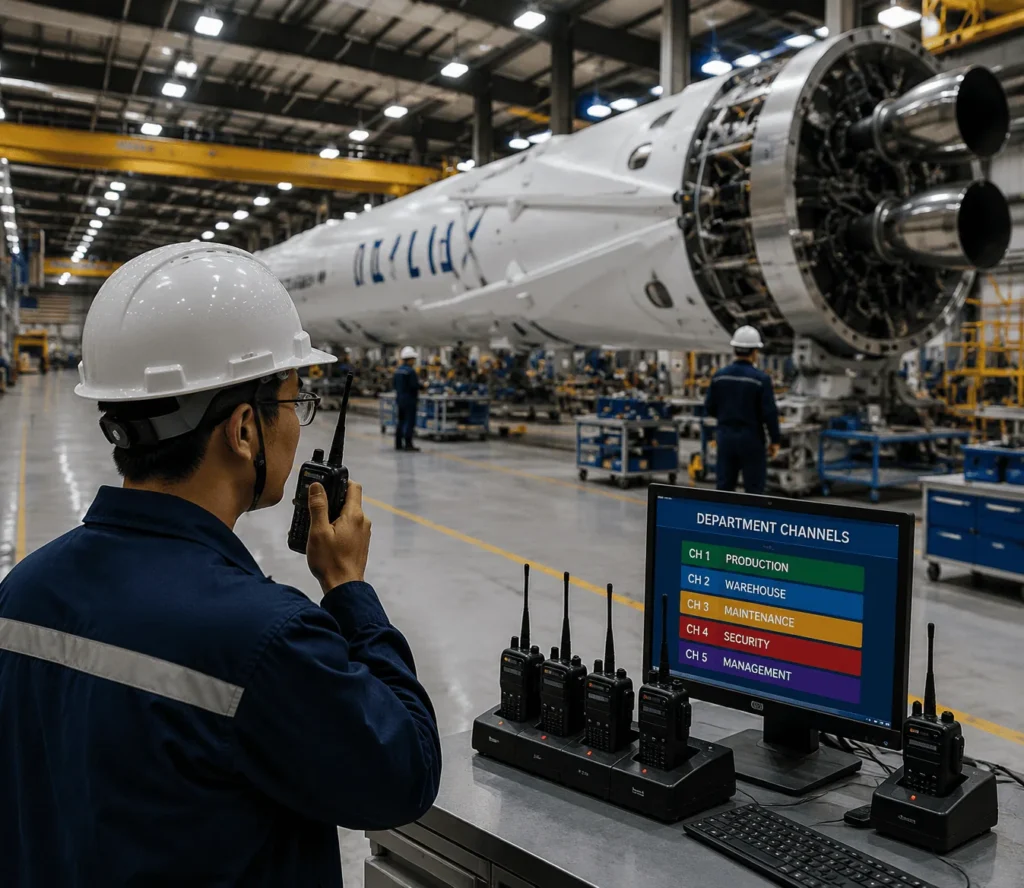
Short answer: There is no single best walkie talkie for every manufacturing plant. Small workshops may only need straightforward analog radios, while multi-department factories may benefit from DMR radios and larger or separated sites may need repeaters or PoC/LTE communication. The correct choice depends on the building layout, noise, user roles, shift pattern, coverage test and local radio requirements.
Use this guide to turn those operating conditions into a practical radio specification before comparing models or requesting bulk pricing.
Manufacturing Walkie Talkie Selection at a Glance
| Factory situation | Starting option | Main reason to consider it | Confirm before ordering |
|---|---|---|---|
| Small workshop or single production area | Analog radio | Simple local voice communication | Usable coverage, channel plan and charger arrangement |
| Several departments on one site | DMR radio | Department groups and digital system options | Feature support, programming and compatibility for the exact model |
| Concrete, steel or multi-floor facility | DMR system with site-tested infrastructure | Potential repeater and antenna planning | Survey results, dead zones, frequency plan and installation requirements |
| Separate plants, warehouses or mobile teams | PoC / LTE radio | Communication through supported cellular or Wi-Fi networks | Indoor coverage, SIM or platform costs, data service and fallback plan |
| Hazardous work area | Application-specific approved equipment | Safety requirements may determine the equipment category | Exact hazardous-area classification and valid product documentation |
The table is a starting point, not a model recommendation. Test the shortlisted system at the actual site and verify every required rating, frequency and approval for the exact product.
Start with the Factory Communication Problem
A production manager and a purchasing manager may describe the same request differently. One may ask for “better coverage,” while the other asks for “industrial walkie talkies.” Convert the request into measurable operating conditions before selecting hardware.
- Site layout: building count, floors, production zones, loading areas and outdoor routes.
- Construction: reinforced concrete, metal walls, machinery, racks and enclosed rooms that may affect signal behavior.
- Users: number of simultaneous users, departments, supervisors, contractors and shift changes.
- Noise: where ordinary radio audio becomes difficult to understand and which hearing or PPE restrictions apply.
- Workflow: routine production calls, maintenance dispatch, safety escalation, warehouse coordination and emergency procedures.
- Existing system: installed repeaters, antennas, programming files, accessories and radios that may need to remain compatible.
Analog vs DMR vs PoC/LTE for Manufacturing
When Analog Radios May Be Enough
Analog radios may fit small teams that need uncomplicated push-to-talk communication in a limited area. Buyers should still test coverage, audio, channel use and battery operation during the actual shift. If the plant expects more departments, tighter call organization or a future repeater system, compare the upgrade path before standardizing the fleet.
When DMR Radios Deserve Consideration
DMR radios are often considered for organized on-site communication where departments need planned channels or talk groups and the system may use repeaters. Available functions differ by model, so confirm programming, repeater compatibility, audio accessories and any required operational features on the exact radio. Review the DMR radio sourcing page for a platform-specific checklist.
When PoC or LTE Radios May Fit
PoC and LTE radios may suit teams spread across separate buildings, logistics routes or multiple facilities when supported network service is available. They introduce different dependencies from conventional radio systems, including indoor cellular or Wi-Fi coverage, compatible SIM arrangements, platform availability and recurring service costs. Include those items in the total system comparison.
Features to Evaluate for Factory Two-Way Radios
| Selection factor | Why it matters | How to verify it |
|---|---|---|
| Coverage | Walls, metal equipment and distance can create weak areas. | Run a site test across defined routes and record failures. |
| Audio usability | A signal is not useful if the message cannot be understood. | Test speech with real machinery running and approved accessories in use. |
| Battery operation | Shift length, call activity and charging routines vary. | Test the actual duty pattern; plan spare units and charging capacity. |
| Housing protection | Dust, moisture and impacts differ between departments. | Define the required environment and verify the exact model’s documented rating. |
| Controls | Gloves, PPE and low-light conditions can affect operation. | Have representative users test buttons, displays and accessory controls. |
| System compatibility | Repeaters, antennas, programming and connectors may limit choices. | Compare written specifications and test with the installed system. |
| Accessories | Earpieces, speaker microphones, batteries and chargers affect daily use. | Approve the complete kit, not only the handheld radio. |
For high-noise areas, use the dedicated radio selection guide for noisy manufacturing environments. This page keeps its focus on the overall factory system instead of duplicating that specialist topic.
Match Radios and Accessories to Factory Departments
| Department | Communication need | Equipment questions |
|---|---|---|
| Production | Line coordination and supervisor calls | Can operators use the controls with gloves, and is audio usable at the workstation? |
| Maintenance | Dispatch and fault response | Is a speaker microphone or hands-free accessory appropriate for the task? |
| Warehouse | Loading, picking and forklift coordination | Are docks, cold areas, racks and outdoor routes included in the coverage test? |
| Security | Patrol and escalation | Which call groups, accessories and shift-charging plan are required? |
| Management and safety | Cross-department coordination | Which users need access to multiple groups, and how will emergency procedures be documented? |
Compare compatible batteries, chargers, earpieces and speaker microphones on the walkie talkie accessories supplier page.
How to Test Radio Coverage in a Factory
A useful site test checks whether intended users can exchange understandable messages along real work routes. Test during representative operating conditions rather than only in an empty building.
- Mark priority locations, including control rooms, production lines, maintenance areas, warehouses, stairs, loading docks and outdoor zones.
- Define who needs to communicate with whom and which calls must cross departments.
- Test the shortlisted radios with machinery operating and doors in their normal positions.
- Record intelligible audio, missed calls, weak locations and accessory problems.
- Repeat tests from different user positions and during relevant shift conditions.
- If gaps remain, evaluate antenna or repeater planning with a qualified system provider and retest the proposed configuration.
How Many Walkie Talkies Does a Factory Need?
Calculate radio quantity by role and shift rather than total employee count. Start with positions that require immediate communication, then add the operational spares needed for charging, maintenance and replacement.
- List radio-assigned roles for each shift.
- Identify shared radios and individually assigned units.
- Separate simultaneous users from employees who never need a radio.
- Plan chargers around shift handovers and the available charging area.
- Keep a controlled spare pool based on the site’s maintenance process.
- Include any supervisor, security or contractor units that require different programming.
Factory Radio RFQ Checklist
To receive a relevant model comparison and bulk quotation, provide:
- Destination country and intended use
- Factory dimensions, floors, buildings and construction materials
- Indoor and outdoor coverage routes
- Number of users by department and shift
- Noise conditions and required audio accessories
- Existing radios, repeaters, frequencies and accessory connectors
- Preferred analog, DMR or PoC/LTE system, if already determined
- Battery and charger arrangement
- Required ratings, documents or market approvals for the exact model
- Quantity, OEM branding, packaging and sample requirements
Request a Factory Radio System Comparison
Send your plant layout, user count, departments, noise conditions, coverage routes, preferred radio type, accessory list, destination country and required quantity. These details make it possible to discuss suitable hardware and prepare a project-specific quotation.
Small Workshop vs Large Manufacturing Facility
Scale changes the requirements. A large plant rarely needs “more of the same radio”; it needs infrastructure and a channel plan that a small workshop can skip.
| Requirement | Small Workshop | Large or Multi-Building Facility |
|---|---|---|
| Radio platform | Analog or entry-level DMR is often enough | DMR system, or PoC/LTE where suitable network coverage exists |
| Coverage | Usually covered radio-to-radio | Repeater and antenna plan, confirmed by a site test |
| Channels | One or a few shared channels | Dedicated channels or talk groups per department |
| Batteries and charging | Charge at shift end | Spare batteries and multi-unit chargers sized for every shift |
For multi-floor and metal-heavy sites, see the most reliable walkie talkies for large manufacturing facilities. To source a complete kit for your plant, visit our walkie talkies for manufacturing page.
Best Walkie Talkies for Noisy Manufacturing Environments
In stamping, metal fabrication, bottling and packaging lines, the radio is rarely the weak point. The audio path is. A radio with a strong signal is still useless if the operator cannot hear the call over a press or cannot speak without the microphone picking up the machine.
| Audio option | Best for | Watch out for |
|---|---|---|
| Radio with loud built-in speaker | Supervisors and moving staff in moderate noise | Loses clarity near presses, compressors and grinders |
| Noise-cancelling speaker microphone | Operators who transmit near machines | Must be matched to the radio’s connector and tested on the actual line |
| Earpiece (acoustic tube or D-shape) | Quieter areas, security, discreet listening | Limited use in very loud zones; may not fit under hearing protection |
| Headset with integrated hearing protection | Continuous high-noise zones and long shifts | Heavier and more costly; confirm compatibility with required PPE |
Coverage problem or noise problem?
Before changing radios, find out which problem you have. If calls break up, drop out or fail only in certain rooms, basements or behind racking, it is usually a coverage issue. If the signal is clean but people keep asking for repeats near specific machines, it is a noise issue that accessories, not a new radio, will fix.
Run a production-hour sample test
Test samples during a normal running shift, not on a quiet weekend. Stand at the loudest workstation, transmit and receive with each accessory option, and ask the listener to repeat back a short message. Score clarity at each point and record which accessory worked.
Repeat the test at shift change, when forklifts, conveyors and extraction fans are all running, and include at least one worker who wears hearing protection. Keep the results with the RFQ so the supplier can match the accessory to your real conditions.
Remember the regulatory side: under OSHA 29 CFR 1910.95, employers in the US must run a hearing conservation program where noise reaches an 8-hour time-weighted average of 85 dBA. In those areas, pick radio accessories that work with the hearing protection workers already wear rather than asking them to remove it to hear a call.
Most Reliable Walkie Talkies for Large Manufacturing Facilities
For a large plant, “reliable” means more than a radio that does not break. It covers four things:
- Coverage: every building, mezzanine, cold room and yard can be reached, not only the main hall.
- Battery across shifts: radios finish a full shift and are charged, rotated and replaced on a schedule. Our battery charging guide for 24/7 shifts covers rotation planning.
- Durability: housings, antennas and connectors survive drops, dust and cleaning.
- Fleet management: consistent programming, channel plans and spare parts across hundreds of units.
When a large plant needs repeaters
Consider a repeater, or a PoC/LTE system, when direct radio-to-radio calls fail between distant buildings, when steel structures and concrete block the signal, or when several departments need separate talk groups. Digital systems such as DMR radios can also support more talk groups on the same licensed frequencies. Coverage depends on building layout, frequency band and installation, so confirm the design with a site survey.
Plan for growth as well. A system sized only for today’s headcount can become congested when a new line or warehouse opens. Ask the manufacturer how many users and talk groups the proposed setup can handle, and how extra radios would be added later.
Reliability checklist
- Walk test completed in every zone, including basements and outdoor yards
- Spare batteries and multi-unit chargers sized for shift changes
- Housing protection rated for the dust and water in each area
- One programming file and channel plan applied to the whole fleet
- Accessory and battery part numbers confirmed for future reorders
Recommended Factory Radio Kit by Role
Different roles in the same factory need different kits. Matching radio type and accessory to the job reduces missed calls and damaged equipment.
| Role | Suggested radio type | Suggested accessory |
|---|---|---|
| Production line operators | Rugged analog or DMR handheld | Noise-cancelling speaker mic or hearing-protection headset |
| Maintenance technicians | DMR handheld with higher IP rating | Speaker mic with strong clip; spare battery |
| Forklift and warehouse drivers | Analog or DMR handheld, or PoC for multi-site stock | Hands-free headset or earpiece; vehicle-safe mounting |
| Supervisors and managers | DMR or PoC/LTE for wider reach and group calls | Earpiece for meetings; speaker mic on the floor |
| Security and gatehouse | DMR or PoC/LTE covering perimeter and car parks | Covert earpiece; spare batteries for night shifts |
Quote radios as a system, not as single units. Ask for radios, batteries, chargers, audio accessories, programming and spare parts in one RFQ so everything is compatible and priced together. A walkie talkie accessories supplier that also makes the radios can confirm connector types and test the full kit before shipment.
Include spare batteries, belt clips and antennas for each role, and label chargers by department so kits do not drift between teams.
Industrial Walkie Talkies for Heavy-Duty Sites
Industrial sites add dust, water, heat, chemicals and large metal structures to the noise problem. The right radio type depends on the application.
| Industrial application | Typical radio type | Key requirement |
|---|---|---|
| Metal fabrication and foundries | Rugged DMR or analog UHF | Heat, dust and noise-cancelling audio |
| Food and beverage processing | Waterproof analog or DMR | Washdown resistance; check IP67 or similar |
| Chemical, oil and gas areas | Intrinsically safe models where required | Certification under a recognised scheme such as ATEX, IECEx or UL 913 |
| Multi-site or outdoor industrial parks | PoC/LTE or DMR with repeaters | Wide-area coverage and group management |
| Warehousing and logistics yards | Analog or DMR UHF | Penetration through racking; long battery shifts |
Hazardous-location requirements are set by the site’s area classification. Only use models that carry the required intrinsic-safety certification, and confirm this with the manufacturer for each model.
Why consumer radios fail on industrial sites
- Low IP rating: dust and washdown water enter the housing. See IP65 vs IP67 vs IP68 to choose the right level.
- Drops: thin housings, belt clips and antennas break on concrete floors.
- Battery: small packs rarely last a full industrial shift, and replacements are hard to source.
- Interference: shared license-free channels get crowded, and the frequency band may not suit the building. Compare UHF vs VHF for industrial sites before ordering.
Related Guides
Equipping a factory or plant floor?
Tell us the site size, noise level and number of users. We will recommend radios and noise-ready accessories and send samples for a shift test.
Get a Quote →Radios for ManufacturingRelated reading: Walkie Talkies for Mining and Tunnels: Underground Coverage Guide
Manufacturing Walkie Talkie FAQ
What are manufacturing walkie talkies?
Manufacturing walkie talkies are two-way radios used by factory teams for production, maintenance, warehouse, quality and safety communication. They are usually chosen as a system: radios, accessories, chargers, channel plan and, where needed, repeaters.
Are industrial walkie talkies different from normal radios?
Industrial walkie talkies usually need stronger housings, longer battery life, clearer audio and support for speaker microphones and earpieces. Consumer radios are designed for light, short-range use and may not suit shift work or PPE.
What are the best walkie talkies for manufacturing?
The appropriate radios depend on the factory layout, noise, departments, shift operation and coverage test. Analog may fit simple local communication, DMR may fit organized on-site systems, and PoC/LTE may fit separated locations with suitable network coverage.
Are DMR radios better than analog radios for factories?
DMR may provide useful digital system and group-management options, but analog may still meet a small team’s requirements. Compare the exact models, system compatibility, user workflow and total cost instead of choosing by technology name alone.
Do factory walkie talkies need a repeater?
Not every factory needs one. A repeater may be considered when documented site testing shows coverage gaps and the selected radios, frequencies and installation plan support it. Retest the proposed system before deployment.
How should radios be selected for a noisy production floor?
Test intelligible speech while machinery is operating and evaluate compatible speaker microphones or earpieces under the site’s PPE and safety rules. Do not rely only on a generic noise-reduction label.
Can a factory radio system be customized?
Depending on the model and project, possible items may include labels, logo application, packaging, manuals, channel programming and accessory bundles. Confirm each requested item and its quantity in writing before ordering.
What information is needed for a factory walkie talkie quote?
Provide the country, application, site layout, construction materials, users by department, noise, coverage routes, existing equipment, preferred technology, accessories, quantity and OEM requirements.
Do noise-cancelling speaker microphones really help in a factory?
Yes, in most loud areas. A noise-cancelling speaker mic reduces the machine noise picked up when an operator transmits, so the listener hears the voice more clearly. Results depend on the noise type and the accessory model, so test samples at the loudest workstation during a normal production shift before ordering in bulk.
Does a large manufacturing plant need a repeater?
Often, but not always. If direct calls fail between buildings, basements or yards, a repeater or a PoC/LTE system can extend coverage. Steel structures, concrete walls and site size all affect this. Run a walk test with sample radios first, then confirm the repeater design and licensing with the manufacturer.
What IP rating do factory walkie talkies need?
It depends on the area. General production floors usually do well with IP54 or IP65 for dust and splash protection. Washdown areas in food processing, or outdoor yards, often need IP67. Hazardous areas also require intrinsically safe certification, which is separate from the IP rating.
Related Factory Communication Guides
- Factory Walkie Talkie System Planning
- Radios for Noisy Manufacturing Environments
- DMR Radio Manufacturer and Bulk Buying Guide
- 4G Walkie Talkie Manufacturer
- OEM Walkie Talkie Buying Guide
- Two-Way Radio Accessories