
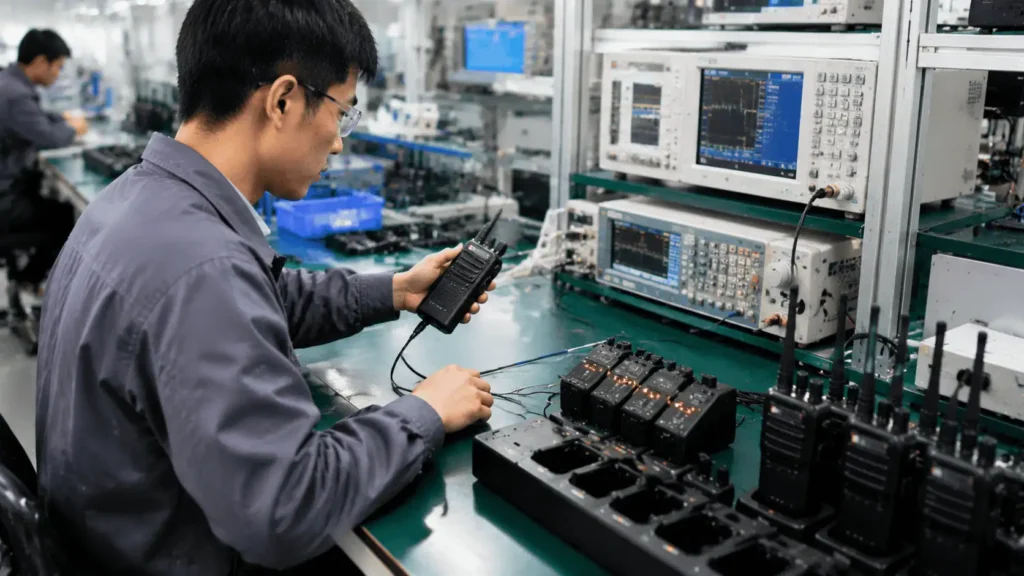
[B2B Quality Assurance Summary] How to verify a genuine two-way radio OEM factory?
Sourcing two-way radios directly from an authentic OEM manufacturer requires evaluating eight critical quality and compliance markers:
- Solder & RF Calibration: High-speed SMT lines equipped with Keysight/Agilent wireless communication spectrum analyzers.
- Environmental & Durability Testing: In-house IP67/IP68 immersion tanks, 1.2m drop test towers, and thermal shock chambers.
- Regulatory & Battery Compliance: Valid FCC ID (USA), CE RED (Europe), RoHS, and UN38.3/MSDS battery air transport certificates.
Evaluating unit manufacturing costs and order tiers? See our 2026 Custom Walkie Talkie Wholesale Pricing Guide.
The Risks of Sourcing Two-Way Radios from Trading Brokers
Importers purchasing wireless communication hardware often face hidden hazards when sourcing from intermediary trading companies instead of direct factories:
- Overstated RF Output Power: Radios marketed as 5W or 10W that deliver less than 2W of actual transmission output due to cheap power amplifiers.
- Frequency Instability & Audio Distortion: Inferior crystal oscillators causing frequency drift under high temperatures, leading to noisy transmissions.
- Customs Seizures & Fines: Fake or missing FCC/CE certification IDs that result in shipment confiscation at ports of entry.
The 8-Point Walkie Talkie Factory Audit Checklist
Use this technical framework when auditing custom two-way radio suppliers or evaluating factory audit reports:
1. Anti-Static (ESD) SMT Placement Cleanroom
High-frequency radio circuit boards (PCBs) are highly sensitive to electrostatic discharge. A qualified factory must operate anti-static SMT (Surface Mount Technology) assembly lines with real-time wrist-strap grounding monitoring, ESD floor matting, and automated optical inspection (AOI).
2. Precision RF Spectrum Calibration & Tuning
Every motherboard must be individual calibrated using industry-grade wireless communication test sets (e.g., Keysight, Rohde & Schwarz, or HP). Technicians calibrate frequency error, modulation distortion, receiver sensitivity (SINAD ≤ -119dBm), and target RF power output.
3. IP67 / IP68 Dust & Water Ingress Chambers
For industrial clients sourcing heavy-duty waterproof two-way radios, verify that the facility features dedicated water pressure immersion tanks and dust ingress chambers to validate sealing gaskets under 1-meter depth for 30 minutes.
4. Mechanical Drop, Button Life & Vibration Testing
Commercial radios must withstand rugged daily wear. Essential lab equipment includes automatic PTT (Push-to-Talk) button life testers (100,000+ press cycles), 6-axis tumbling drop towers, and transport vibration tables.
5. Acoustic Distortion & Noise Cancellation Chambers
Audio testing uses anechoic acoustic boxes to verify speaker sound pressure levels (SPL ≥ 1W / 80dB) and background noise suppression capabilities, crucial for digital DMR noise-canceling radios.
6. International Wireless Regulatory Certifications
Demand official test reports from accredited third-party laboratories (SGS, TUV, Intertek) confirming valid certifications:
| Target Market Region | Mandatory Radio Certification | Key Testing Standards |
|---|---|---|
| North America (USA / Canada) | FCC ID & ISED (IC) | FCC Part 15B, Part 90 (Licensed), Part 95 (FRS/GMRS) & SAR Exposure |
| European Union (EU) | CE RED Directive & RoHS | EN 300 086 (Radio performance), EN 301 489 (EMC), EN 62368-1 (Safety) |
| Global Logistics / Transportation | UN38.3 & MSDS | Lithium-ion battery safety, altitude simulation, thermal test, and 1.2m drop test |
7. Lithium-Ion Battery Safety & Aging Testing
Batteries are the primary failure point in wireless devices. Ensure the factory performs 100% battery capacity grading, short-circuit protection testing, thermal runaway isolation, and aging burn-in cycles on all cell batches.
8. 100% Full-Load Aging & Pre-Shipment AQL Inspection
Before final packaging, assembled radios should undergo 2–4 hours of continuous high-power transmission burn-in aging to filter out premature component failures. Final shipments must adhere to ISO 2859-1 (AQL 1.5 Major / 4.0 Minor) sampling standards.
Direct Factory vs. Trading Broker Comparison
Evaluating vendor capabilities side-by-side helps streamline procurement decisions:
| Capability / Metric | Genuine OEM Radio Manufacturer | Third-Party Trading Company |
|---|---|---|
| Tooling & Molding Customization | In-house CAD design & plastic injection molds | Outsourced (High markup & slow response) |
| Firmware & Frequency Flashing | Direct software engineering & channel table setup | Limited to standard default factory presets |
| RF Power Verification | Guaranteed exact wattage with spectrum test logs | Often inflated or unverified specs |
| Lead Times & Sample Speeds | Samples in 5–7 days; mass order in 15–20 days | 2–3 weeks for simple prototypes |
Planning your frequency setup and custom enclosure molds? Review our Custom Radio Ordering & Technical Guide.
Factory Audit Scoring Table
A checklist becomes far more useful when every area gets a score and a documented piece of evidence. Scoring lets you compare two or three shortlisted factories on the same basis, and the evidence column stops the audit from turning into a friendly factory tour. Rate each area from 1 (weak or missing) to 5 (strong and documented), and note what you actually saw.
| Audit area | What to check | Evidence to request | Score (1–5) |
|---|---|---|---|
| Business legitimacy | Registered manufacturer, not only a trading address | Business license scope, factory address, export records | |
| Engineering capability | In-house R&D for hardware, firmware and programming | Engineering team list, recent design change records, firmware version control | |
| Incoming quality control | Checks on PCBs, batteries, housings and antennas | IQC procedures, supplier list, rejection records | |
| Production process | Stable SMT, assembly and programming flow | Work instructions at each station, process flow chart | |
| RF and audio testing | Every unit tested for power, frequency and audio | Test station photos, calibration certificates, sample test logs | |
| Final inspection | Outgoing QC against an agreed sampling plan | OQC reports, AQL levels used, defect categories | |
| Compliance documents | Test reports matched to the exact model | Report copies, model numbers on reports, lab names | |
| After-sales support | Repair process, spare parts, firmware support | RMA procedure, spare parts list, response process |
Treat any area scored 1 or 2 as a condition to fix before the first order, not as a detail to accept. A low score on compliance documents or RF testing is usually more serious than a low score on packaging or showroom presentation.
Weight the scores to reflect your priorities. A distributor selling into regulated markets may double the weight of compliance documents and RF testing, while a buyer focused on custom branding may give more weight to engineering and programming control. Agree the weighting inside your team before the audit, so the result is not adjusted afterwards to favour a preferred supplier.
How to Run a Remote or Video Audit
Travel is not always possible, and a well-planned video audit can still reveal a lot. The key is to control the order of the walk-through yourself, rather than following a prepared route.
- Send the agenda in advance, listing areas you want to see, but reserve the right to change the order during the call.
- Start at the gate or reception and ask the camera to walk continuously to the production floor, so you can confirm the site is one location.
- Ask for a live test: pick a random finished radio and watch it being checked on the RF test station, with readings visible on screen.
- Check the date on production records, work orders and QC logs shown on camera to confirm they are current.
- Request screen sharing of the programming software and a sample test report during the call.
- Record the session with permission, and follow up with a written list of documents promised during the call.
If the factory declines to show live production or test stations, score that area low. A remote audit can be combined with a third-party inspection company for a physical visit before a large order.
Production Line and RF Test Station Checks
For two-way radios, the test stations tell you more about quality than any brochure. Every unit should pass through RF and audio checks before packing, and the equipment used should be maintained and calibrated.
What to look for on the line
- SMT and soldering: clean boards, controlled reflow profiles and inspection of solder joints
- ESD protection: grounded workstations, wrist straps and anti-static trays for boards
- Programming station: a controlled master file, so every radio receives the approved frequencies and settings
- RF test station: checks of transmit power, frequency error, receiver sensitivity and modulation
- Audio test: speaker and microphone checks for volume and clarity
- Battery and charging checks: sample charge tests and correct battery labelling
- Traceability: serial numbers linked to test results and production batch
| Test station | Typical parameters | Red flag |
|---|---|---|
| RF transmit test | Output power, frequency error, deviation or modulation accuracy | No printed or saved results; manual checks only |
| RF receive test | Sensitivity, squelch operation | Test done by ear only, with no instrument |
| Audio test | Speaker output, mic level, distortion | Random checks instead of every unit |
| Functional test | Keys, knobs, LED, display, PTT | No checklist at the station |
Post-Audit Follow-Up
An audit only creates value if its findings change the supply agreement. Share a written summary with the factory, including each score and every corrective action you need, with an agreed date for evidence.
- Convert findings into quality clauses in your purchase contract, such as test records per batch and a defined inspection standard
- Ask for photos or documents that prove corrective actions are complete
- Schedule a pre-shipment inspection for the first order, and compare results against the audit
- Repeat the audit periodically or when the factory changes location, key suppliers or product platform
To connect audit results to commercial terms, see how to negotiate a walkie talkie supply contract and our guide to choosing a walkie talkie manufacturer in China. If you would like to arrange a video audit with our team, please contact us.
Frequently Asked Questions (FAQ)
Q1: Can we schedule an on-site audit or third-party inspection (e.g., SGS/V-Trust) at your factory?
A1: Yes! We welcome both live in-person factory visits and accredited third-party quality inspections at all production stages (Pre-Production, During Production, and Pre-Shipment AQL).
Q2: Do you provide OEM FCC ID registration under our brand name?
A2: Absolutely. We assist client brand owners in submitting radio test reports to FCC Telecommunication Certification Bodies (TCB) to issue an exclusive FCC ID under your company grantee code.
Q3: How are wireless radios safely packaged for international sea and air freight?
A3: Every radio unit is packed in anti-static ESD bags, fitted into custom shock-absorbing molded pulp or EVA trays, and boxed in heavy-duty double-wall corrugated shipping cartons with UN-certified battery hazard labels.
Request Factory Audit Reports & Compliance Documentation
Want to inspect our ISO9001 certifications, FCC/CE test lab reports, or schedule a virtual live factory tour? Contact our QA engineering team today for Instant Access to Our Audit File Pack & Factory Quote!
Can a video audit replace a factory visit for walkie talkies?
A well-run video audit can confirm the site, production flow, test stations and records, which is often enough for a first sample order. For large or long-term contracts, many buyers add a physical visit or a third-party inspection. The right mix depends on order size and risk.
What RF tests should a walkie talkie factory perform on every unit?
Typical checks include transmit power, frequency error, modulation or deviation, receiver sensitivity and squelch, plus audio and functional tests. Ask to see instrument readings and saved records linked to serial numbers. Exact test parameters depend on the model and radio type, so confirm them with the manufacturer.
How should I score a factory audit?
Rate each area, such as engineering, incoming QC, RF testing, final inspection and compliance documents, on a simple 1 to 5 scale. Record the evidence you saw for each score. Treat low scores in testing or compliance as issues to fix before ordering, and compare factories on the same table.
Related Guides
Equipping a factory or plant floor?
Tell us the site size, noise level and number of users. We will recommend radios and noise-ready accessories and send samples for a shift test.
Get a Quote →Radios for Manufacturing