
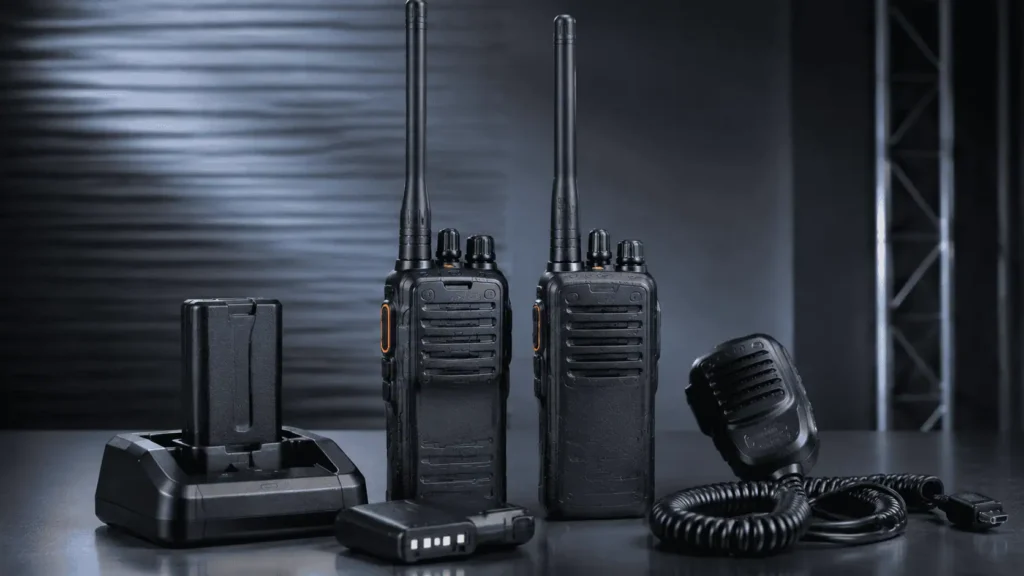
Long Range Walkie Talkies: Real-World Range, Types and Buying Guide
Short answer: The best long range walkie talkie depends on your coverage area, buildings, terrain, user quantity and communication system. For local business communication, DMR radios with a repeater are often more reliable than basic analog radios. For communication across cities or regions, PoC and 4G walkie talkies are usually more suitable.
A walkie talkie advertised with a long distance range may not achieve the same distance in a real workplace. Walls, metal structures, hills, interference, antenna position, battery power and radio frequency all affect actual performance.
This guide explains how long range walkie talkies work, how to choose the right radio type and what distributors, importers and project buyers should confirm before ordering.
What Is a Long Range Walkie Talkie?
A long range walkie talkie is a portable two way radio designed to provide communication over a larger distance than a basic short-range radio.
However, “long range” does not refer to one fixed distance. The real communication range depends on the radio system and working environment.
| Radio Solution | Typical Coverage Use | Best For |
|---|---|---|
| Analog UHF/VHF Radio | Local and short-to-medium range | Small teams and cost-sensitive projects |
| DMR Digital Radio | Local or extended site coverage | Factories, warehouses and security teams |
| DMR Radio with Repeater | Large buildings and wider sites | Industrial facilities, campuses and construction projects |
| PoC Radio | Wide-area cellular coverage | Logistics, patrol and multi-site teams |
| 4G/LTE Walkie Talkie | Regional or nationwide coverage | Mobile teams and field service companies |
How Far Can Long Range Walkie Talkies Reach?
There is no universal answer because advertised range is normally measured under ideal line-of-sight conditions.
In an open outdoor area, a professional handheld radio may communicate several kilometers depending on power, antenna and frequency. Inside a factory, warehouse or concrete building, the usable range can be much shorter because metal, walls and equipment block or weaken the signal.
For business buyers, it is more useful to evaluate the coverage requirement by environment:
- Small shop, hotel or office: Basic analog or compact DMR radios may be sufficient.
- Warehouse or factory: DMR radios with suitable antennas may provide better communication.
- Large industrial site: A DMR repeater may be required to reduce dead zones.
- Multiple buildings or cities: PoC or LTE radios may be more suitable than traditional radios.
- Remote outdoor project: Radio power, antenna position, terrain and repeater planning should be checked together.
What Affects Walkie Talkie Range?
1. Terrain and Line of Sight
Open and flat terrain normally provides better coverage than mountains, forests or dense urban areas. Buildings, hills and large machinery can significantly reduce the effective range.
2. Building Materials
Concrete walls, steel structures, underground areas and metal warehouse racks can weaken radio signals. For large buildings, buyers should consider a repeater and an appropriate antenna system.
3. Frequency Band
UHF radios are commonly selected for buildings, warehouses and urban environments because they can perform well around obstacles. VHF radios are often considered for outdoor and open-area communication. The correct frequency depends on the country, application and local regulations.
4. Radio Power and Antenna
Higher output power does not automatically guarantee better communication. Radio design, antenna quality, battery condition and system configuration also affect performance.
5. Radio Technology
Analog radios are simple and economical. DMR radios provide digital voice and professional fleet functions. PoC radios use cellular networks and can support communication across much larger geographic areas.
Which Long Range Walkie Talkie Is Best for Business?
Long Range Analog Walkie Talkies
Analog radios are suitable for simple local communication and price-sensitive projects. They are easy to operate and can be used by small teams in hotels, shops, warehouses, construction sites and security operations.
Analog radios may be a good choice when the required coverage is limited and advanced functions such as GPS, dispatch or digital group management are not necessary.
Long Range DMR Walkie Talkies
DMR radios are designed for professional two way radio communication. They can provide clearer digital audio, organized channels, group communication and repeater compatibility.
DMR radios are often selected for:
- Manufacturing plants
- Warehouses and logistics centers
- Security teams
- Construction sites
- Hotels and property management
- Large commercial buildings
For professional local communication, DMR radios are often a stronger option than basic analog walkie talkies.
Learn more about our DMR radio solutions.
Long Range Walkie Talkies with Repeaters
A repeater receives and retransmits radio signals to improve coverage. It can help radios communicate across large buildings, multiple floors, factories, warehouses, campuses and industrial sites.
A repeater may be necessary when:
- Handheld radios cannot cover the entire building.
- There are several floors or underground areas.
- Steel structures and concrete walls create dead zones.
- Different departments need stable communication across a large site.
- The project requires more reliable coverage than direct radio-to-radio communication.
Long Range PoC and 4G Walkie Talkies
PoC, or Push-to-Talk over Cellular, radios use 4G/LTE networks instead of relying only on traditional radio distance.
They are suitable for logistics fleets, security patrols, field service, property management, transportation companies and teams working across different cities.
PoC radios may support:
- Wide-area push-to-talk communication
- GPS positioning
- Group calling
- Dispatch platforms
- Multi-site team management
Before ordering PoC radios, buyers should confirm local LTE bands, SIM card compatibility, platform fees and network coverage.
View our PoC and LTE radio solutions.
Long Range Walkie Talkie vs PoC Radio
| Feature | Traditional Long Range Radio | PoC / 4G Radio |
|---|---|---|
| Coverage | Local or extended site coverage | Wide-area cellular coverage |
| SIM Card | Usually not required | Usually required |
| Repeater | May be required | Usually not required for cellular coverage |
| GPS | Optional | Commonly available |
| Best Application | Factories, warehouses and construction | Logistics, patrol and multi-site teams |
How to Choose the Best Long Range Walkie Talkies
Before requesting a quotation, prepare the following information:
- Target country: Frequency, certification and charger requirements vary by market.
- Coverage area: Provide the site size, building height, floors and outdoor distance.
- Working environment: Explain whether the radios will be used in a factory, warehouse, hotel, construction site or outdoor project.
- Number of users: The number of radios affects channels, accessories, programming and total system design.
- Required technology: Choose between analog, DMR, repeater, PoC or 4G communication.
- Battery requirement: Confirm expected working hours, spare batteries and charging method.
- Accessories: Consider earpieces, speaker microphones, antennas, chargers, belt clips and programming cables.
- OEM requirements: Confirm logo, packaging, manuals, labels and accessory bundles.
Common Mistakes When Buying Long Range Walkie Talkies
- Choosing a radio based only on the advertised distance.
- Ignoring walls, steel structures and terrain.
- Using the wrong frequency band for the application.
- Failing to test communication with local SIM cards for PoC radios.
- Ordering radios without checking certificates and local frequency regulations.
- Not confirming batteries, chargers and accessories in the quotation.
- Skipping sample testing before placing a large OEM order.
Can You Order OEM Long Range Walkie Talkies?
Yes. OEM long range walkie talkie programs can include:
- Logo printing
- Private-label packaging
- Model labels and serial number requirements
- Custom user manuals
- Frequency and channel programming
- Battery and accessory bundles
- Neutral packaging for distributors
- Sample testing before bulk production
The MOQ and customization options depend on the selected model, logo method, packaging design and order quantity.
View all two way radio products or request a quotation for your project.
Long-Range Options by Site Type
“Long range” means different things on an open quarry, a multi-building campus and a city-wide delivery fleet. Terrain, structures and the distance between users decide which radio type and infrastructure make sense, so start from the site rather than from the advertised range on a box.
| Site type | Main range challenge | Typical radio approach | What to confirm |
|---|---|---|---|
| Open field, farm or quarry | Distance and terrain; few obstructions | Higher-power analog or DMR handhelds, often VHF; external or longer antennas | Licensed power level for your market, antenna options, battery capacity |
| Multi-building campus or plant | Concrete, steel and floors between users | UHF analog or DMR, often with a site repeater | Repeater placement, frequency coordination, indoor coverage in samples |
| Mine, tunnel or underground car park | Signal loss through rock and long enclosed runs | Repeaters, leaky feeder or other infrastructure; rugged, high-IP radios | Infrastructure design with a specialist, intrinsic-safety needs where gases or dust exist |
| City-wide or regional fleet | Distance beyond any single repeater | PoC/LTE radios over mobile networks, or a multi-site DMR system | Mobile coverage along routes, SIM and platform plans, dispatch needs |
For hazardous areas, intrinsic-safety schemes such as ATEX, IECEx and UL 913 apply. Whether a specific model is covered depends on the model and destination market, so always confirm documentation with the manufacturer before specifying radios for those zones.
Repeater vs PoC: Which Extends Range Better?
Industrial buyers who outgrow handheld-to-handheld range usually choose between a conventional repeater and push-to-talk over cellular. Both extend coverage, but they solve different problems.
| Factor | Repeater (analog or DMR) | PoC / LTE radio |
|---|---|---|
| Coverage area | One site or campus per repeater; can be linked for more | Wherever the mobile network has usable coverage |
| Running costs | Mainly upfront equipment, installation and licensing | SIM data plans and platform subscriptions per user |
| Dependence on third parties | Independent of mobile operators | Depends on carrier coverage and network availability |
| Latency and group calls | Near-instant PTT, suited to fast site coordination | Small delay possible; strong for large or dispersed groups |
| Best fit | Factories, ports, campuses, mines with local infrastructure | Logistics fleets, multi-city security, field service |
Many operations mix both: DMR with a repeater for the core site, plus PoC radios for drivers or supervisors who travel. Our DMR vs analog vs PoC comparison covers the trade-offs in more detail, and the PoC radio vs traditional walkie talkie guide explains when cellular makes more sense than licensed spectrum.
Industrial features that matter for real range
- Adjustable power levels, so users can switch to high power only where needed and save battery elsewhere
- Antenna quality and matching to the frequency band, which often affects range more than the radio body
- Receiver sensitivity and, on DMR, error correction that keeps weak signals intelligible
- Rugged housings and IP ratings for dust and water, which keep radios working in the places long range is needed
- Battery options and multi-unit chargers suited to long or rotating shifts
If you are sourcing long-range radios for resale or a large project, ask for samples of the exact model, antenna and battery you plan to order, and test them on site. Our sample testing checklist shows what to record before approving bulk production.
Long Range Walkie Talkie FAQs
What is the best long range walkie talkie?
The best model depends on the application. DMR radios are suitable for professional local communication, DMR radios with repeaters are suitable for large sites, and PoC or 4G radios are suitable for wide-area communication.
Do long range walkie talkies really work?
Yes, but actual range depends on terrain, buildings, frequency, antenna, battery and radio system design. Buyers should test radios in the real working environment before bulk ordering.
Are DMR radios better than analog radios?
DMR radios are generally better for professional teams that need clearer audio, group communication and repeater compatibility. Analog radios may be more suitable for simple and cost-sensitive applications.
Do long range walkie talkies need a repeater?
Not always. A repeater is usually considered for large buildings, factories, warehouses, campuses and areas where direct handheld communication cannot cover the entire site.
Are PoC radios better for long-distance communication?
PoC radios can be better for communication across cities or regions because they use cellular networks. They require compatible LTE coverage, SIM cards and a suitable communication platform.
Can I buy private-label long range walkie talkies?
Yes. OEM options may include logos, packaging, manuals, labels, programming and accessory kits. Contact the supplier with your target country, quantity and application for an accurate quotation.
What is the difference between commercial and industrial long-range walkie talkies?
Industrial models usually add tougher housings, higher IP ratings, stronger battery options and features such as higher power levels or DMR digital audio. Commercial radios suit shops, hotels and events with shorter distances. Specifications depend on the model, so compare datasheets and samples.
Is a repeater or PoC better for extending walkie talkie range?
A repeater suits a defined site such as a plant, port or campus and avoids ongoing data fees. PoC suits users spread across a city or region where mobile coverage is good. Many businesses combine both depending on who needs to talk to whom.
Can long-range radios be used in mines or hazardous areas?
Underground sites usually need repeaters or other infrastructure because rock blocks radio signals. Areas with explosive gases or dust require radios certified under schemes such as ATEX, IECEx or UL 913. Confirm the certification status of any specific model with the manufacturer.
Request a Long Range Walkie Talkie Recommendation
We supply analog radios, DMR radios, repeaters, PoC radios, LTE walkie talkies and accessories for distributors, importers and project buyers.
Send us the following information:
- Target country
- Quantity
- Application
- Coverage area
- Required radio type
- OEM and packaging requirements
We can recommend a suitable long range radio solution, accessory package and OEM option for your market.
Related Guides
Not sure which radio fits your site?
Describe your site, coverage needs and number of users. Our team will recommend suitable radios and accessories and send samples for testing before bulk orders.
Get a Quote →Browse Our Radios