
How Should You Test Walkie Talkie Samples?
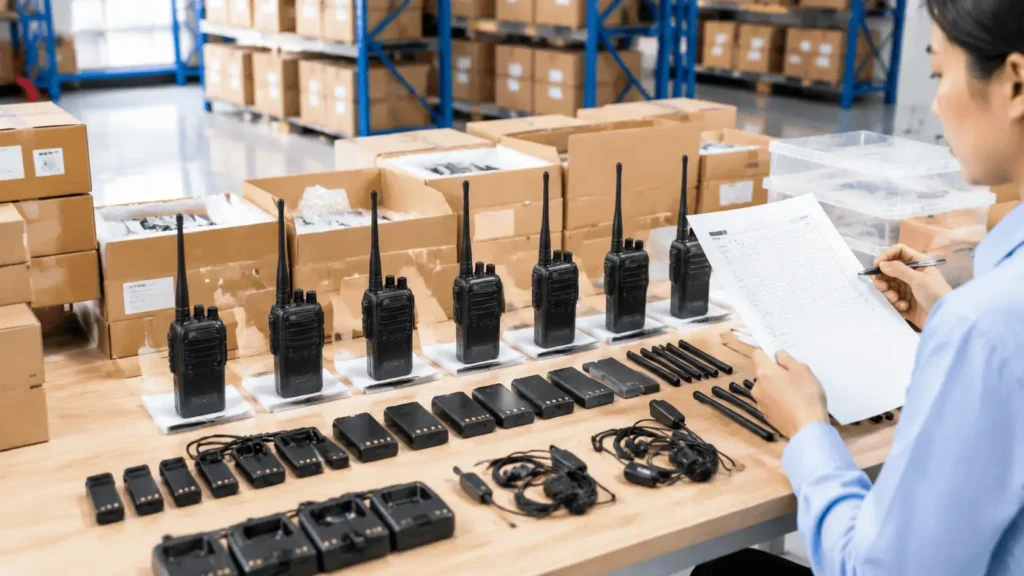
Test the proposed radios in the locations, operating conditions and configuration your team will use. Evaluate two-way communication, intelligibility, battery runtime, accessories and everyday controls. Record the results against agreed requirements before approving a bulk order.
A short demonstration across an office does not establish coverage across a warehouse, construction site or multi-floor building. Your sample trial should answer whether the proposed equipment supports the actual job.
1. Define Acceptance Before the Samples Arrive
List the work areas that require communication, the normal shift duration and the accessories each role needs. Identify which locations are essential and which are desirable additions.
Agree how results will be recorded. For example, record whether a message was understood on the first attempt, needed repetition or failed. Establish your own acceptance thresholds before comparing models.
Confirm that the trial configuration is appropriate for the destination and authorized operating conditions before transmitting.
2. Record the Exact Sample Configuration
Record the model and hardware version, firmware, battery, antenna, audio accessories and programmed settings. For PoC radios, also record the SIM, operator, platform and service plan.
If the trial uses a repeater or network service, include it in the record. Results from that configuration should not be presented as direct radio-to-radio performance.
3. Test Coverage in Both Directions
Mark test points on a simple site plan. Include the actual communication paths: loading dock to office, production floor to maintenance, or reception to upper floors. Test messages in both directions at each required location.
Repeat representative checks during normal operations. Record closed doors, loaded racks, machinery activity and where the radio is worn. A successful call in an empty building may not represent the working environment.
Field evaluation is an established part of coverage planning. Motorola’s RPX repeater guide includes a coverage field-test procedure; use the method appropriate to your proposed system.
4. Evaluate Speech, Not Just Speaker Volume
Use short, repeatable messages containing names, numbers and instructions. Check whether the receiving user understands them without guessing.
Test the supplied earpiece or speaker microphone as well as the radio speaker. Include normal background noise and the protective equipment your team uses. A louder speaker alone does not establish intelligibility.
Keep trial calls separate from real operational instructions so test messages cannot be mistaken for work commands.
5. Measure Battery Runtime Under Your Work Pattern
Start with a fully charged battery and record the configuration, shift length and approximate transmit activity. Note when a low-battery warning appears and whether the radio completes the required shift.
Published runtime figures depend on test conditions. For example, KENWOOD specifications identify a 5-5-90 duty cycle for certain battery-life ratings. Ask the supplier for the conditions behind the figure quoted for your model.
For cellular radios, include the location and platform features used during the trial. Record the need for spare batteries or charging during the shift rather than assuming every quoted runtime applies to your workload.
6. Use a Simple Trial Record
| Test | What to Record | Decision |
|---|---|---|
| Coverage | Location pair, direction, conditions and failed calls | Does it cover the required work areas? |
| Speech clarity | Messages understood, repeated or missed | Can users communicate reliably in normal noise? |
| Battery | Configuration, use pattern and observed runtime | Does the charging plan support the shift? |
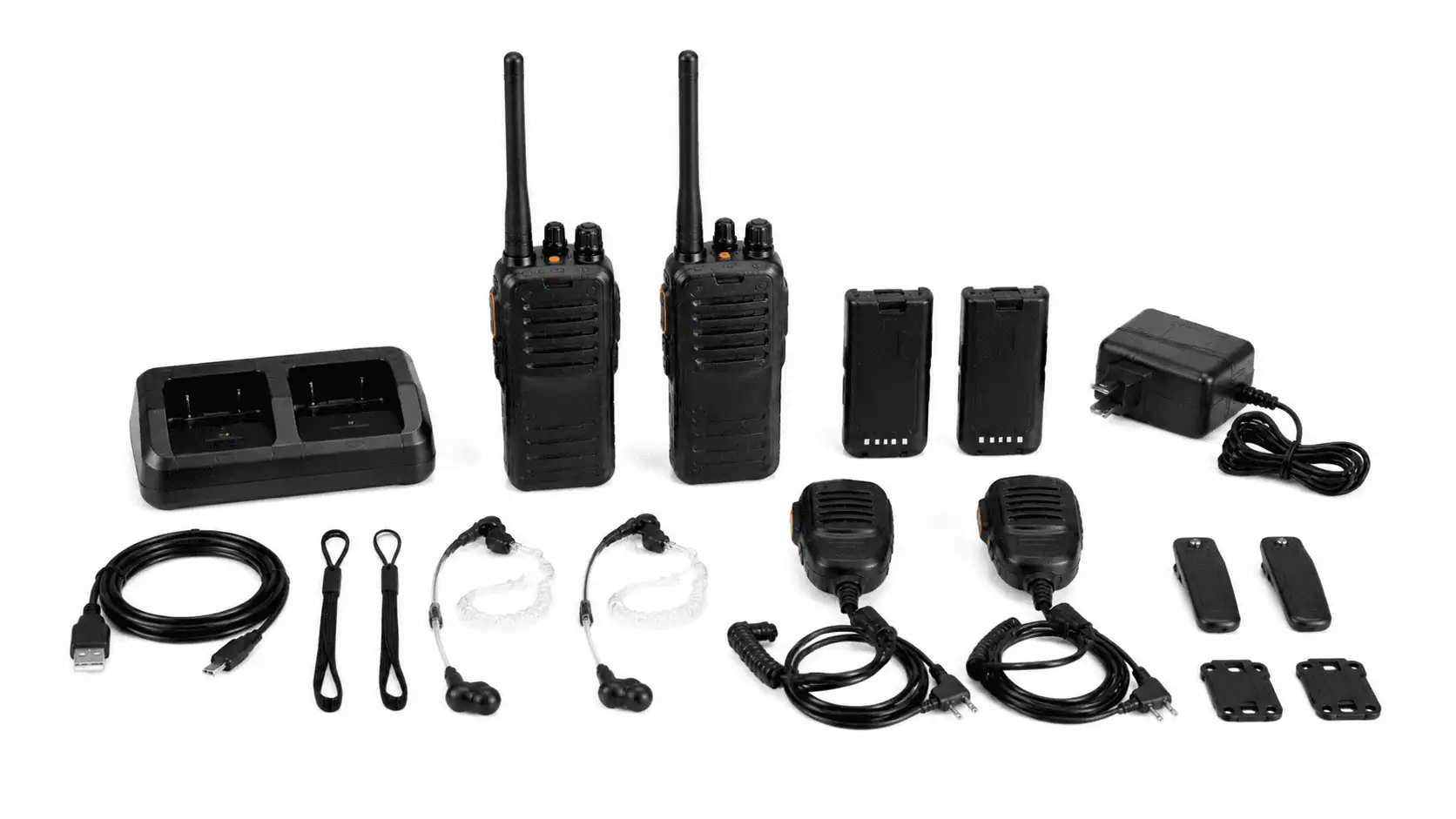
| Accessories | Connection, comfort, audio and push-to-talk operation | Does the complete kit suit the user? |
| Controls | Channel or group selection, gloves and accidental presses | Can staff operate the radio consistently? |
| Compatibility | Calls with the actual existing equipment or platform | Do the required functions work together? |
| Recovery | Restart and reconnection behavior under controlled conditions | Does it recover as required by the workflow? |
7. Verify Compatibility with Your Existing Fleet
Test against the equipment your team already uses. Sharing a frequency band or a technology label does not establish compatibility for every feature.
Confirm the required configuration with the supplier. For PoC devices, test on the intended platform. For a mixed radio fleet, verify the specific calling functions and operating modes you need.
8. Connect Sample Approval to the Bulk Order
Keep an approved configuration record and, where practical, an identified reference sample. The purchase order should describe the selected hardware, accessories, firmware or programming requirements and any agreed changes.
Sample approval does not establish that every production unit will be identical or defect-free. Agree on incoming inspection and how discrepancies will be handled.
Ask for model-specific evidence for any environmental rating you require. An informal trial is not a substitute for the relevant test documentation.
Sample Test Scorecard
Testing samples is most useful when each person on your team records results in the same format. A simple scorecard turns individual impressions into data you can compare between models, suppliers and sample rounds. Score each item as pass, marginal or fail, and add notes on the conditions of the test.
| Test item | How to test | Pass criteria (set your own) | Result |
|---|---|---|---|
| Range on your site | Walk agreed routes between fixed points; note where audio breaks | Clear audio at all critical locations | |
| Audio clarity | Read a set phrase at normal and noisy locations | Message understood first time | |
| Battery endurance | Run a full shift with normal use pattern | Lasts your shift length with margin | |
| Charging | Charge from empty in the supplied charger | Consistent charging, no overheating | |
| Build and controls | Check knobs, PTT, clip, battery latch | Firm, no looseness or cracks | |
| Programming | Confirm frequencies, tones, channel names | Matches your approved channel plan | |
| Accessories | Test earpiece, speaker mic, charger fit | Secure connection, clear audio | |
| Compatibility | Talk to your existing radios, if any | Two-way communication on all needed channels |
Keep the completed scorecards with photos and test dates. They become the reference when you compare mass-production units later.
Who should test the samples
Give samples to the people who will actually use the radios, not only to purchasing or IT staff. A security guard, a forklift driver and a hotel housekeeper will notice different problems. Ask each tester to complete the same scorecard after a full shift, and hold a short review meeting to collect comments before deciding. If you are testing two or more models, rotate them between testers so results do not depend on one person’s preferences or one location.
Testing Audio in Real Noise
Many radios sound good in an office and poor on a factory floor. Audio should be tested where the radios will actually be used, with the same noise, protective equipment and accessories.
- Test near the loudest machines, generators, forklifts or crowds on your site
- Wear the same helmets, ear defenders or gloves your users wear
- Test both the radio speaker and any speaker mic or headset you plan to buy
- Check transmit audio: does the listener understand you when you speak near noise?
- Compare standard and noise-cancelling microphones if available
Where noise may exceed the OSHA 29 CFR 1910.95 action level of 85 dBA as an 8-hour time-weighted average, hearing protection is part of the site’s safety program, so choose headsets or earpieces that work with it. Our walkie talkie accessories page lists noise-cancelling speaker mics and headsets.
Record the noise conditions for each test, for example the machine running nearby and the approximate distance. This makes it possible to repeat the test later with production units and compare results fairly.
Pay attention to transmit audio as well as receive. A radio can sound loud to its user while sending muffled or clipped audio to others. Ask a colleague at a quiet location to rate what they hear from you, and swap roles so both directions are checked on every sample.
Drop and Water Checks Appropriate to the Rating
Durability tests should match the rating the manufacturer claims, not exceed it. Testing a radio beyond its rating tells you little and may damage samples you still need.
| Claimed rating | Reasonable buyer check | Avoid |
|---|---|---|
| No IP rating | Light splash test only, if at all | Any immersion or heavy rain exposure |
| IP54 / IP55 | Light rain or splash from different angles | Pressure jets or immersion |
| IP65 / IP66 | Water jets from a hose; dust exposure | Submersion |
| IP67 / IP68 | Short immersion per the rated depth and time, with battery fitted | Going beyond the stated depth or time |
For drops, test from a realistic height onto the surfaces your users work on, then check function, housing, battery latch and antenna. Ask the manufacturer for their own drop and IP test records for the model. See IP65 vs IP67 vs IP68 walkie talkies for help choosing a rating.
Golden Sample Approval and Documentation
Once a sample passes, it should become the golden sample: the physical reference that mass production must match. This protects you if later units differ in color, audio, programming or build quality.
- Choose the approved unit and label it clearly with model, date and version.
- Record firmware version, programming file and accessory list in writing.
- Photograph the radio, logo, packaging and labels from all sides.
- Keep one golden sample yourself and ask the factory to keep a matching sealed unit.
- Reference the golden sample in your purchase order and inspection criteria.
- Use it during pre-shipment inspection to compare random production units.
Any change after approval, such as a new component or firmware, should be agreed in writing and may need a new sample. Our private label sample checklist covers the approval steps, and you can request samples from our team.
Buyer Questions
How many samples should I request?
Request enough to test the required communication paths and representative users. Two devices may support a basic point-to-point trial, but group workflows and multiple locations can require more.
Can I judge range from a supplier’s kilometre claim?
Use that claim only with its stated conditions. Confirm performance at your site before committing to a fleet.
Should I perform drop or water tests?
Review the required rating and supporting documents first. Agree any additional testing with the supplier, including the method and sample terms.
What if a required area fails?
Document the location and conditions, then ask the supplier to review the system design. Retest any proposed change before approving it.
What is a golden sample for walkie talkies?
A golden sample is the approved unit that mass production must match. It records the agreed appearance, logo, firmware, programming and accessories. Both buyer and factory keep a matching sealed sample, and inspectors compare production units against it before shipment. Changes after approval should be agreed in writing.
How should I test walkie talkie audio before ordering?
Test in the noisiest real locations where radios will be used, wearing the same protective equipment as your users. Check both receive and transmit audio, with and without accessories such as speaker mics or headsets. Record whether messages are understood first time, and compare noise-cancelling options where available.
Should I drop test or water test walkie talkie samples?
Yes, but only within the rating the manufacturer claims. Use realistic drop heights and surfaces, and match water tests to the IP rating, such as jets for IP65 or short immersion within stated limits for IP67. Testing beyond the rating tells you little and may damage samples.
Request Samples for Your Site Trial
Send your industry, destination country, site layout, user count and current equipment details. Ask for a proposed sample configuration, trial terms and an itemized quotation for the planned fleet.
Email: lorabanzhitao@gmail.com
Related Guides
Sourcing radios for your brand or distribution business?
We support OEM and private label orders: logo, housing color, packaging, firmware and channel programming. Send your target market and quantities for a quote and samples.
Get a Quote →Browse Our Radios