
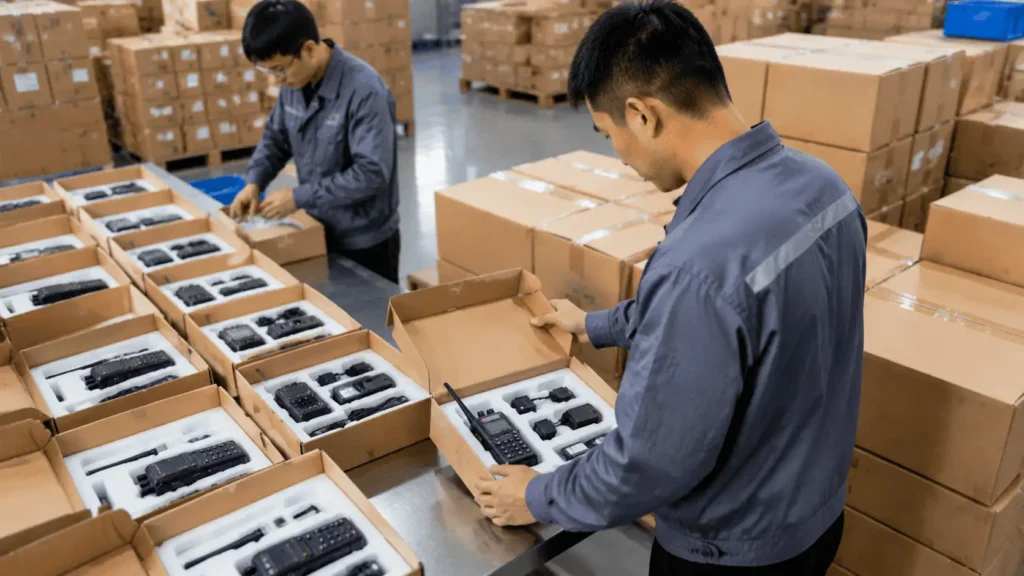
How to Negotiate a Walkie Talkie Supply Contract
Short answer: Before signing, confirm the MOQ per SKU (not just per order), payment terms tied to inspection milestones, a written warranty period with clear defect-return responsibility, and lead time commitments with a penalty or remedy clause if missed.
Once a buyer has chosen a radio type and supplier, the final step is agreeing on contract terms. Many disputes between importers, distributors and manufacturers come from vague or unclear terms agreed verbally or in a quick quotation, rather than a properly structured supply agreement. This guide covers what to check before signing.
MOQ Terms Worth Clarifying
- MOQ per SKU vs per order: Some suppliers require a minimum quantity for each color, accessory bundle or configuration, not just a total order minimum.
- MOQ for reorders: Confirm whether repeat orders have the same or a lower minimum once a relationship is established.
- Mixed-SKU orders: Ask whether the MOQ can be split across multiple models to reduce inventory risk on a first order.
Payment Terms and Milestones
Common structures include a deposit before production, with the balance due before shipment or after a pre-shipment inspection. Buyers should confirm what happens if a shipment fails inspection: is the balance renegotiated, or does the supplier rework the goods at their own cost? Clear milestones tied to inspection reports protect both sides and reduce disputes.
Warranty and After-Sales Terms
- Warranty period: Confirm the length (commonly 12 to 24 months) and whether it covers parts, labor, or both.
- Defect return process: Clarify who pays return shipping for defective units and the expected replacement timeline.
- Spare parts availability: Confirm whether spare batteries, antennas and chargers will remain available after the initial order.
Lead Time and Delay Clauses
Ask for a written production lead time, separate from shipping time, and confirm what happens if production is delayed beyond the agreed date. Some contracts include a penalty clause or a discount for late delivery, which encourages suppliers to prioritize the order and gives the buyer recourse if timelines slip.
Red Flags to Watch For
- No written quotation or contract: Verbal agreements on price, MOQ or lead time are difficult to enforce.
- Vague warranty language: Terms like “quality guaranteed” without a specific period or process are not enforceable.
- Full payment required upfront: Reputable manufacturers typically accept a deposit and balance structure, not 100% prepayment for new buyers.
- Reluctance to allow inspection: A supplier unwilling to allow a pre-shipment inspection or sample approval is a warning sign.
Documents to Request Before Signing
- A detailed proforma invoice listing SKU, specification, quantity and unit price
- Written confirmation of MOQ, lead time and payment terms
- Certification documents relevant to your target market (FCC, CE, or others)
- Sample approval sign-off before mass production begins
Quality Clauses and Inspection
Price, payment and lead time get most attention in negotiations, but quality clauses decide what happens when goods arrive with problems. A contract should define how quality is checked, by whom and what happens when a batch fails.
| Clause | What it should state | Why it matters |
|---|---|---|
| Quality standard | The agreed specification, approved sample and any applicable standards | Gives both sides one reference for acceptance |
| AQL levels | The sampling standard (commonly ISO 2859-1) and acceptable quality limits for critical, major and minor defects | Sets a clear pass or fail rule for inspections |
| Defect classification | Examples of critical, major and minor defects for radios, such as no transmit, wrong frequency, cosmetic scratches | Avoids arguments over how serious a defect is |
| Pre-shipment inspection | Who inspects (buyer, third party or both), when, and who pays | Finds problems before goods leave the factory |
| Functional tests | Tests to include, such as transmit, receive, audio, programming check, battery and charger function | Visual checks alone miss most radio faults |
| Failed inspection | Rework, re-inspection and who pays the cost | Prevents shipment of known defective goods |
| Defects found after arrival | Reporting period, evidence needed and remedy (repair, replacement or credit) | Protects the buyer once goods are in stock |
Many buyers combine a factory audit before the first order with pre-shipment inspection for each shipment. Our factory audit checklist covers what to verify before signing.
Keep inspection reports, photos and test records for every shipment. Over time they show whether quality is stable, improving or slipping, and they give you evidence if a dispute arises. Share recurring findings with the supplier and agree corrective actions in writing, with a date for the next check.
Spare Parts and After-Sales Clauses
Radios often stay in service for years, and distributors need parts and support for all of that time. After-sales terms should be agreed before the order, not after the first failure.
- Spare parts availability: state which parts (batteries, antennas, housings, knobs, clips, speakers) will remain available and for how long after the model ends production.
- Free spare parts: agree whether a percentage of spare parts or units ships with each order to cover early failures.
- Warranty terms: define what the warranty covers, what it excludes, how claims are made and how they are settled. Warranty periods depend on the product and agreement.
- Repair process: decide whether faulty radios are repaired locally with supplied parts or returned to the factory, and who pays shipping.
- Technical support: include access to service manuals, programming software, firmware updates and a named technical contact.
- End-of-life notice: require advance notice before a model or battery is discontinued, so you can place a last-time order.
These points are especially important for OEM bulk orders, where end customers expect the distributor to handle every service request.
Also agree how long the supplier will keep spare parts for accessories such as speaker mics and chargers, since these often wear out faster than the radios themselves. If your market has specific requirements for repair or recycling, include them in the after-sales section as well, so responsibilities are clear from the start.
Intellectual Property and Branding Ownership
Private-label orders create assets that both sides may later want to use: logos, housing designs, packaging artwork, manuals and programming files. The contract should say who owns them.
| Asset | Typical question | What to agree |
|---|---|---|
| Brand name and logo | Can the factory use your brand elsewhere? | Buyer owns the brand; factory uses it only for your orders |
| Packaging and manual artwork | Who owns files created for your brand? | Ownership of final artwork and source files |
| Custom moulds or tooling | Who owns moulds you paid for? | Ownership, storage, maintenance and exclusivity |
| Custom firmware or features | Can the feature be sold to others? | Exclusivity period or shared use |
| Programming files | Who keeps customer channel data? | Confidentiality and data handling |
Include a confidentiality clause covering drawings, specifications and customer information. Where brand protection matters, register trademarks in your sales markets, and consider an agreement that addresses non-use, non-disclosure and non-circumvention.
Protecting brand consistency
Branding clauses should also cover consistency. Specify colour references for logos and housings, print positions and approved artwork versions, and require the factory to use only the latest approved files. If the same factory produces radios for other brands, ask how your artwork and packaging stock are kept separate to avoid mixing during production and packing.
The Golden Sample Clause
A golden sample is an approved production-standard sample that both buyer and manufacturer sign and keep as the reference for bulk production. It turns “the same as the sample” into something both sides can check.
- Approve samples of the exact model, colour, logo, battery, accessories and packaging you will order.
- Record programming settings, firmware version and key test results with the sample.
- Seal, sign and date the golden samples; keep one set with the buyer and one at the factory.
- State in the contract that bulk production must match the golden sample, and that any change in components or suppliers needs written approval.
- Use the golden sample during pre-shipment inspection to compare appearance and function.
A golden sample works best when combined with structured sample testing. Our guide on testing walkie talkie samples before a bulk order explains what to record.
Contract Negotiation FAQs
What payment terms are standard for radio orders?
A common structure is 30% deposit before production and 70% balance before shipment, though terms vary by order size and buyer relationship history.
Can MOQ be negotiated?
Often yes, especially for a first trial order, a mixed-SKU order, or when a buyer commits to a reorder schedule. It is worth discussing directly with the supplier.
What warranty period should I expect?
Most reputable manufacturers offer 12 to 24 months on hardware defects. Confirm this in writing before signing.
Should I request a sample before signing a bulk contract?
Yes. Sample approval before mass production is standard practice and helps confirm quality expectations are aligned before committing to a full order.
What AQL level should be used for walkie talkie inspections?
Many buyers use ISO 2859-1 sampling with stricter limits for critical and major defects and looser limits for minor cosmetic issues. The right levels depend on the product, order size and risk. Agree the levels, defect definitions and functional tests in the contract before production starts.
What after-sales terms should a walkie talkie supply contract include?
Include spare parts availability after the model ends, any free spare parts per order, warranty coverage and exclusions, the repair process and shipping costs, access to service manuals and programming software, and advance notice of discontinued models or batteries. Warranty periods depend on the product and agreement.
What is a golden sample in radio manufacturing?
A golden sample is a signed, sealed, approved sample kept by both the buyer and the manufacturer as the reference for bulk production. It records appearance, components, programming and firmware. The contract states that production must match it, and inspectors use it to compare shipments.
Request Contract and Quotation Support
To receive a detailed quotation and draft contract terms, please tell us:
- Product model and target quantity
- Target market and required certifications
- Preferred payment structure
- Required lead time
We can provide a written quotation with clear MOQ, payment, warranty and lead time terms for review.
Related Guides
Sourcing radios for your brand or distribution business?
We support OEM and private label orders: logo, housing color, packaging, firmware and channel programming. Send your target market and quantities for a quote and samples.
Get a Quote →Browse Our Radios