
Two Way Radio Supplier Saudi Arabia
OEM analog radios, DMR radios, PoC radios, LTE walkie talkies, repeaters and accessories for Saudi security, construction, logistics, warehouses, hotels and distributors. Export documentation, CE/FCC/RoHS certificates and OEM packaging provided to support smooth customs clearance in Saudi Arabia.
Short answer: Saudi Arabia buyers should source two way radios based on worksite size, coverage needs, user quantity, radio type and accessory package. DMR radios fit construction, warehouses and large facilities, while PoC radios fit mobile teams and multi-site operations.
We support Saudi distributors and project buyers with bulk walkie talkie supply, OEM packaging, accessories, sample testing and product recommendations.Recommended Radios for Saudi Arabia
| Application | Recommended Radio | Why It Fits |
|---|---|---|
| Construction projects | Long range DMR radio | Clearer audio, group communication and rugged daily use. |
| Security companies | Analog radio or DMR radio | Simple patrol communication or professional fleet management. |
| Warehouses and logistics | DMR radio or PoC radio | Supports warehouse coordination, loading docks and mobile teams. |
| Hotels and facilities | Compact analog or DMR radio | Useful for housekeeping, maintenance and front desk teams. |
| Multi-site companies | PoC radio or LTE walkie talkie | Wide-area push-to-talk with cellular network coverage. |
DMR, PoC or Analog Radios?
For local job sites and facilities, analog radios and DMR radios are usually the first choices. Analog radios are lower cost and easy to deploy. DMR radios offer clearer audio, groups and repeater support. For transportation, logistics, mobile patrols and distributed teams, PoC radios or LTE walkie talkies may be better because they use cellular networks for wide-area communication.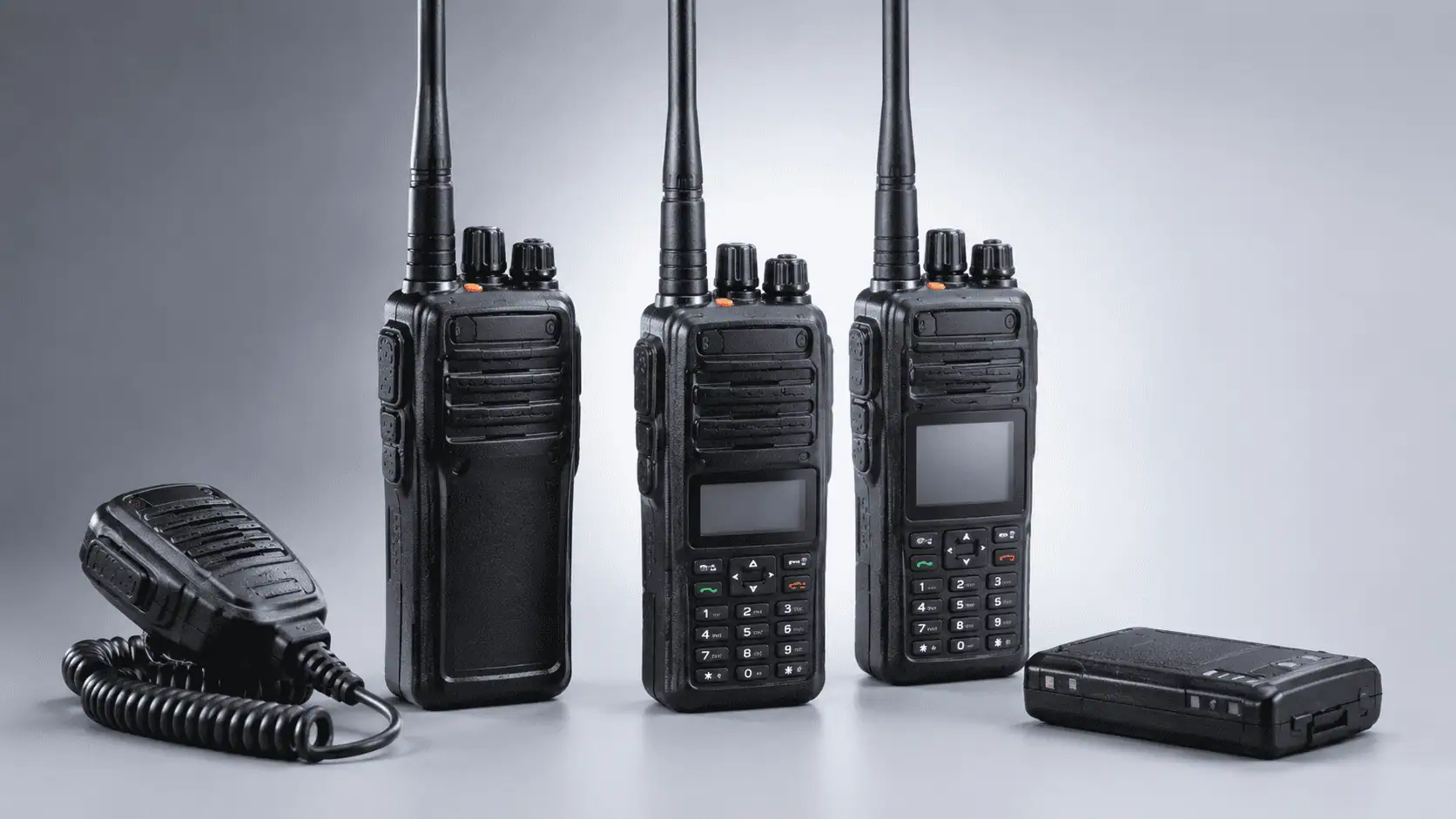
Saudi Buyer Checklist
| Application | Security, construction, hotel, warehouse and logistics teams need different radios. |
| Quantity | Affects unit price, production planning and shipping cost. |
| Coverage area | Helps decide analog, DMR, repeater or PoC solution. |
| Accessory bundle | Batteries, chargers, earpieces and microphones affect total project cost. |
| OEM needs | Logo, packaging, labels and manuals affect quotation and MOQ. |
Import & Compliance Notes for Saudi Arabia
Two-way radios imported into Saudi Arabia are regulated by the Communications, Space and Technology Commission (CST, formerly CITC). Before a bulk order, confirm who will hold the local type approval for the exact model, and which frequencies the radios may be programmed to use. CE, FCC and RoHS test reports support an application, but they do not replace CST approval.
| Item to Confirm | Why It Matters |
|---|---|
| CST type approval for the exact model | Customs and resellers may ask for proof that the radio model is approved for the market. |
| Frequency band and channel programming | Radios should be programmed only to frequencies the end user is permitted to use. |
| Frequency licence for business or DMR systems | Licensed UHF/VHF and repeater systems usually need a spectrum licence held by the operator. |
| Test reports and labels | We supply CE/FCC/RoHS reports, model labels and manuals to support the importer’s application. |
Requirements change, so check the latest rules on the CST website or with your customs broker before shipping.
Radio Choices for Saudi Arabian Industries
Large construction programmes, energy operations and a growing events calendar create steady demand for two-way radios in Saudi Arabia. The right radio depends on the site, the team size and whether hazardous areas are involved.
| Industry | Typical working conditions | Suggested radio direction |
|---|---|---|
| Giga-projects and construction | Very large sites, heat, dust, many contractors | Rugged DMR with talk groups per contractor; repeaters or PoC for wide areas |
| Oil and gas | Refineries, pipelines, remote camps | Standard rugged radios for safe zones; certified intrinsically safe models only where the area classification requires them |
| Security | Compounds, malls, hospitals, government sites | DMR with emergency and lone-worker functions; PoC for multi-site control rooms |
| Events and entertainment | Stadiums, festivals, temporary venues | Pre-programmed analog or DMR fleets with multi-unit chargers and spare batteries |
| Logistics and warehousing | Ports, distribution centres, fleets | UHF DMR on-site; PoC/LTE radios for drivers and inter-site coordination |
For oil and gas, the need for intrinsic safety must be confirmed from the site’s hazardous-area classification. Schemes such as ATEX and IECEx certify equipment for explosive atmospheres; ask for the certificate for the exact model and do not assume a standard radio is suitable. For construction fleets, see our guide to walkie talkies for construction sites.
Shipping, Documents and Conformity for Saudi Imports
Shipments usually arrive by sea at Jeddah or Dammam, or by air into Riyadh. Saudi customs typically links clearance to conformity registration, so documents should be prepared before booking freight.
| Document or item | What it covers | Buyer note |
|---|---|---|
| Commercial invoice | Model numbers, quantities, unit values, HS code proposal, Incoterms | Match descriptions to the conformity documents so customs sees one consistent product name |
| Packing list | Carton count, net and gross weights, carton dimensions, serial or batch ranges | Serial ranges help later warranty and spare-part tracking |
| Battery UN38.3 test summary | Lithium battery transport testing for the battery model shipped | Air and sea forwarders typically ask for it; confirm it matches the actual battery part number |
| Safety data sheet (SDS/MSDS) | Handling information for lithium batteries | Often requested together with UN38.3 documents |
| Conformity documents | Test reports and technical files that may support CST equipment approval and SASO/SABER conformity certificates | Coverage depends on the selected model and destination market; confirm with your importer or broker |
| Bill of lading or air waybill | Shipment evidence for customs clearance | Check consignee details match the importer of record |
Radio equipment in Saudi Arabia is typically subject to type approval from the Communications, Space and Technology Commission (CST, formerly CITC), while product conformity is commonly handled through the SASO SABER platform, which issues product and shipment certificates. Which certificates apply depends on the product classification and current rules. Confirm with CST, a SABER-registered conformity body or your importer before shipping. A manufacturer can usually provide test reports to support these steps, depending on the model.
Allow time for conformity steps in the project schedule. A shipment that arrives before certificates are in place may wait at the port, adding storage costs and delaying site mobilisation. Share the model list with your importer early so they can check which approvals already exist and which still need to be applied for.
After-Sales and Spare Parts Planning
Long project timelines mean fleets are used hard for years. Build a spares plan into the purchase order so replacement parts match the original model and firmware.
- Batteries: plan rotation stock for double shifts and hot storage conditions.
- Speaker mics and headsets: noise-cancelling accessories wear quickly on construction and plant sites.
- Antennas and charger trays: easy to lose across large sites.
- Firmware and codeplug records: keep a master programming file so replacements join the right talk groups.
- Repair and swap: decide whether your importer holds a swap pool or returns units to the factory.
Order spares in the same production batch where possible; a later batch may use different parts.
For large contracts, agree a spares list in the purchase order itself, with quantities for batteries, chargers and audio accessories. It is also useful to request a small stock of complete radios as a swap pool, so a faulty unit can be replaced on site the same day while repairs are arranged.
Working With Saudi Distributors and Importers
Many buyers work through a Saudi importer that already manages CST approval, SABER registration and local service. Contractors on large projects sometimes import directly through their procurement team.
| Buying route | Best for | Points to check |
|---|---|---|
| Local importer or dealer | Most commercial fleets | Registered models, stock levels, programming and repair service |
| Direct project import | Large contractors and facilities operators | Importer of record, conformity certificates, customs broker |
| OEM supply to a distributor | Dealers building a private label | Branding, Arabic packaging or manuals, technical files for approval |
Before signing, compare supplier types using our manufacturer vs trading company guide, and test samples on site. For wider coverage needs, read about PoC radio options.
Related Buying Guides
- Long Range & Heavy Duty Walkie Talkies
- IP65 vs IP67 vs IP68 Walkie Talkies
- Battery & Charging Guide for 24/7 Shifts
- Logistics & Fleet Radios for Ports
- DMR vs Analog vs PoC Sourcing Guide
Other markets we supply: UAE · Philippines · South Africa
Two Way Radio Supplier Saudi Arabia FAQ
What radios are suitable for Saudi construction projects?
DMR radios with speaker microphones, spare batteries and possible repeater support are often suitable for larger construction projects.Can you supply OEM radios for Saudi distributors?
Yes. We can support logo printing, private label packaging, user manuals, carton marks, accessory bundles and bulk production.Are PoC radios suitable for Saudi logistics teams?
PoC radios can be suitable for mobile logistics and transport teams when cellular coverage and SIM support are available.Who approves two-way radios in Saudi Arabia?
Radio equipment is regulated by the Communications, Space and Technology Commission (CST, formerly CITC). Confirm that the exact model has CST approval, or that your importer will obtain it, and ask your customs broker which shipment documents are required before dispatch.
What should Saudi buyers check for desert and outdoor sites?
Dust and heat are the main risks. Compare IP ratings for dust and water protection, check the operating temperature range, and test batteries during a full outdoor shift. Our IP65 vs IP67 vs IP68 guide explains the difference.
Do large Saudi projects need repeaters?
Large construction, oil and gas or industrial sites often need a repeater to cover long distances, several buildings or underground areas. Repeaters and licensed frequencies are normally planned together, so share your site map and coverage goals when you request a quote.
Do radios need CST approval in Saudi Arabia?
Radio equipment in Saudi Arabia typically needs type approval from CST, formerly known as CITC, and product conformity is commonly managed through the SASO SABER platform. The importer usually handles registration. Requirements depend on the product and change over time, so confirm current rules with CST or your importer before ordering.
Can standard walkie talkies be used at oil and gas sites?
Only in areas classified as non-hazardous. Where explosive atmospheres may be present, the site usually requires radios certified under a recognised intrinsic-safety scheme such as ATEX or IECEx for the relevant zone. Confirm the area classification with the site safety team and request the certificate for the exact model offered.
Which radio works best on large Saudi construction projects?
Rugged UHF DMR radios are common because they offer clear digital audio, talk groups for each contractor and good battery efficiency. Very large sites may add repeaters, while PoC radios suit supervisors moving between distant zones with mobile network coverage. Test samples on site before choosing a bulk model.