
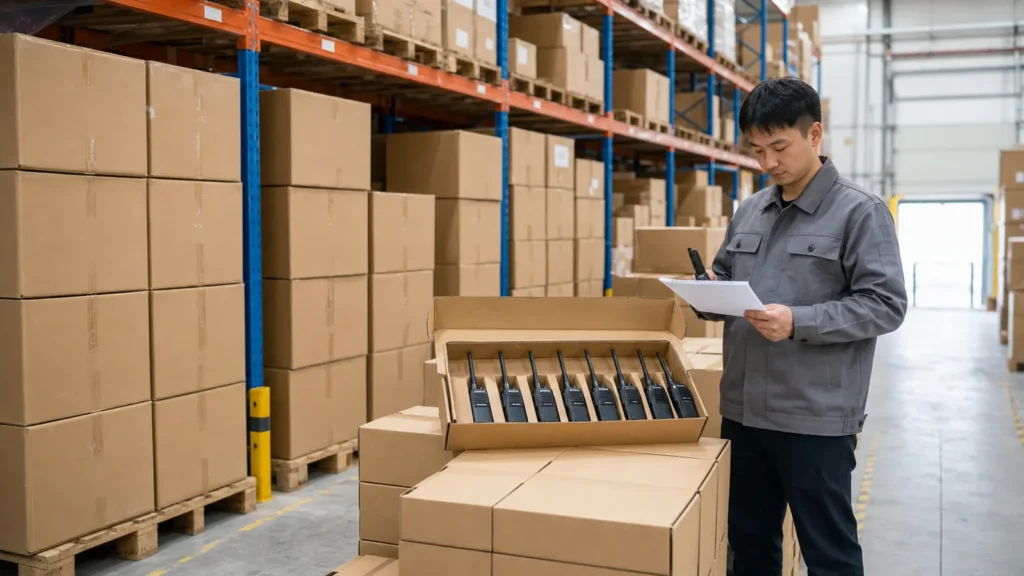
Logistics & Fleet Radios: Guide for Ports and Distribution
Short answer: Trucking yards, ports and distribution centers usually need a mix of long-range mobile radios for vehicles and rugged handheld radios for yard staff, connected through a repeater or PoC network that covers the full site, including loading docks, gates and outdoor yard areas.
Logistics sites are large, often spread across open yards, multiple buildings and vehicle traffic lanes. Coordinating trucks, forklifts, dock workers and gate security with a phone call for every instruction is slow and unsafe. Two-way radios remain the standard for fast, hands-free coordination across a logistics operation.
This guide covers what trucking companies, port operators, distribution centers and fleet radio distributors should confirm before ordering.
Where Radios Are Used in Logistics Operations
- Yard and gate coordination: Directing trucks to the correct dock or gate.
- Dock and warehouse staff: Coordinating loading, unloading and inventory movement.
- Vehicle-to-vehicle communication: Mobile radios installed in yard trucks, forklifts or terminal tractors.
- Security and access control: Coordinating with gate staff and site security.
- Port and terminal operations: Coordinating crane operators, container handling and vessel schedules.
Handheld vs Mobile Radios for Logistics Sites
Handheld Radios
Portable radios for yard staff, dock workers and supervisors who move on foot around the facility.
Mobile (Vehicle-Mounted) Radios
Higher-power radios installed in yard trucks, terminal tractors and forklifts, offering stronger transmission power and better range than handhelds, often paired with an external antenna for maximum coverage across a large yard.
Coverage Planning for Large Logistics Sites
Distribution centers and port terminals often cover a very large area with metal containers, warehouse racking and vehicle traffic that can create interference. A single repeater is often not enough for a large port or multi-building distribution campus. Site surveys, repeater placement and, in some cases, a multi-site PoC radio solution are used to guarantee coverage across the entire operation, including outdoor yard areas that a standard analog radio may not reach.
How to Choose the Best Logistics Radios
- Map the yard, docks and buildings to identify likely coverage gaps
- Decide how many handheld vs mobile (vehicle-mounted) radios are needed
- Confirm whether a repeater or PoC solution is required for full-site coverage
- Check IP rating for outdoor yard use in rain, dust and temperature extremes
- Plan channel structure for gate, dock, security and management traffic
Common Mistakes When Buying Logistics Radios
- Underestimating site size: A radio spec that works for a small warehouse often fails to cover a full distribution campus or port terminal.
- Mixing incompatible radio types: Handheld and mobile radios from different systems may not communicate cleanly without proper planning.
- Ignoring vehicle interference: Metal container yards and heavy machinery can degrade radio signal more than expected.
- No coverage testing before bulk order: A site survey with sample units avoids costly gaps after full deployment.
Can You Order OEM Logistics Radios?
Yes. Trucking companies, port operators, third-party logistics providers and fleet equipment distributors can order private-label handheld and mobile radios with custom branding, packaging and channel presets configured for typical logistics site operations. Sample units and a coverage assessment are recommended before a bulk rollout across a large facility.
Ready to source? See our walkie talkies for warehouses page for models, OEM options and quotation details.
Channel Plan for Ports and Large Yards
On busy ports, container yards and distribution centres, a clear channel plan matters as much as radio choice. When every team shares one channel, urgent calls get lost in routine traffic. Separating teams by function keeps talk short and makes emergency calls easier to hear.
| Channel or talk group | Typical users | Purpose | Planning notes |
|---|---|---|---|
| Operations control | Supervisors, yard control, shift managers | Coordination between teams and priority decisions | Monitored at all times; supervisors may scan other groups |
| Crane and quay operations | Crane operators, signallers, lashers | Lift instructions and vessel operations | Keep traffic separate so lift calls are never blocked |
| Yard and straddle carriers | Yard drivers, reach stackers, planners | Container moves and stack locations | Mobile radios in vehicles often work best here |
| Gate and truck control | Gate staff, security, truck marshals | Arrivals, inspections and queue management | Can link with security channel during incidents |
| Warehouse and cross-dock | Forklift drivers, loaders, team leaders | Dock allocation and loading priorities | Earpieces or noise-cancelling mics for loud areas |
| Maintenance | Technicians, engineers | Breakdowns and repair requests | Useful to allow private calls to specific technicians |
| Emergency | All users via emergency function or dedicated channel | Accidents, fires, spills | Test emergency alerts during commissioning and drills |
On DMR systems, talk groups and time slots allow several teams to share infrastructure without hearing each other. On analog systems, separate frequencies or tones are used. Frequency choices must follow local licensing rules, so confirm permitted frequencies before channels are programmed. Our UHF vs VHF guide explains which band usually suits steel-heavy yards.
PoC and LTE Radios for Multi-Site Fleets
A conventional radio system covers a site well, but many logistics operators also run drivers between ports, depots and customer sites. Push-to-talk over cellular (PoC) radios use mobile networks, so a driver on the motorway can talk to the same dispatcher as a forklift team at the depot.
- Dispatcher console: most PoC platforms offer PC-based dispatch, letting a controller call individuals, groups or the whole fleet.
- Dynamic groups: talk groups can be changed from the platform without reprogramming each radio.
- Coverage: performance depends on mobile network coverage along routes and at sites; test in weak-signal areas such as ship holds and cold stores.
- Running costs: PoC adds SIM data plans and platform subscriptions per user, which should be included in total cost planning.
- Interoperability: some platforms can bridge PoC groups with DMR or analog site radios through a gateway.
A common pattern for logistics groups is to keep DMR or analog radios for fast on-site coordination and give PoC radios to drivers, managers and staff who move between locations.
For a deeper comparison, see our 4G PTT radio guide and the PoC radio manufacturer page, which outline hardware and platform options.
GPS and Fleet Tracking Features to Ask About
Location data turns radios into a fleet management tool. Not every model or platform includes it, so list the features you need and confirm them with the manufacturer before ordering.
| Feature | What it does | Questions to ask |
|---|---|---|
| GPS location reporting | Shows radio positions on a dispatcher map | Which models include GPS? How often are positions updated? |
| Location history | Replays where a user or vehicle has been | How long is history stored, and where? |
| Geofencing | Alerts when a radio enters or leaves a defined area | Is it supported on the platform you plan to use? |
| Man-down and lone-worker alarms | Triggers alerts when a user falls or does not respond | Which models support it, and can alerts include location? |
| Emergency button with location | Sends position with an emergency call | Is the alert sent to the dispatcher and to a group? |
| Indoor positioning | Improves location inside warehouses where GPS is weak | Is Bluetooth beacon or other indoor positioning supported? |
Location and tracking may involve employee privacy rules in some countries. Agree internally how data will be used and who can see it before you roll tracking out across a fleet.
Vehicle Installation Considerations
Yard tractors, forklifts, reach stackers and delivery trucks often benefit from vehicle-mounted radios or vehicle kits for handhelds. Planning the installation early avoids poor audio and damaged equipment.
- Power supply: confirm vehicle voltage and use fused connections; plan how radios behave when ignition is off.
- Antenna placement: an external roof antenna usually performs better than a radio inside a steel cab.
- Mounting: place radios and mics where drivers can reach them without taking their eyes off the work, and away from airbags.
- Vibration and dust: use secure brackets and check the radio or kit is suited to vehicle conditions.
- Audio: add external speakers or noise-cancelling mics for loud engines and open cabs.
- Handheld chargers in vehicles: vehicle chargers let drivers keep handhelds topped up between tasks.
Before a full rollout, fit one or two vehicles as a pilot and run them through normal shifts. Check audio clarity with engines running, confirm that cables are routed away from moving parts and hot surfaces, and ask drivers whether the controls are easy to use with gloves. Adjust the design before fitting the rest of the fleet, and document the installation so every vehicle is fitted the same way.
Ask whether the radio platform offers mobile units or in-vehicle kits and which accessories are compatible. Our accessories supplier page covers vehicle chargers, speaker mics and antennas that can be matched to a fleet.
Logistics Radio FAQs
Can radios cover an entire port or distribution campus?
Yes, with proper repeater placement based on a site survey, or with PoC radios using cellular coverage for very large or multi-building sites.
Do we need both handheld and mobile radios?
Most logistics operations use both: handhelds for staff on foot and mobile radios in vehicles for stronger range and hands-free operation while driving.
What IP rating is needed for outdoor yard use?
IP65 or higher is recommended for radios used regularly outdoors in rain, dust and temperature extremes typical of yard and port environments.
Do logistics radios need a license?
This depends on frequency band, power output and country. Confirm local licensing requirements, especially for higher-power mobile radio installations.
How should channels be planned for a port or container yard?
Separate teams by function, such as operations control, crane operations, yard vehicles, gate, maintenance and emergency. Keep safety-critical lift traffic on its own channel or talk group. On DMR, talk groups and time slots help teams share infrastructure. Frequencies must follow local licensing rules, so confirm them before programming radios.
Can PoC radios work with a dispatcher for multi-site logistics?
Yes. Most PoC platforms include a PC-based dispatch console that can call individuals, groups or the whole fleet across any site with mobile coverage. Performance depends on network coverage along routes and inside buildings, so test before rollout. Include SIM plans and platform fees in your cost planning.
Do fleet radios include GPS tracking?
Some models and platforms offer GPS location, history, geofencing and lone-worker alarms, while others do not. Features depend on the specific radio and the dispatch platform. List the tracking functions you need, confirm them with the manufacturer and check local employee privacy rules before enabling tracking.
Request a Logistics Radio Recommendation
To get an accurate recommendation and quote, please tell us:
- Site type (yard, port, distribution center) and approximate size
- Number of handheld and mobile radios needed
- Known coverage challenges or previous radio issues
- OEM or branding requirements
- Target quantity and delivery timeline
We can recommend a suitable radio system, accessory package and OEM option for your operation.
Related Guides
Equipping a warehouse or logistics team?
Share your site size, shift pattern and number of users. We will recommend radios, accessories and multi-unit charging for round-the-clock use.
Get a Quote →Radios for Warehouses & Logistics