
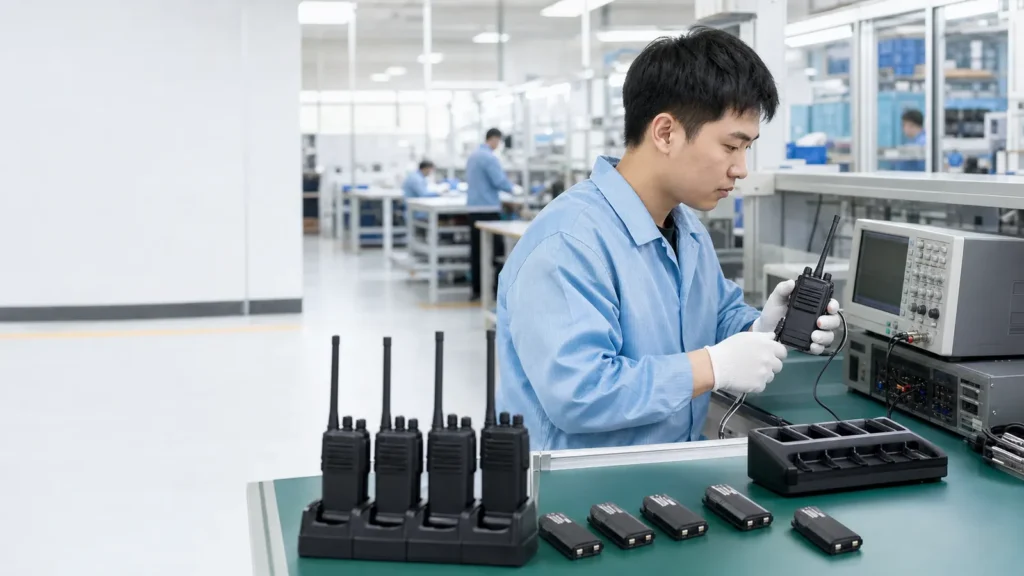
CE, RoHS & PSE Certification for Walkie Talkie Imports
Short answer: EU and UK buyers need CE (or UKCA) marking plus RoHS compliance documentation, while Japan requires PSE certification for certain electrical components and radio-type approval from Japan’s regulator. Always request the actual test report and certificate number, not just a logo on a product page.
Importing walkie talkies into a new market involves more than choosing the right radio type. Customs authorities and market surveillance bodies in the EU, UK and Japan can hold, fine, or reject non-compliant shipments. This guide explains what distributors and importers should verify before placing an order.
CE Marking for the European Union
CE marking indicates a product meets EU health, safety and environmental protection standards. For radio equipment, this typically falls under the Radio Equipment Directive (RED), covering RF performance, electromagnetic compatibility (EMC) and electrical safety. A genuine CE-marked radio should have a Declaration of Conformity (DoC) referencing the specific test standards applied, issued by the manufacturer or an accredited test lab.
UKCA Marking for the United Kingdom
Since the UK’s exit from the EU, many products sold in Great Britain require UKCA marking in addition to, or in some transition cases instead of, CE marking. Requirements closely mirror the EU’s RED requirements, but importers should confirm current UKCA rules for radio equipment, as transition timelines have changed over time.
RoHS Compliance
RoHS (Restriction of Hazardous Substances) limits the use of substances like lead, mercury and certain flame retardants in electronic products. Both the EU and UK require RoHS compliance for electronics, including two-way radios. Ask your supplier for a RoHS test report from an accredited lab, not just a written statement of compliance.
PSE Certification for Japan
Japan’s PSE (Product Safety Electrical Appliance and Material) mark applies to specified electrical products, including certain components used in radios, such as battery chargers. In addition, radio transmitters generally require type approval (technical conformity certification) from Japan’s regulatory authority before they can be legally sold or used, separate from the PSE mark itself. Importers should confirm both PSE status for electrical components and radio type approval status for the transmitter itself.
Documents to Request From Your Supplier
- Declaration of Conformity (DoC) for CE or UKCA, listing applicable standards
- Test reports from an accredited, named laboratory, including report number
- RoHS test report covering restricted substances
- PSE certification or type approval documentation for Japan-bound shipments
- Product photos showing marking placement on the actual unit and packaging
Common Certification Mistakes
- Accepting a logo without documentation: A CE or PSE logo on a product photo is not proof of compliance without a matching certificate and test report.
- Assuming one certificate covers all models: Certification is typically tied to a specific model and its exact specifications, not an entire product line.
- Not checking frequency band compliance: A radio certified for one region’s frequency allocation may not be legal to use in another region, even with CE marking.
- Ignoring packaging and labeling rules: Some markets also require specific labeling, language and recycling symbols on packaging.
Certification Requirements in Other Markets
CE, UKCA, RoHS and PSE cover Europe, the UK and Japan. Importers selling elsewhere will meet different schemes, and each applies to a specific model and configuration. The overview below is general; confirm current requirements with the regulator, a test laboratory or a local compliance consultant.
| Market | Main scheme for radios | What it involves | Typical mark or identifier |
|---|---|---|---|
| United States | FCC equipment authorization | Radio transmitters are usually certified through a recognised certification body; licensed business radios must also meet Part 90 technical rules | FCC ID on the label |
| Canada | ISED certification | Radio equipment must be certified to the relevant RSS standards and listed with ISED | IC certification number on the label |
| Australia and New Zealand | RCM compliance framework | The local supplier must be registered and hold evidence that the product meets applicable radio, EMC and safety standards | RCM mark |
| Other markets | National type approval | Many countries run their own approval process, sometimes requiring local testing or a local representative | Varies by country |
A certificate for one market rarely transfers directly to another, although test reports can sometimes be reused as supporting evidence. U.S. buyers can find more detail in our FCC certification vs Part 90 guide. Certification support from any manufacturer depends on the selected model and destination market.
Who is responsible for compliance?
In most markets, legal responsibility sits with the company that places the product on the market, which is often the importer or brand owner rather than the overseas factory. That company must hold, or be able to obtain, the technical documentation and answer questions from customs or market surveillance authorities. Before signing a supply agreement, agree in writing which documents the manufacturer will provide, which tests you will arrange locally and who pays if extra testing is needed for a market version. Our guide to choosing a manufacturer in China includes questions to ask about documentation.
Battery Transport Documents
Walkie talkies are almost always shipped with lithium-ion batteries, which are regulated as dangerous goods in transport. Product certifications such as CE do not cover this, so importers need a separate set of documents.
- UN38.3 test summary: shows the battery passed the UN Manual of Tests and Criteria, section 38.3, covering altitude, thermal, vibration, shock, short circuit and other tests.
- Safety data sheet (SDS or MSDS): describes the battery’s hazards, handling and emergency measures; forwarders commonly request it.
- Packing and labelling information: batteries shipped inside equipment, packed with equipment or shipped alone fall under different rules.
- Transport assessment or declaration: some forwarders and airlines ask for an additional report confirming how the shipment should be classified.
Rules for air freight are generally stricter than for sea freight, and carriers may apply their own requirements. Ask the supplier for battery documents early, before booking freight. Our battery guide for 24/7 shifts also covers storage of spare packs.
Labeling and Manuals Checklist
Many shipments are delayed not because a certificate is missing, but because labels and manuals do not match requirements. Use this checklist when approving artwork, and adapt it to your market.
| Item | What to check | Typical market relevance |
|---|---|---|
| Compliance mark | CE, UKCA, FCC ID, IC number, RCM or PSE shown correctly and at the right size | All markets, depending on scheme |
| Manufacturer details | Name and contact address on product, packaging or accompanying document | EU, UK and many other markets |
| Importer details | Importer name and address where required | EU and UK |
| Model and serial or batch number | Matches the certificate and test reports exactly | All markets |
| WEEE symbol | Crossed-out wheeled bin on product or packaging | EU and UK |
| Radio information in manual | Frequency bands and maximum transmit power stated | Required under EU radio equipment rules; good practice elsewhere |
| Declaration of Conformity | Full or simplified DoC included or referenced | EU and UK |
| Language | Manual and safety information in the official language(s) of the destination market | Most markets |
| Battery markings | Chemistry, capacity, voltage and recycling marks | Most markets |
| Usage restrictions | Notes on licensing or restricted frequencies where applicable | Markets with licensing requirements |
As part of private-label projects, manuals and labels are often customised. Our private label buyer’s checklist shows how to plan artwork approval alongside compliance.
How to Verify a Certificate
Unfortunately, some certificates sent to buyers are outdated, belong to a different model or were never valid. A few checks take minutes and can prevent customs holds or market withdrawals.
- Match the model: the model number and manufacturer name on the certificate must match the product you are buying, not a similar or older model.
- Check the issuer: look up the laboratory or certification body and confirm it is recognised for that scheme.
- Search public databases: FCC IDs can be searched in the FCC equipment authorization database, and ISED keeps a public radio equipment list.
- Read the scope: confirm which standards and frequency bands were tested, and that they match your market version.
- Ask for the test reports: a certificate without supporting reports is weak evidence.
- Understand self-declaration: in the EU, the manufacturer issues the Declaration of Conformity; a test-lab “CE certificate” alone is not the DoC.
- Check dates and revisions: standards are updated, so older documents may no longer be sufficient.
If documents cannot be verified, request clarification before placing the order, or arrange your own testing on samples.
Certification FAQs
Is CE marking enough to sell radios in the EU?
CE marking under the Radio Equipment Directive is required, along with RoHS compliance. Depending on the product and market, additional local registration may also apply.
Do I need both CE and UKCA marking?
If selling in both the EU and Great Britain, you generally need both markings, since UKCA replaced CE requirements for the GB market following the UK’s exit from the EU.
What does PSE certification cover?
PSE certification in Japan applies to specified electrical products and components. Radio transmitters typically also require separate type approval from Japan’s telecommunications regulator.
Can a manufacturer provide certification for a custom OEM radio?
Yes, but certification testing is tied to the exact specification. Significant design changes to a certified model may require re-testing before certification remains valid.
Do walkie talkies need FCC certification to be sold in the United States?
Radio transmitters sold in the U.S. generally need FCC equipment authorization, shown by an FCC ID on the label. Licensed business radios must also meet Part 90 technical rules. Requirements apply to the exact model and configuration, so confirm the FCC ID and scope with the manufacturer before ordering.
Is UN38.3 the same as product certification?
No. UN38.3 is a transport test for lithium batteries, required to ship them safely by air, sea or road. Product schemes such as CE, FCC or RCM cover radio performance, EMC and safety. Importers usually need both, along with a safety data sheet for the battery.
How can I check if a walkie talkie certificate is genuine?
Confirm the model and manufacturer match exactly, check that the issuing body is recognised, and search public databases such as the FCC equipment authorization system or ISED’s radio equipment list. Ask for full test reports, check dates and scope, and remember that in the EU the manufacturer issues the Declaration of Conformity.
Request Certified Radio Options for Your Market
To confirm which certifications apply to your target market, please tell us:
- Target country or region
- Radio model or specification of interest
- Required certifications (CE, UKCA, RoHS, PSE, or others)
- Target order quantity and timeline
We can provide certified product options and the relevant compliance documentation for your market.
Related Guides
Equipping a warehouse or logistics team?
Share your site size, shift pattern and number of users. We will recommend radios, accessories and multi-unit charging for round-the-clock use.
Get a Quote →Radios for Warehouses & Logistics