
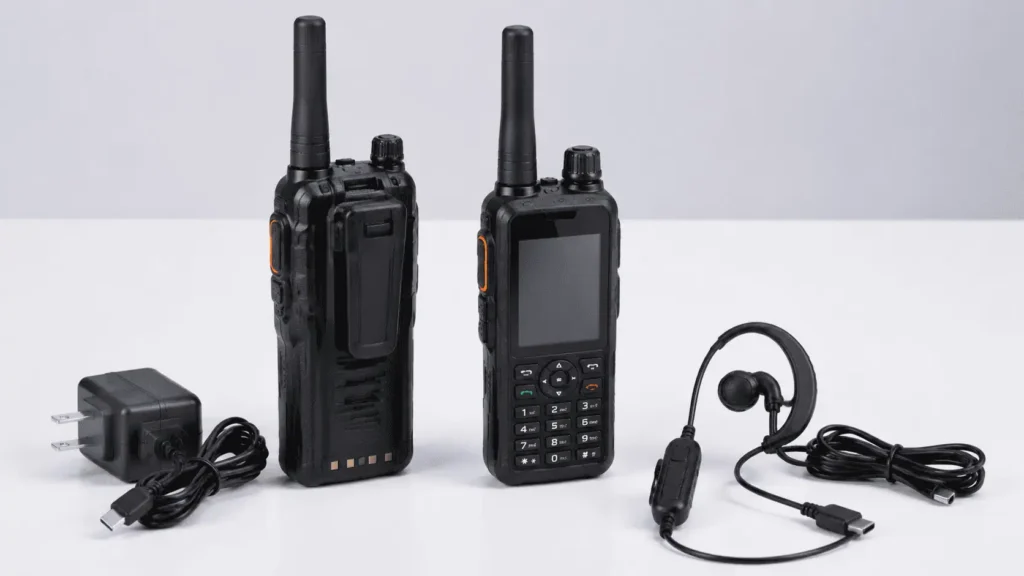
Walkie Talkies vs PTT Apps: Total Cost of Ownership
Short answer: Smartphone push-to-talk apps look cheaper upfront because there is no radio hardware to buy, but ongoing data plans, device replacement cycles, battery limitations and reliability gaps often make traditional or PoC two-way radios more cost-effective for teams over 10 to 15 users within one to two years.
Many businesses evaluating team communication compare two very different approaches: dedicated two-way radios (analog, DMR or PoC) versus smartphone push-to-talk apps like Zello or similar services running on phones the team already carries. Both can work, but the total cost and reliability picture looks very different once you account for more than just the sticker price.
This guide breaks down the real cost and performance differences so operations managers and procurement teams can make an informed decision.
Upfront Cost Comparison
- PTT apps: Little or no hardware cost if staff already have smartphones, but a per-user monthly or annual app subscription is usually required for business features.
- Traditional two-way radios: A one-time hardware cost per unit, with no ongoing subscription fee for basic analog or DMR radios.
- PoC radios: Hardware cost similar to or slightly above standard radios, plus a data plan, but often positioned between the two other options for wide-area coverage needs.
Ongoing Cost Differences
Data and Subscription Fees
PTT apps and PoC radios both require an ongoing data connection, which means either a cellular data plan or Wi-Fi dependency per device. Over several years, this recurring cost can exceed the one-time cost of a basic radio.
Device Replacement Cycles
Consumer smartphones are typically replaced every 2 to 3 years and are not built for industrial use. Rugged two-way radios are designed for 5 or more years of daily commercial use, reducing replacement frequency.
Battery Life Under Real Use
A smartphone running a PTT app, GPS and other business apps simultaneously drains battery far faster than a dedicated radio, often requiring mid-shift charging that a purpose-built radio does not need.
Reliability and Coverage Differences
PTT apps and PoC radios depend entirely on cellular or Wi-Fi network availability. In basements, remote sites, rural areas or during network outages, this connection can fail completely. Traditional analog and DMR radios communicate directly, device to device or through a private repeater, independent of public cellular networks, making them more reliable in areas with poor or no cell coverage.
When PTT Apps Make Sense
PTT apps can be a reasonable choice for small teams, short-term projects, or organizations spread across wide geographic areas with reliable cell coverage where hardware procurement is not practical. They also make sense when staff already carry company smartphones for other purposes.
When Two-Way Radios Make More Sense
- Teams working in basements, warehouses, rural sites or areas with weak cell coverage
- Operations where instant, zero-delay communication is critical, such as security or manufacturing floors
- Teams of 10 or more users, where per-user subscription costs add up quickly
- Environments where rugged, drop-proof, weatherproof hardware is required
- Situations requiring dedicated emergency channels independent of a phone network
How to Calculate Your Real Total Cost of Ownership
- Estimate hardware cost per user for radios versus current or planned smartphone cost
- Add subscription or data plan costs over a 3 to 5 year period for PTT or PoC options
- Factor in expected device replacement cycles for each option
- Account for the cost of communication failure during a network outage or coverage gap
- Include accessory and maintenance costs on both sides of the comparison
Ready to source? See our rugged LTE walkie talkies page for models, OEM options and quotation details.
Three-Year TCO Worksheet
Comparing walkie talkies with push-to-talk apps on phones is only fair when both options are measured over the same period and with the same line items. The worksheet below lists what to include over a typical three-year planning horizon. Fill in your own quotes; prices vary widely by model, country, carrier and fleet size.
| Cost line | Walkie talkies (analog/DMR) | PoC radios | PTT app on smartphones |
|---|---|---|---|
| Devices | Radios for every user plus spares | PoC radios plus spares | Rugged or standard phones plus spares |
| Accessories | Batteries, multi-unit chargers, earpieces, speaker mics, holsters | Batteries, chargers, audio accessories | Cases, screen protectors, Bluetooth or wired PTT accessories |
| Infrastructure | Repeaters, antennas, installation where needed | Usually none | Usually none |
| Licences | Radio licences where required by the market | Usually none for the user | Usually none for the user |
| Recurring service | Low; licence renewals if applicable | SIM data plan and PoC platform subscription per user | Data plan and app subscription per user |
| Device management | Programming and channel updates | Platform administration | Mobile device management, app updates, security policies |
| Repairs and replacements | Housing, antenna and battery replacements | Similar to radios, plus SIM management | Screen, charging port and battery replacements; lost devices |
| Downtime | Rare once installed | Depends on mobile coverage | Depends on coverage, app updates and phone battery life |
| Training and rollout | Short training | Short training plus platform setup | App setup, login management and user training |
| End of life | Resale or recycling | Resale or recycling | Data wiping and recycling |
Add up each column for year one, then for years two and three. Radios usually carry more of their cost upfront, while app-based options shift more cost into recurring fees and device replacement. Our guide to PoC radio costs lists questions to ask about platform and SIM charges.
Hidden costs deserve a line of their own. Staff time spent charging phones, resetting app logins or chasing lost devices rarely appears in a quote but adds up across a large fleet. Include an estimate for these, and for the cost of a communication failure during an incident, when comparing options.
Rugged Phones vs Radios: Durability in Practice
Durability is where the two options often separate on industrial sites. A rugged phone and a rugged radio may share similar IP ratings, but they are built for different use patterns.
| Factor | Rugged radio | Rugged smartphone |
|---|---|---|
| Screen | Small or no screen; less to break | Large touchscreen that can crack and is harder to use with gloves |
| Controls | Large PTT button, rotary knobs, usable with gloves | Touch interface; a physical PTT key on some models only |
| Battery | Designed for full shifts of radio use; swappable on most models | Shared with apps, screen and data; often not swappable |
| Audio | Loud speaker designed for noisy areas | Depends on model; many need an external accessory |
| Replacement cycle | Often used for several years | Operating system support and battery ageing may shorten life |
| Loss and theft risk | Lower resale appeal | Higher resale appeal |
For users who need data apps, scanning or photos, a rugged phone can replace several devices. For users who only need fast voice, a radio is usually simpler and more robust. Site trials with samples show the difference quickly, especially on construction sites and in noisy plants.
Hybrid Setups: Radio Plus PoC Gateway
Many organisations do not choose one option. A hybrid setup keeps radios for on-site teams and adds PoC radios or phone apps for staff who travel, linked through a gateway.
- Site radios: analog or DMR radios handle fast, local communication on the shop floor, yard or venue.
- PoC for mobile users: drivers, managers and remote technicians use PoC radios or an approved app.
- Gateway or bridge: a gateway connects a radio channel or talk group to a PoC group, so both sides hear each other. Support depends on the platform and radio models.
- Dispatch: a dispatcher can often manage both groups from one console, depending on the platform.
Hybrid systems protect previous radio investment while extending coverage. They do add complexity, so plan who administers the gateway and test audio delay across both networks before rollout. Our PoC vs traditional radio comparison explains how each network behaves.
A pilot with one team on each side of the gateway is the simplest way to find problems early. Record call delays, missed calls and battery performance for at least a few full shifts before extending the setup to the whole fleet.
Decision Checklist
Use these questions to narrow the choice before requesting quotes:
- Do most users stay on one site, or do they travel between sites and cities?
- Is mobile coverage reliable in every area where people work, including basements, cold stores and steel buildings?
- Do users need data apps, or only voice?
- Do users wear gloves or work in high-noise areas?
- How much budget is available upfront, and how much for monthly fees?
- Are licences required and practical for radios in your market?
- Who will manage devices, apps, SIMs or programming internally?
- What happens if a device is lost, and how quickly must it be replaced?
- Will you need radios and PoC users to talk to each other now or later?
If your answers are mixed, a hybrid system or a staged rollout is often the practical result. You can contact our team with your user groups and site details to discuss radio and PoC options.
Comparison FAQs
Are PTT apps cheaper than walkie talkies?
Often only in the first year. Ongoing subscription and data costs, plus more frequent smartphone replacement, can make PTT apps more expensive than radios over a multi-year period, especially for larger teams.
Do walkie talkies work without cell service?
Yes. Traditional analog and DMR radios communicate directly or through a private repeater and do not depend on cellular networks, unlike PTT apps and PoC radios.
Can a business use both radios and PTT apps together?
Yes. Some organizations use radios for on-site teams and PTT apps or PoC radios for staff who travel between multiple sites or regions.
Which option is more reliable in an emergency?
Traditional radios with a dedicated emergency channel are generally considered more reliable during emergencies, since they do not depend on cellular network availability or capacity.
What should a three-year TCO comparison include?
Include devices and spares, accessories, infrastructure, licences, recurring SIM and subscription fees, device management, repairs, replacements, downtime, training and end-of-life costs. Apply the same fleet size and period to each option. Radios usually cost more upfront, while app-based solutions shift more cost into monthly fees and device replacement.
Are rugged smartphones as durable as walkie talkies?
Rugged phones can share similar IP ratings, but their large touchscreens, shared batteries and shorter software support cycles often mean more repairs and earlier replacement. Radios are simpler, with physical controls usable with gloves and loud audio for noisy areas. Test both in your real site conditions before deciding.
Can walkie talkies and PoC users talk to each other?
Yes, in many cases, through a gateway or bridge that links a radio channel or talk group with a PoC group. Support depends on the PoC platform and the radio models used. Plan who manages the gateway, and test audio delay and reliability across both networks before a full rollout.
Request a Communication System Comparison
To get a tailored cost and reliability comparison, please tell us:
- Team size and typical work environment
- Current communication method and any known pain points
- Coverage area and any known weak cell signal locations
- Budget range and expected usage timeline
We can recommend a suitable radio solution and provide a cost comparison against your current setup.
Related Guides
Planning a PoC or 4G radio fleet?
Tell us the countries, network needs and fleet size. We will recommend suitable PoC/LTE models, explain platform options and arrange samples for testing before you order.
Get a Quote →View PoC & 4G Radios