
A walkie talkie exporter in China turns your specification into a shipped order through a predictable sequence: quotation, sample approval, frequency and compliance checks, production, inspection, lithium battery shipping documents and final delivery under an agreed Incoterm. Knowing each step helps importers compare walkie talkie factories fairly, avoid customs delays and plan cash flow. This guide explains what happens at each stage, which documents to expect and which details you should confirm before paying a deposit.
What a Walkie Talkie Exporter Actually Does
An exporter is responsible for more than making radios. It must translate your market requirements into a buildable specification, programme frequencies that are legal in your country, prepare commercial and technical documents, pack lithium batteries correctly and hand the goods to a forwarder or carrier.
Some exporters are the factory itself; others are trading companies that buy from factories. Both models can work, but they differ in engineering control and traceability. Our article on two-way radio manufacturers vs trading companies explains how to tell them apart.
The Export Order Process Step by Step
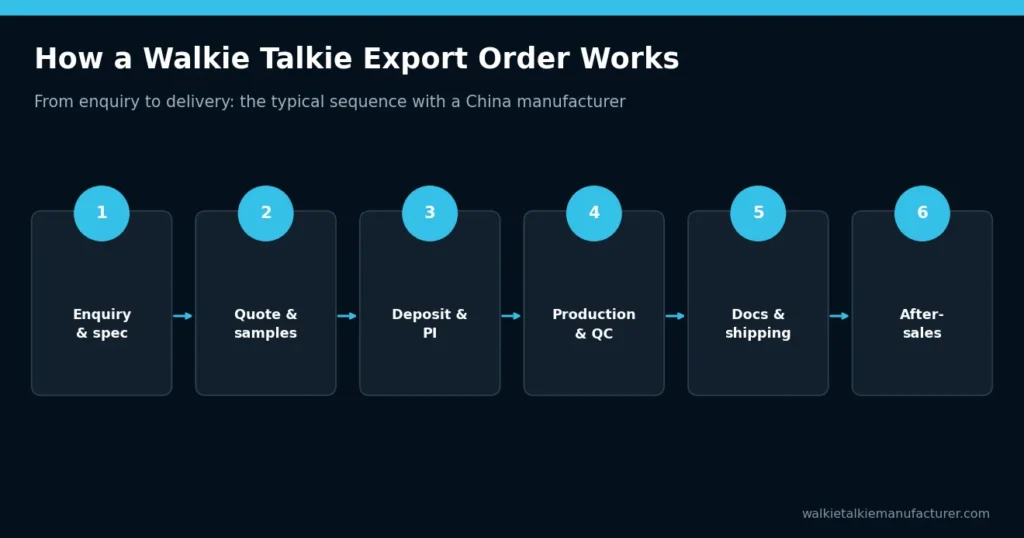
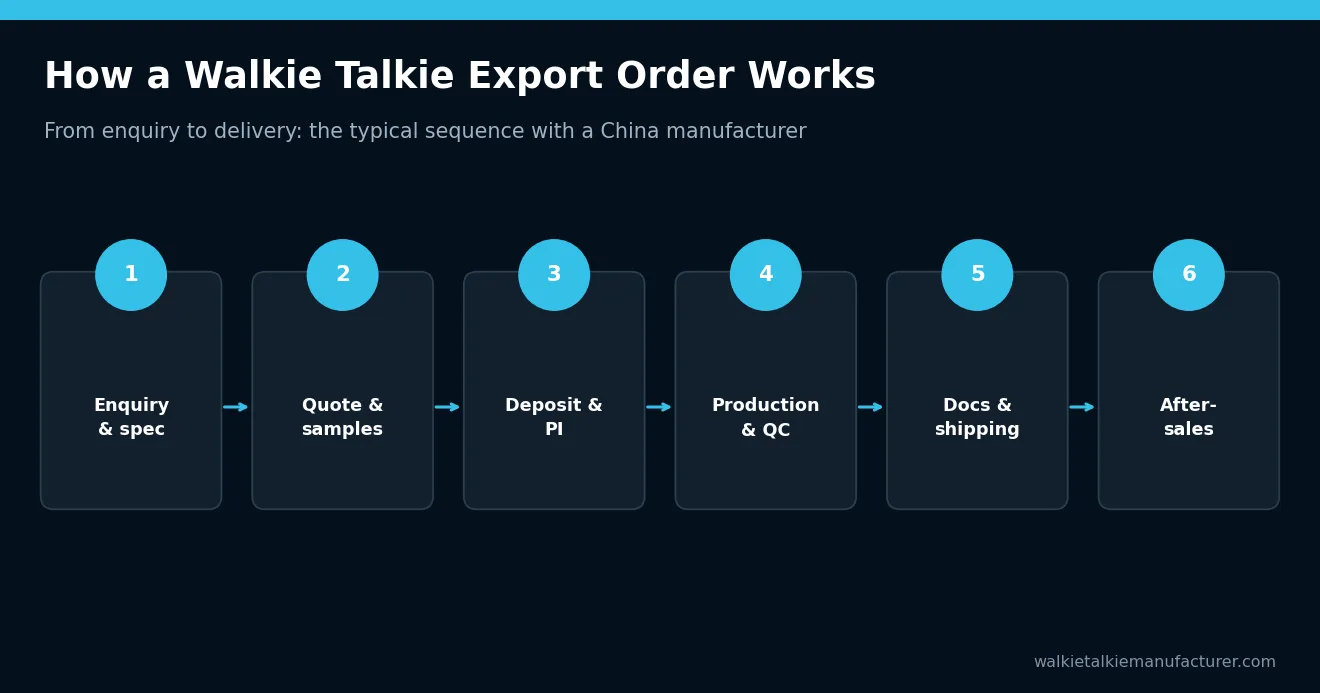
Most walkie talkie export orders follow a sequence similar to this:
- Enquiry and specification: technology, band, quantity, accessories and branding.
- Quotation: unit price basis, Incoterm, payment terms and validity period.
- Samples: programmed to your band for testing and approval.
- Proforma invoice and deposit: confirms the approved specification.
- Production: components, SMT, assembly, programming and testing.
- Inspection: in-house QC and, if you choose, third-party inspection.
- Balance payment and shipping: documents released, goods dispatched.
- After-sales: spare parts, firmware support and claims handling.
Sample testing deserves its own plan. Use our guide to testing walkie talkie samples before a bulk order to check audio, range in your environment, battery behaviour and programming.
Frequencies, Compliance and Market Documents
Radios must be configured for the destination market. A model sold as license-free in one region may be illegal in another, and professional business radios usually require licensing. A capable walkie talkie exporter will ask where the radios will be used before quoting.
| Market example | Typical requirement | Ask the exporter for |
|---|---|---|
| United States | FCC equipment authorisation; licensing for business radios | Test reports and labelling for the selected model |
| European Union | CE marking under the Radio Equipment Directive, RoHS | Declaration of Conformity and test reports |
| Other markets | National type approval may apply | Which documents exist and who applies |
| Any market with lithium batteries | UN38.3 test summary, safety data sheet | Battery documents matching the shipped cell |
Support for these documents depends on the selected model and destination market. Confirm in writing which documents already exist and which would need new testing before you place the order.
Firmware settings deserve the same care. Some markets restrict certain features, such as transmit power levels, channel spacing or encryption, so ask the exporter to lock settings that end users should not change and to keep a copy of the approved programming file for repeat orders.
Incoterms and Who Pays for What
The Incoterm decides where responsibility and cost pass from exporter to buyer. Choose it deliberately, because it changes your landed cost and your control over the forwarder.
| Incoterm | Exporter handles | Buyer handles |
|---|---|---|
| EXW | Goods ready at factory | Export clearance, freight, import |
| FOB | Export clearance, delivery to port | Ocean freight, insurance, import |
| CIF | Freight and minimum insurance to port | Import clearance, duties, delivery |
| DDP | Almost everything to your door | Receiving goods; check tax registration |
FOB is common for experienced importers with their own forwarder. DDP looks simple but can hide freight margins and may not suit every country’s import rules.
Shipping Batteries and Customs Classification
Walkie talkies ship with lithium-ion batteries, so they are treated as dangerous goods in transport. Batteries packed with or inside equipment are usually shipped under UN3481, and carriers ask for a UN38.3 test summary and packing that meets their rules. Air freight is stricter than sea freight, and some airlines limit battery shipments.
Customs classification also needs attention. Two-way radios are commonly classified under HS heading 8525 or 8517 depending on the product and local interpretation, so confirm the code with your customs broker before shipping.
For a detailed list of documents and carrier questions, read our checklist for shipping walkie talkies from China.
Export Packaging, Labels and Carton Marks
Export cartons travel through several warehouses, ports and trucks before reaching you, so packaging should be agreed as part of the order rather than left to the factory’s default. Confirm the retail box design, the number of radios per master carton, carton dimensions and gross weight, because these figures drive freight cost and pallet planning.
Ask for shipping marks that include your order number, carton number and destination, and check whether your market needs specific labels on the product or box, such as regulatory markings, recycling symbols or importer details. Lithium battery handling labels may be required depending on how batteries are packed.
- Approve box artwork and label files before mass production.
- Request photos of a packed master carton for your records.
- Keep a copy of the packing list with serial number ranges if available.
Payment Terms and Risk Control
Payment terms for export orders are usually a deposit before production and a balance before shipment, although letters of credit and other structures are possible for larger buyers. Whatever structure you agree, link each payment to a clear milestone.
- Tie the deposit to an approved sample and a signed specification sheet.
- Tie the balance to an inspection report or photos of packed cartons.
- List accessories, manuals and packaging in the proforma invoice, not only radios.
- Agree how defective units found after arrival will be handled.
- Pay only to the company bank account named in the contract.
If this is your first order, our guide on negotiating a walkie talkie supply contract covers clauses buyers often miss.
How to Evaluate Walkie Talkie Factories as Exporters
When comparing walkie talkie factories, look beyond the price. Ask how many export markets they already serve, whether their engineers can adjust firmware and channel programming, and how they document RF testing. Request example shipping documents with sensitive details removed, and check that battery paperwork matches the cells actually used.
Communication matters too. An exporter that replies clearly on specifications, confirms assumptions in writing and flags compliance limits early is usually easier to work with over several years than one that promises everything.
Red flags
- Claims that one model is legal in every country.
- No willingness to programme and ship a sample to your band.
- Vague answers about battery documents or lithium packing.
- Pressure to pay a personal or third-party account.
What to Send When Requesting a Quote
To receive a comparable export quotation, send:
- Destination country and intended users
- Technology: analog, DMR, PoC/4G or a mix
- Frequency band or licence information
- Estimated quantity and delivery schedule
- Accessories, spare batteries and chargers
- Branding, packaging and manual language
- Preferred Incoterm and destination port or address
Browse our two-way radio product range, then send your details through the contact page. We will confirm available documents, sample options and shipping arrangements for your market.
Related Guides
Equipping a warehouse or logistics team?
Share your site size, shift pattern and number of users. We will recommend radios, accessories and multi-unit charging for round-the-clock use.
Get a Quote →Radios for Warehouses & LogisticsFrequently Asked Questions
How do I import walkie talkies from China?
Define the radio type, band and quantity, request quotations, approve programmed samples, sign a proforma invoice and pay the deposit. After production and inspection, pay the balance and ship under your chosen Incoterm. Confirm local licensing, compliance documents and customs classification with your broker before the goods leave the factory.
Can a Chinese exporter programme radios for my country?
Yes, most manufacturers can programme frequencies, channels and privacy codes before shipping, provided you share the legal band and licence details. Whether a model can be sold in your market also depends on its equipment approval, so confirm which compliance documents exist for the selected model and destination.
Why do walkie talkie shipments need battery documents?
Lithium-ion batteries are regulated as dangerous goods in transport. Carriers usually require a UN38.3 test summary, a safety data sheet and correct packing and labelling. Missing or mismatched documents can lead to rejected bookings, delays or extra costs, especially for air freight.
Which Incoterm is best for buying walkie talkies?
It depends on your experience and forwarder. FOB gives you control of freight with a forwarder you trust, while CIF or DDP shift more work to the exporter. Compare landed cost rather than unit price, and check who handles import clearance and duties under each option.
How long does a walkie talkie export order take?
Timing depends on model availability, customisation, sample approval, component supply and shipping method. Branded or custom firmware orders usually take longer than standard models. Ask the manufacturer for a schedule broken into sample, production, inspection and shipping stages, and confirm it in the contract.
Get a Factory Recommendation & Quote
Tell us your product type, quantity, target country, application, coverage, frequency or network and OEM requirements. We will review suitable options, MOQ factors, estimated lead time and the next sample step.
Prefer a direct conversation? Email lorabanzhitao@gmail.com or message WhatsApp +86 173 1689 5054.