
Analog walkie talkies are still the right choice in 2026 for many single-site teams that need simple, low-cost, instant voice with no monthly fees. Professional analog radios work with most existing fleets, are easy to program and are forgiving for new users. They are less suitable when you need encryption, GPS, text messaging or wide-area coverage. This guide explains where analog fits, where digital or PoC is better, and what to define before ordering.
What ’Analog’ Means in a Modern Two-Way Radio
An analog radio sends your voice as a continuous frequency-modulated (FM) signal. There is no digital encoding step, so audio simply fades and gets noisier as the signal weakens. Digital radios such as DMR convert voice into data, which usually sounds cleaner until the signal drops below a threshold, then cuts out.
Most professional analog radios sold today are not old designs. They use modern chipsets, lithium-ion batteries, rugged housings and PC programming software. The difference is the air interface, not the build quality. Many current DMR radios also include an analog mode, which is why analog remains the common language between fleets of different ages and brands.
For a full comparison of the three main technologies, see our DMR vs analog vs PoC walkie talkie guide.
Where Analog Walkie Talkies Still Make Sense
Analog is strongest where the job is simple: short messages between a small group of people on one site. The table below lists typical scenarios where buyers still choose analog.
| Scenario | Why analog fits | What to watch |
|---|---|---|
| Small retail or restaurant teams | Simple operation, low unit cost, no subscription | Channel crowding in busy shopping areas |
| Single-site warehouses | Easy to add radios, works with existing units | Coverage in racking and cold rooms |
| Events with rental fleets | Staff learn it in minutes; mixed brands can share channels | Frequency coordination with other users |
| Mixed legacy fleets | Talks to older analog radios and DMR radios in analog mode | Matching CTCSS/DCS codes and bandwidth |
| Budget-sensitive distributors | Wide market, fast turnover, simple after-sales | Local licensing rules for the band |
If most users only need push-to-talk voice and stay within one building or site, analog often gives the lowest total cost of ownership.
Analog also suits buyers who value simplicity in after-sales support. Programming is straightforward, spare parts are widely understood by local repair shops, and there are no talk group IDs, encryption keys or platform accounts to manage. For a distributor serving many small customers, that can mean fewer support calls per radio sold.
Analog vs DMR vs PoC at a Glance
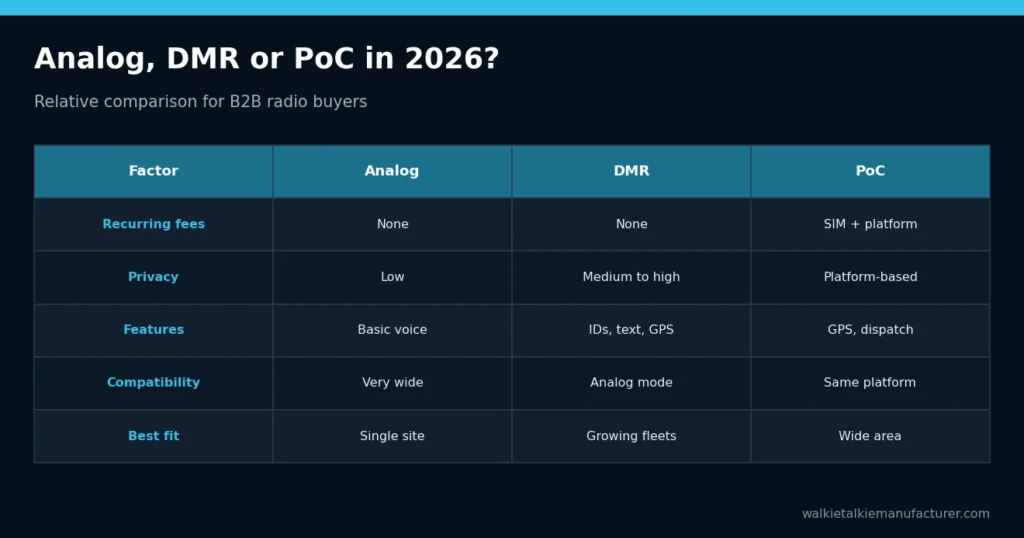
The right choice depends on coverage area, features and budget. This summary uses relative terms because real performance depends on model, antenna, terrain and local conditions.
| Factor | Analog | DMR | PoC (4G/LTE) |
|---|---|---|---|
| Voice at weak signal | Noisy but often still readable | Clear until it drops out | Depends on cellular data |
| Features | Basic voice, scan, signalling | IDs, text, GPS, private calls | GPS, dispatch, groups, apps |
| Privacy | Easy to monitor | Basic privacy; encryption optional | Depends on platform |
| Recurring cost | None besides license where needed | None besides license where needed | SIM data and platform fees |
| Coverage | Radio range, repeaters extend it | Radio range, repeaters extend it | Wherever the carrier has coverage |
| Compatibility | Very wide | Analog mode on most models | Same platform only |
Teams that need wide-area coverage without building repeaters usually look at PoC radios instead.
Limitations to Plan Around
Analog is not the best option for every project. Be honest with end users about these limits before they choose it:
- No real privacy: anyone with a scanner on the same frequency can listen. CTCSS and DCS codes only mute unwanted traffic; they do not encrypt.
- Fewer features: no text messaging, individual IDs or GPS reporting without add-on signalling.
- Spectrum efficiency: one conversation per channel, while DMR two-slot TDMA carries two on one 12.5 kHz channel.
- Regulatory changes: some regions have moved business users to narrowband channels, and digital is increasingly preferred for new licenses.
- Audio at the edge: noise rises gradually, which some users prefer and others find tiring on loud sites.
None of these limits is a problem for a team that only needs clear voice on one site. They become important when the customer mentions security staff, confidential information, lone workers or several buildings. In those cases, present DMR or PoC alongside analog so the end user can compare features and running costs before committing.
What Professional Analog Radios Should Include
A professional analog radio should be clearly different from a consumer toy. When comparing samples, check these specifications:
| Specification | Why it matters | Typical options |
|---|---|---|
| Frequency band | Must match your license or license-free service | UHF or VHF; confirm exact range |
| Channel bandwidth | Narrowband is required in many markets | 12.5 kHz and/or 25 kHz, programmable |
| Signalling | Reduces unwanted audio, enables basic calling | CTCSS, DCS, DTMF, 2-tone/5-tone on some models |
| Ingress protection | Dust and water resistance for field use | Depends on model; ask for the tested rating |
| Battery and charger | Shift coverage and fleet charging | Li-ion packs, single and multi-unit chargers |
| Accessory connector | Links to speaker mics and earpieces | Common 2-pin or multi-pin types |
Also check the practical details: a clear channel knob, a large PTT button that works with gloves, a loud speaker for noisy areas and a belt clip that does not loosen over time. These features rarely appear in headline specifications, but they decide whether users like the radio.
Accessories matter as much as the radio. Our walkie talkie accessories range covers speaker mics, earpieces, batteries and chargers matched to each connector.
A Practical Migration Path: Analog Now, Digital Later
Many buyers choose analog today but want the option to move to digital later. The simplest route is to buy DMR radios that can run in analog mode. The fleet works on analog channels with older radios, and you switch channels to digital once all users have compatible units.
If budget allows only pure analog radios today, plan for migration anyway. Keep a clear channel plan, record every CTCSS/DCS code, and choose accessories with a connector that is also used on the digital models you might buy later. Our DMR radio manufacturing page explains dual-mode options.
Licensing and Frequency Rules for Analog Radios
Analog does not remove the need for a license. In the US, FRS radios are license-free, GMRS requires a license, and business radios under Part 90 usually need an FCC license. In the EU, PMR446 is license-free with fixed power and antenna limits, while other business channels are licensed nationally.
Rules differ by country and change over time, so confirm them with the local regulator. For a buyer-level overview, read licensed vs license-free walkie talkies. Compliance documents such as FCC or CE RED test reports depend on the selected model and destination market.
What to Send When Requesting a Quote
To get an accurate quotation for professional analog radios, send the following details:
- Destination country and the license or license-free service you will use.
- Frequency band (UHF or VHF) and any fixed frequencies or channel list.
- Number of channels, bandwidth and CTCSS/DCS requirements.
- Working environment: indoor, outdoor, dust, water or noise levels.
- Accessories needed: speaker mics, earpieces, spare batteries, multi-unit chargers.
- OEM needs: logo, housing color, packaging and manual language.
- Whether you want DMR radios with analog mode for future migration.
Send your list through our contact page and we will confirm model options, compliance documents available for your market and sample arrangements.
Related Guides
Need reliable analog radios in volume?
Send your band, channel count and quantity. We will recommend analog models that match your existing fleet and quote OEM options.
Get a Quote →View Analog RadiosFrequently Asked Questions
Are analog walkie talkies obsolete in 2026?
No. Analog radios are still widely made and used, especially for single-site teams that need simple voice. Digital and PoC offer more features, but analog remains cost-effective and compatible with many existing fleets. Whether it suits you depends on your coverage needs, privacy requirements and local licensing rules.
Can analog and DMR radios talk to each other?
Yes, if the DMR radios have an analog mode and are programmed with the same frequency, bandwidth and CTCSS or DCS settings. They cannot communicate on digital channels, so mixed fleets usually keep one or more shared analog channels until everyone moves to digital.
Do analog radios have better range than digital radios?
Not by default. Range depends on power, antenna, frequency, terrain and buildings. Analog audio degrades gradually and can stay readable at the edge, while digital audio stays clear longer and then drops. In practice both give similar useful range, so test samples on your actual site.
Are analog radio conversations private?
No. Analog transmissions can be heard by anyone tuned to the same frequency. CTCSS and DCS codes only stop your radio from hearing other users; they do not hide your audio. If privacy is important, consider DMR with encryption or a PoC platform with secure accounts.
What is a professional analog radio?
It is a business-grade analog two-way radio with a rugged housing, programmable channels, narrowband support, signalling options and a proper accessory connector. It is designed for daily shift use and supported with batteries, chargers and programming software, unlike basic consumer radios.
Get a Factory Recommendation & Quote
Tell us your product type, quantity, target country, application, coverage, frequency or network and OEM requirements. We will review suitable options, MOQ factors, estimated lead time and the next sample step.
Prefer a direct conversation? Email lorabanzhitao@gmail.com or message WhatsApp +86 173 1689 5054.