
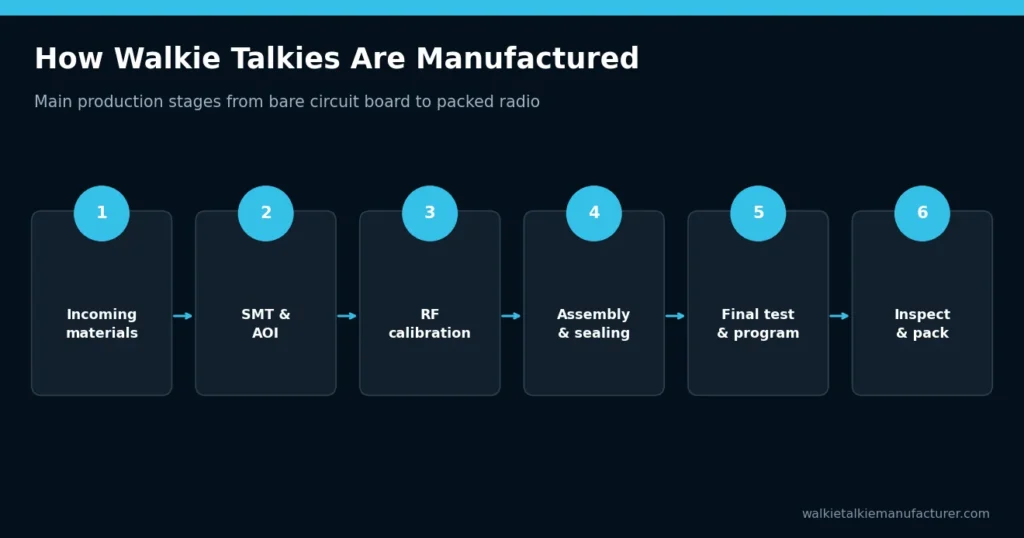
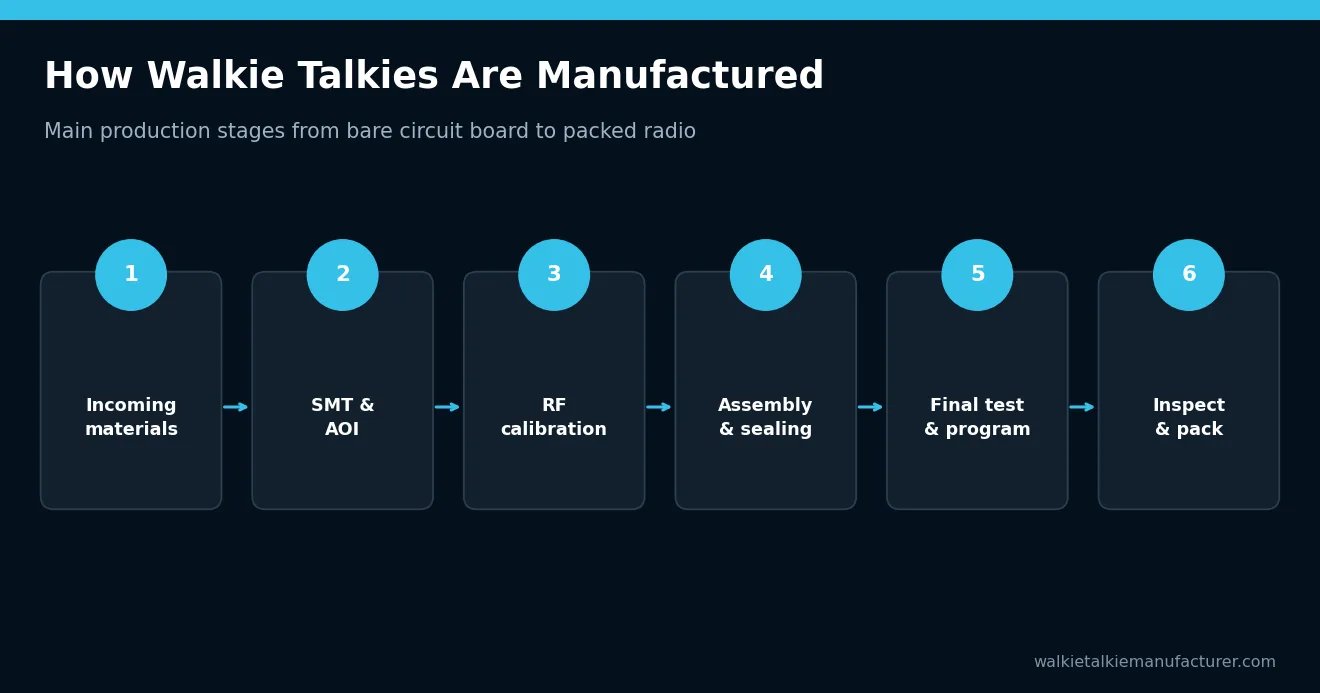
Manufacturing walkie talkies follows a clear path: the circuit board is assembled and inspected, the radio section is calibrated, housings and keypads are produced, everything is assembled and sealed, and each radio is tested, programmed and packed. Understanding how walkie talkies are manufactured helps buyers ask better questions during a walkie talkie factory visit, read inspection reports and spot where quality is built in. This guide walks through each stage, from bare PCB to packed radio.
Overview of the Walkie Talkie Production Line
A two-way radio combines a radio frequency transceiver, audio circuits, a microcontroller, power management, a battery pack and a sealed housing. Each of these parts has its own production and test process before they come together on the final assembly line.
| Stage | Main activities | Typical checks |
|---|---|---|
| Incoming materials | Components, PCBs, plastics, batteries | Sampling inspection, supplier documents |
| PCB assembly (SMT) | Solder paste, placement, reflow | Automated optical inspection |
| Through-hole and hand work | Connectors, larger parts | Visual and solder checks |
| RF calibration | Tuning power, frequency, audio | Test equipment readings logged |
| Housing production | Moulding, painting, printing | Colour, fit and finish |
| Final assembly | Boards, speaker, keypad, seals | Function and leak tests |
| Programming and QC | Firmware, channels, final test | Outgoing inspection |
If you are new to radio components, our article on walkie talkie parts explained describes what each part does.
Incoming Material Control
Quality starts before assembly. Factories check incoming components, printed circuit boards, plastic parts, speakers, microphones and battery cells against approved samples and specifications. Critical items such as RF components and battery cells should come from approved sources, with traceable lot numbers.
For buyers, the key question is whether the factory keeps an approved vendor list and how it handles substitutions. A component change can affect RF performance, battery safety or compliance, so ask to be informed before any significant change is made to your model.
Battery packs
Battery packs are usually assembled from cells, a protection circuit and a housing, either in-house or by a specialist supplier. Checks typically include capacity sampling, protection circuit function, contact dimensions and labelling. Transport documents such as the UN38.3 test summary must match the actual cell and pack design, so a change of battery supplier is a change buyers should hear about.
PCB Assembly: SMT, Reflow and Inspection
The main board is built on a surface-mount technology (SMT) line. The typical sequence is:
- Solder paste is printed onto the bare PCB through a stencil.
- Pick-and-place machines position resistors, capacitors, ICs and RF parts.
- The board passes through a reflow oven to melt and set the solder.
- Automated optical inspection (AOI) checks for missing, shifted or bridged parts.
- Boards with hidden joints may be checked by X-ray where the process requires it.
- Through-hole parts such as some connectors are added by hand or selective soldering.
Boards are then cleaned where needed, labelled with serial or batch numbers, and moved to functional testing. Good traceability allows a factory to link a field failure back to a production batch.
RF Calibration and Board-Level Testing
Radio performance is set during calibration. Each board is connected to test equipment, and software adjusts parameters so the radio meets its design targets across the frequency band.
- Transmit power: set for high and low power levels.
- Frequency accuracy: checked against a reference.
- Modulation or deviation: adjusted for clear audio.
- Receiver sensitivity: confirmed with a calibrated signal.
- Current consumption: checked in standby, receive and transmit.
Digital models also require checks of digital modulation quality and protocol functions. Our DMR radio manufacturing page explains how digital radios are specified for OEM buyers.
Housings, Keypads and Surface Finishing
Housings are usually injection moulded from engineering plastics, sometimes with an internal metal chassis that adds strength and helps with heat dissipation. Rubber keypads and push-to-talk buttons are moulded separately. Private label work happens here: housing colour, logo pad printing or laser marking, and custom keypad printing.
Fit and finish checks include colour matching against the approved sample, gap and flush measurement, and adhesion tests for printed logos. Poor moulding can compromise seals, so housing quality is directly linked to water and dust resistance.
For new private label projects, buyers often approve a colour plaque or first-off sample before production moulding starts. If you want a completely new housing shape, tooling must be designed and made first, which adds cost and time compared with changing only colour and logo on an existing model.
Final Assembly and Sealing
On the final assembly line, operators fit the main board, speaker, microphone, display if present, volume and channel knobs, antenna connector, battery contacts and seals. Screws are tightened to defined torque values, and gaskets or sealing rings are inspected for correct seating.
For rugged models with an IP rating, a sample or every unit may be tested with an air leak tester, which checks pressure loss rather than immersing the radio. Immersion or spray tests may also be carried out on samples according to the model’s design.
Learn what the different ratings mean in our guide to IP65 vs IP67 vs IP68 walkie talkies.
Antennas, belt clips and accessories are usually checked and packed at this stage as well, so the final assembly station is also where missing-part errors are prevented.
Final Testing, Ageing and Programming
After assembly, every radio should pass a functional test: power on, transmit and receive on test channels, audio quality, keypad and knob operation, charging, and indicator lights. Many factories run an ageing or burn-in step, leaving radios powered for a period to reveal early failures.
Radios are then programmed with the customer’s firmware and channel configuration. For export orders, this includes frequencies legal in the destination market, privacy codes, button functions and any locked settings.
| Final test item | Why it matters |
|---|---|
| Transmit and receive on channel | Confirms basic RF function |
| Audio loudness and clarity | Detects speaker or mic faults |
| Keys, knobs and PTT | Confirms controls work |
| Charging and battery contacts | Prevents charging complaints |
| Programming verification | Right channels for your market |
Outgoing Inspection and Packing
Before shipping, finished radios are inspected against the order: quantity, model, colour, logo, accessories, labels and packaging. Many buyers use sampling inspection based on AQL levels, performed by the factory’s quality team or an independent inspector.
If you plan to visit or audit a factory, our walkie talkie factory audit checklist lists what to observe on the SMT line, in RF testing and in the warehouse.
What buyers can request
- Photos or video of your order on the assembly line.
- Sample test records from RF calibration and final testing.
- Serial number lists linked to cartons.
- Golden sample retained by both sides for future comparisons.
What to Send When Requesting a Quote
To discuss an OEM production order, send:
- Radio type and technology: analog, DMR, PoC/4G
- Destination market and frequency band
- Estimated quantity and repeat order plans
- Customisation: housing colour, logo, firmware, packaging
- Quality requirements: inspection level, test records, samples
- Accessories to include in the box
Visit our about page for background on our company, then contact us through the contact page to arrange samples or a factory visit.
Related Guides
Sourcing radios for your brand or distribution business?
We support OEM and private label orders: logo, housing color, packaging, firmware and channel programming. Send your target market and quantities for a quote and samples.
Get a Quote →Browse Our RadiosFrequently Asked Questions
How long does it take to manufacture walkie talkies?
Timing depends on the model, customisation level, component availability and order size. Standard models with minor branding are usually faster than projects with new housings or custom firmware. Ask the manufacturer for a schedule that separates sample approval, material preparation, production, testing and packing, and confirm it in writing.
What is RF calibration in walkie talkie production?
RF calibration is the process of adjusting each radio’s transmit power, frequency accuracy, modulation and receiver performance using test equipment and software. It ensures every radio performs to its design targets across the band. Good factories record calibration results so they can trace problems back to specific units or batches.
Are walkie talkies tested individually?
Most manufacturers test every radio functionally after assembly, including transmit, receive, audio, controls and charging. Waterproof and more detailed tests may be done on every unit or on samples, depending on the model and process. Ask which tests are 100 percent and which are sampled. Test records help you compare batches.
Can I inspect my order before shipment?
Yes. Buyers commonly arrange a pre-shipment inspection by their own staff or a third-party inspection company. The inspection usually checks quantity, appearance, function, programming, labelling and packaging against the approved sample and order specification, using an agreed sampling plan. Agree the inspection criteria before production begins.
Where are most walkie talkies manufactured?
A large share of the world’s two-way radios and accessories are produced in China, alongside other manufacturing locations. Factories range from large brand-owned plants to OEM suppliers producing for multiple brands. Capability varies, so evaluate engineering, testing and quality systems rather than location alone.