
An LTE radio is a push-to-talk handset that carries voice over 4G LTE cellular data instead of over a dedicated radio channel. An LTE walkie talkie feels like a traditional two-way radio: press, talk, release. The difference is that each call travels through a mobile carrier network and a PoC (push-to-talk over cellular) server, so coverage follows the carrier’s network rather than the handset’s antenna. For teams spread across cities, depots or delivery routes, that can replace repeaters with SIM cards and a dispatch platform.
How an LTE Radio Works
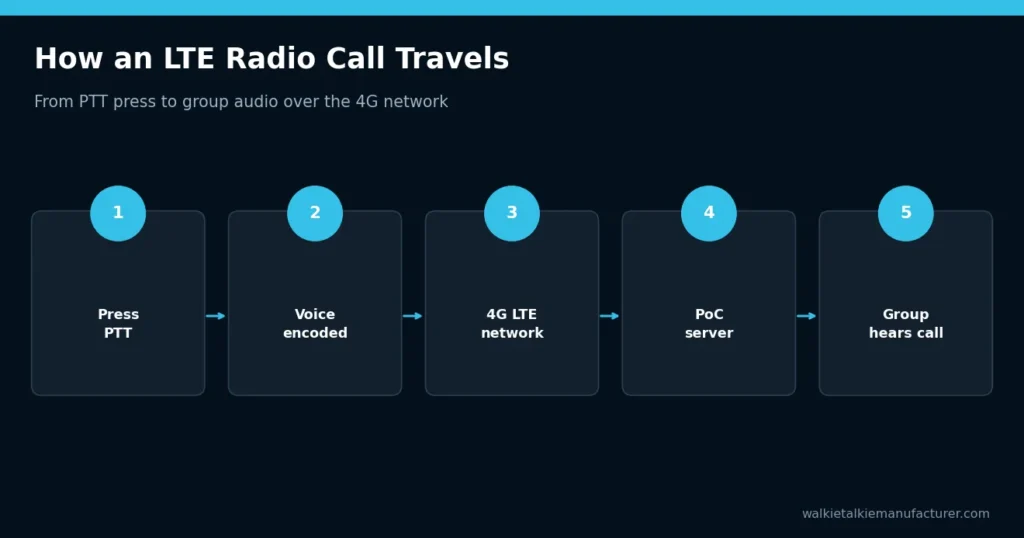
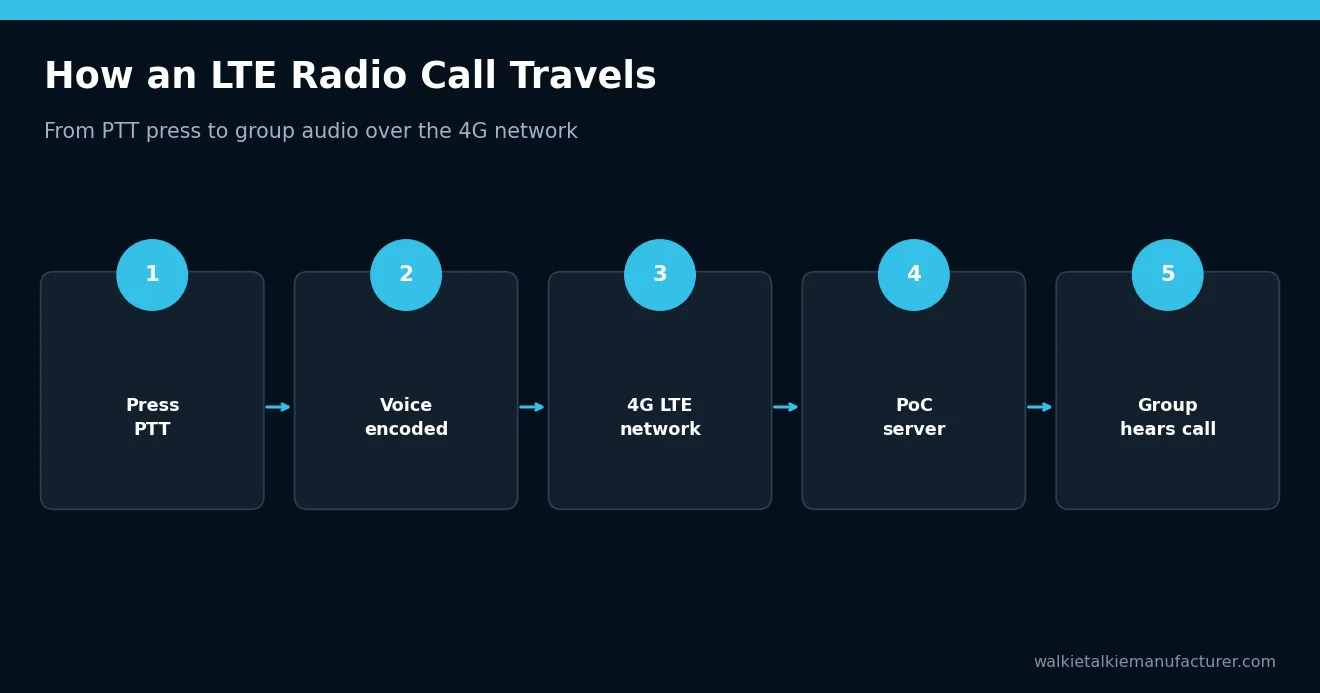
An LTE walkie talkie is essentially a rugged, purpose-built cellular device running a PTT client. When a user presses the PTT button, the radio digitizes the voice, compresses it with a speech codec and sends small data packets over the LTE network to a PoC server. The server looks up which users belong to the selected talk group and forwards the audio to each of them, wherever they are connected.
- The user selects a talk group with the channel knob or menu.
- Pressing PTT requests the floor from the PoC server.
- Voice is encoded and streamed as data over 4G LTE (or Wi-Fi on some models).
- The server relays the audio to every online member of the group.
- Dispatch software can record, monitor and locate users if the platform supports it.
Because the voice path is IP-based, there is no need to coordinate frequencies, and a group can include users in different regions. The trade-off is dependence on mobile coverage, data plans and a server account.
LTE Radio vs Traditional Two-Way Radio
LTE radio communication and conventional analog or DMR radio solve the same problem in different ways. The table summarizes the practical differences buyers usually weigh.
| Factor | LTE / PoC radio | Analog or DMR radio |
|---|---|---|
| Coverage | Follows carrier network | Depends on terrain, antenna and repeaters |
| Infrastructure | SIM cards plus PoC platform | Repeaters, antennas, licensed channels where required |
| Recurring costs | Data plans and platform accounts | Licensing and maintenance, usually no per-user data fee |
| Call setup | Short network delay | Near-instant on a direct channel |
| Works without network | No (unless hybrid model) | Yes, radio-to-radio |
| Extra features | GPS, video, messaging on many models | Varies by model and standard |
For a deeper side-by-side, see our guide on PoC radio vs traditional walkie talkies.
Where LTE Walkie Talkies Fit Best
LTE radios suit organizations whose people move beyond the reach of a single site repeater but stay inside mobile coverage. Common B2B use cases include:
- Logistics and last-mile delivery fleets working across a city or region
- Security companies with guards at several client sites
- Facility and property management teams covering multiple buildings
- Field service and maintenance crews travelling between jobs
- Hospitality and retail groups that want one talk group across branches
In each case, the business values wide-area group calls and central dispatch more than independence from the carrier network.
Limitations to Plan Around
An LTE walkie talkie is not the right tool for every environment. Voice depends on signal quality, so basements, steel-framed plants, tunnels and remote farmland can be weak spots. Network congestion at large events may also affect performance, depending on the carrier and local conditions.
There is also a short delay between pressing PTT and the audio arriving, which is usually acceptable for coordination but noticeable compared with direct radio. Finally, the platform account matters: if the subscription lapses or the server is unavailable, group calls stop. Buyers who need guaranteed local communication often keep some analog or DMR radios, or choose a hybrid handset.
Before a large rollout, test sample units on the actual sites and carriers you plan to use rather than relying on coverage maps alone.
Key Hardware Specs to Compare
Most LTE radios look similar on a spec sheet, so it helps to check the details that affect day-to-day use.
| Specification | Why it matters | What to confirm |
|---|---|---|
| LTE bands | Must match local carriers | Band list vs destination market |
| Network fallback | Keeps calls up where 4G is weak | 3G/2G or Wi-Fi support by model |
| Speaker output and mic | Clarity in noisy areas | Audio test in real conditions |
| Battery and charging | Shift coverage | Capacity options, multi-unit chargers |
| Ingress protection | Dust, rain, drops | IP rating on the chosen model |
| Accessory connector | Mics and earpieces | Connector type and compatible accessories |
Battery life varies with network conditions, screen use and transmit ratio, so treat any figure as a guide and verify it during sample testing.
Software, Accounts and Dispatch
The handset is only half of an LTE radio system. The PoC platform decides how talk groups are created, how users are managed and what the dispatcher sees. Typical platform features include group and private calls, user and group administration, GPS location, call recording and message history, but availability depends on the platform chosen.
Ask early whether the radio is locked to one platform or can run several, who hosts the server, and how accounts are billed. Distributors often prefer a model that supports the platform their customers already use. Our 4G PTT radio guide for B2B buyers covers platform questions in more depth.
Is an LTE Radio Right for Your Business?
A simple way to decide is to look at distance, coverage and budget structure together.
- Choose LTE if teams work across multiple sites or a wide area with reliable mobile coverage.
- Choose analog or DMR if users stay on one site, coverage is patchy, or you want no per-user data costs.
- Consider hybrid if you need both local direct calls and wide-area reach.
If you are comparing LTE radios with smartphone apps, the total cost of ownership comparison explains why rugged PTT devices are often preferred for shift work. For sourcing options, see our LTE walkie talkie manufacturing and OEM page.
OEM and Private Label Options for LTE Radios
Distributors and system integrators often sell LTE radios under their own brand. Common customization options include logo printing on the housing, housing color, custom packaging and inserts, user manuals in local languages and preset programming of talk groups or platform settings. Some projects also involve firmware adjustments, such as default language, boot screen or which PoC client is pre-installed.
What is possible depends on the base model, the platform and the order size, so it is best to list your branding and software requirements at the start. Ask which items change only the appearance and which affect certification documents, because changes to hardware or radio functions can influence compliance support for the destination market.
What to Send When Requesting a Quote
A clear request helps a manufacturer recommend the right LTE model and prepare an accurate quotation. Include:
- Destination countries and the carriers you expect to use
- Intended PoC platform, or whether you need platform recommendations
- Environment: indoor, outdoor, dust, water, temperature extremes
- Required features such as GPS, Wi-Fi, screen, keypad or camera
- Accessories: speaker mics, earpieces, spare batteries, multi-unit chargers
- OEM needs: logo, housing color, packaging, manuals, preset programming
- Estimated quantity and whether you need samples first
Send these details through our contact page and the team will confirm model options, compliance document support for your market and sampling steps.
Related Guides
Planning a PoC or 4G radio fleet?
Tell us the countries, network needs and fleet size. We will recommend suitable PoC/LTE models, explain platform options and arrange samples for testing before you order.
Get a Quote →View PoC & 4G RadiosFrequently Asked Questions
Is an LTE radio the same as a PoC radio?
Mostly, yes. An LTE radio is a handset that uses 4G LTE data, and PoC (push-to-talk over cellular) is the service that carries the voice. Most LTE walkie talkies are PoC radios, although some models also include analog or DMR radio functions for direct communication without the mobile network.
Does an LTE walkie talkie need a license?
In most markets the handset uses the carrier’s licensed spectrum, so the business does not normally need its own radio license. You do need an active SIM data plan and a PoC platform account. Hybrid models with analog or DMR functions may require licensing for those channels depending on the country.
What range does an LTE walkie talkie have?
Range is not set by the radio’s power but by mobile network coverage and the PoC server. Users can talk across cities or countries where both sides have a usable data connection. Coverage gaps such as basements, tunnels or remote areas still apply, so test in your real locations.
Can LTE radios talk to traditional walkie talkies?
Not directly. An LTE radio and an analog or DMR radio use different technologies. Some organizations bridge them with a gateway or use hybrid handsets that support both. Whether this is practical depends on the platform, radio models and how the network is configured.
Can I buy LTE walkie talkies under my own brand?
Yes, many manufacturers offer OEM and private label options such as logo printing, housing color, packaging and preset programming. Order requirements, platform compatibility and compliance document support vary by model and destination market, so confirm these details with the manufacturer before ordering samples.