
The best production walkie talkies for theatre and stage crews are compact, reliable radios with discreet earpieces, a simple channel plan by department, and a charging routine that survives long rehearsal and show days. Stage crews use radios alongside wired or wireless intercom, so walkie talkies usually cover load-in, fly and loading docks, front of house, security and roaming staff. This guide explains how to choose production radios, plan channels, avoid interference with wireless microphones, and keep radios silent on stage.
Where Walkie Talkies Fit in a Stage Production
Most theatres and touring productions use a dedicated intercom system for show calling: the stage manager talks to lighting, sound, fly and follow-spot operators on headsets. Walkie talkies complement this system rather than replace it. They are used by people who move around the venue or work away from intercom stations.
- Load-in and load-out crews coordinating trucks, docks and rigging.
- Stage and fly crew moving between wings, dock and storage areas.
- Front of house and ushers managing doors, seating and late arrivals.
- Production management and technical directors roaming the building.
- Security and venue operations covering entrances and back-of-house.
Some venues link a radio channel to the intercom system through an interface, so roaming staff can hear show calls. This depends on the intercom and radio models, so check compatibility early.
What Makes the Best Production Walkie Talkies
| Requirement | Why it matters on stage | What to look for |
|---|---|---|
| Discreet audio | No speaker noise near the stage | Earpiece use, quick mute |
| Clear voice | Calls in loud load-ins and concerts | Good mic, noise reduction |
| Compact size | Worn all day in black clothing | Light body, low-profile clip |
| Battery endurance | Long rehearsal and show days | Spare packs, multi-unit charger |
| Coverage | Basements, docks, fly floors | UHF, site test, repeater if needed |
| Simple controls | Few mistakes in the dark | Channel lock, clear labels |
Think about the whole day, not just the show. A typical production day may include a morning load-in, afternoon rehearsals, an evening performance and a late strike. Radios that are fine for a two-hour show can struggle across that schedule unless spare batteries and a charging routine are planned in advance. Sample radios should be tested across a full production day before a larger order.
Choose models with a reliable accessory connector, because earpieces are plugged in constantly. A channel knob lock or restricted channel list prevents crew from drifting onto the wrong channel mid-show.
Choosing a Radio Type and Licensing Route
Production radios fall into several regulatory categories, and the right one depends on the country and the size of the operation.
- License-free radios: PMR446 in the EU and FRS in the US are license-free personal services with limited power and fixed channels. They suit small venues but can be crowded near other users.
- GMRS (US): a licensed personal radio service; it is not a business radio service, so check whether it fits your use.
- Licensed business radios: in the US, business radios under Part 90 usually need an FCC license, and many other countries have similar rules. Licensed frequencies give more control and fewer strangers on your channels.
Our guide to licensed vs license-free walkie talkies explains the differences in more detail. Touring productions must also check the rules in each country they visit.
Channel Planning for Stage Crews
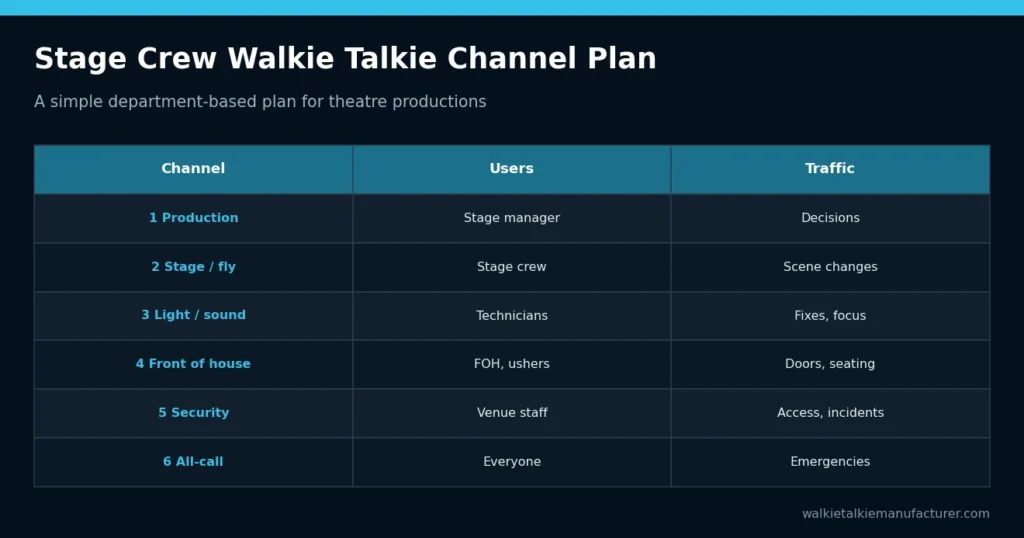
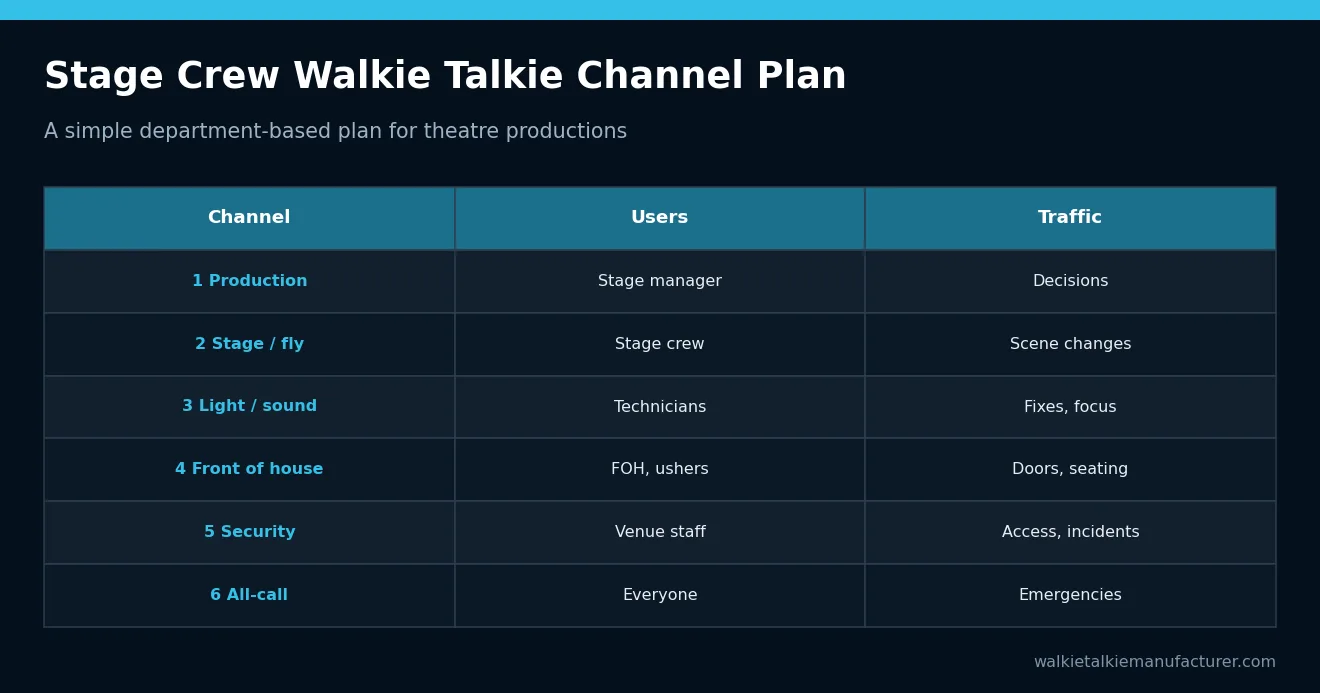
A clear channel plan is the single biggest improvement most crews can make. Separate departments so that routine chatter does not block urgent calls.
| Channel | Users | Typical traffic |
|---|---|---|
| 1 – Production | Stage manager, production manager | Coordination, decisions |
| 2 – Stage / fly | Stage crew, fly crew | Scene changes, rigging |
| 3 – Lighting and sound | Technicians off intercom | Focus, fixes, patching |
| 4 – Front of house | FOH manager, ushers | Doors, seating, audience |
| 5 – Security / ops | Security, venue staff | Access, incidents |
| 6 – Emergency / all-call | Everyone monitors | Evacuation, urgent alerts |
Program the same plan on every radio, label radios by department, and give heads of department radios that scan their own channel plus production. Digital radios can add talk groups and private calls if the crew is large.
Avoiding Interference With Wireless Microphones and IEMs
Stages are crowded radio environments. Wireless microphones, in-ear monitors, wireless intercom and walkie talkies may all operate in nearby frequency ranges. Poor planning can cause intermodulation, dropouts or noise on sensitive audio systems.
- Share the walkie talkie frequency list with the sound department or RF coordinator.
- Keep walkie talkies away from wireless mic receivers and antenna distribution systems.
- Avoid transmitting on radios held right next to wireless mic packs or IEM receivers.
- Test the full RF setup during technical rehearsals, not on opening night.
- Use lower transmit power where coverage allows, which reduces interference risk.
Frequency coordination rules and available bands differ by country. When in doubt, the RF coordinator should approve the walkie talkie frequencies before the production begins.
Earpieces, Silence and Backstage Etiquette
On stage and in the wings, a radio speaker must never be heard by the audience. Every crew member working near the stage should wear an earpiece, and speakers should be set to a low default volume in case an earpiece is unplugged.
- Acoustic tube or D-shape earpieces with inline PTT for stage and FOH staff.
- Lightweight single-muff headsets for load-in crews who need one ear free.
- Black cables and low-profile clips so accessories disappear under show blacks.
- Vibration alerts where available, for staff who must remove earpieces.
Radio discipline matters too: short calls, identifying yourself, and staying off the air during critical cues. Our article on two-way radio etiquette and team training provides a simple framework. Earpieces and headsets can be sourced from our walkie talkie accessories range.
Charging, Labeling and Radio Management
Productions often issue dozens of radios per day to crew, casuals and visiting companies. Without a system, radios go missing and batteries run flat mid-show.
- A central charging station with multi-unit chargers near the production office.
- Numbered radios and a sign-out sheet recording who has each unit.
- Spare charged batteries ready for long days and double shows.
- Color-coded labels or tags by department.
- A quick check of every radio before the half-hour call.
The same approach works for concerts, festivals and corporate events. See our guide to walkie talkies for event management for large-event planning.
Theatre vs Film Production Radios
Theatre, live events and film sets share many needs, but there are differences. Theatre crews work mostly inside one building, prioritize silence near the stage and operate alongside intercom. Film crews often cover larger outdoor locations, change sites frequently and rely more heavily on walkie talkies for coordination between departments.
If you also supply film and video crews, read our buyer’s guide to walkie talkies for film and video production. Rental companies and distributors often stock one radio model for both markets, with different accessory kits and channel plans for each type of production.
What to Send When Requesting a Quote
To recommend production radios for a theatre, venue or touring crew, the manufacturer needs:
- Venue size, number of floors, basements and loading areas, or touring countries.
- Number of radios per department and whether radios are shared or issued daily.
- Licensing route: license-free, licensed business frequencies or existing frequencies.
- Earpiece and headset types, charging needs and spare battery quantities.
- OEM or rental branding needs such as logos, numbering and custom packaging.
Send your requirements through our contact page and we will propose radio models and accessory kits suited to stage work.
Related Guides
Need radios for events or productions?
Tell us your crew size, venue and dates. We will suggest radios, headsets and a channel plan for your production team.
Get a Quote →Radios for Events & ProductionFrequently Asked Questions
What are the best production walkie talkies for theatre?
The best options are compact, reliable radios used with discreet earpieces, a locked channel plan by department, and enough spare batteries for long days. UHF radios usually cope better inside venues. The right model also depends on licensing, the number of crew and whether radios must interface with the intercom system.
Do theatre crews need licensed radios?
Not always. Small venues may use license-free radios such as PMR446 in the EU or FRS in the US. Larger venues and touring productions often prefer licensed business frequencies for more control and fewer outside users. Requirements vary by country, so check local rules before choosing.
Can walkie talkies interfere with wireless microphones?
They can if frequencies and placement are not coordinated. Walkie talkies, wireless mics, in-ear monitors and wireless intercom may operate in nearby ranges. Share frequency lists with the sound department, keep radios away from receivers and test everything during technical rehearsals.
How do stage crews keep radios silent during a show?
Crews working near the stage use earpieces at all times, keep speaker volume low by default and avoid transmitting during critical cues. Vibration alerts help where supported. Clear radio etiquette, including short calls and identifying yourself, keeps the channel quiet and focused on what matters.
How many channels does a stage production need?
Many productions work well with five or six channels: production, stage and fly, lighting and sound, front of house, security, and an emergency or all-call channel monitored by everyone. Larger crews may add channels or digital talk groups. Keep the plan identical on every radio.
Get a Factory Recommendation & Quote
Tell us your product type, quantity, target country, application, coverage, frequency or network and OEM requirements. We will review suitable options, MOQ factors, estimated lead time and the next sample step.
Prefer a direct conversation? Email lorabanzhitao@gmail.com or message WhatsApp +86 173 1689 5054.