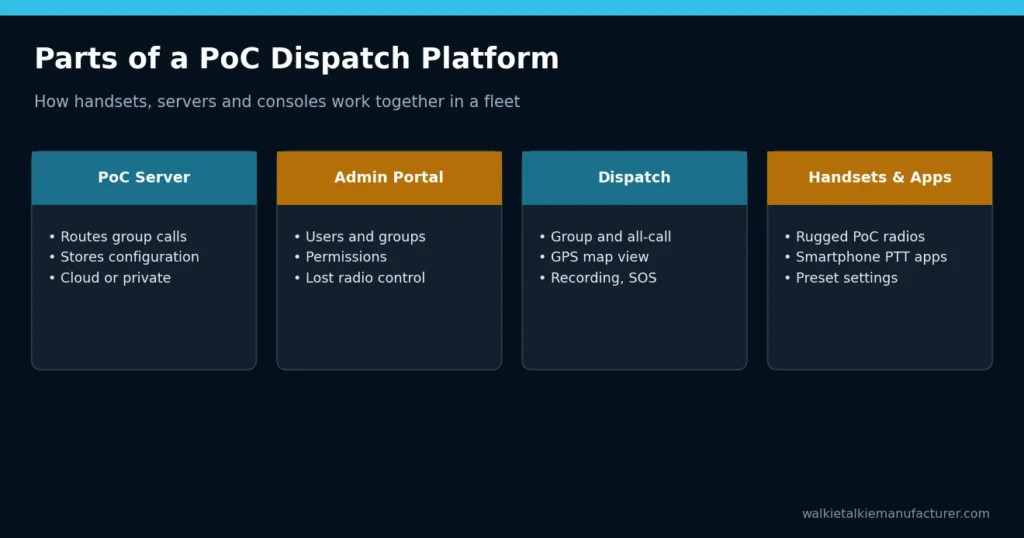
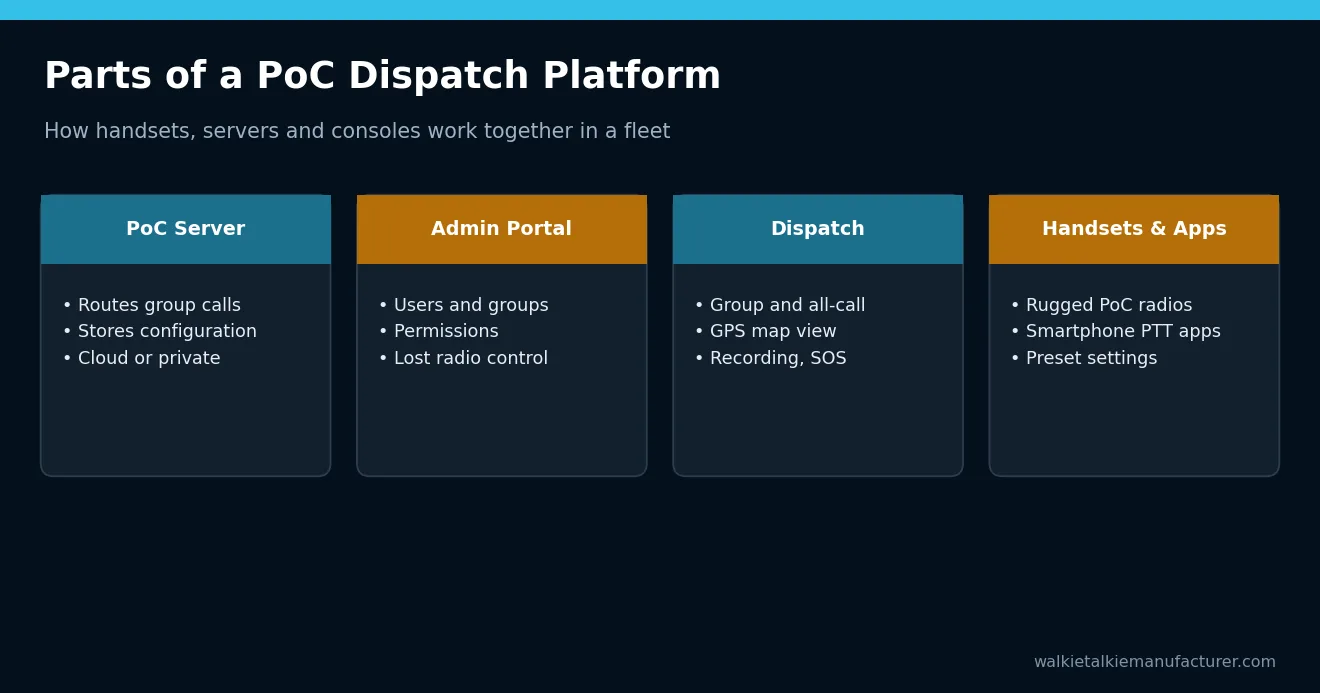
A PoC dispatch platform is the software behind every push-to-talk over cellular fleet. It runs the server that routes calls, the admin portal that creates users and talk groups, and the dispatch console that lets a control room talk to, locate and record radios. If you are asking what is a PoC walkie talkie, the short answer is a 4G handset plus this platform. Choosing the platform carefully matters as much as choosing the radio, especially for private label PoC radio projects.
What Is a PoC Walkie Talkie and Where Does the Platform Fit?
A PoC walkie talkie is a handset that sends push-to-talk voice over 4G LTE or Wi-Fi data. On its own, the radio cannot call anyone: it logs in to a PoC platform, which knows who belongs to each talk group and forwards audio between them.
| Component | Role | Typical users |
|---|---|---|
| PoC server | Routes calls and stores configuration | Platform provider |
| Admin portal | Creates accounts, groups and permissions | Distributor or fleet manager |
| Dispatch console | Talks to groups, views maps, reviews recordings | Control room staff |
| Handset client | PTT app on the radio | Field users |
| Mobile app | PTT on smartphones for managers | Supervisors, office staff |
For a comparison with conventional systems, read PoC radio vs traditional walkie talkie.
Dispatch Console Features
The dispatch console is usually a Windows application or web page used in a control room or office. Features vary by platform and license level, but common ones include:
- Group calls, private calls and all-call broadcasts
- Live map showing radio GPS positions, where the handset reports location
- Call recording and playback for incident review
- Text messages, photos or short video, depending on handset support
- Emergency alert display when a user presses an SOS key
- Temporary groups for incidents or events
Check how many dispatcher seats are included and whether recording storage has limits. For security and logistics buyers, location and recording often drive the platform decision more than the handset itself.
GPS features in particular depend on both sides: the handset must have GNSS enabled and report at a set interval, and the console must display and store positions. Frequent reporting gives a more accurate map but uses more data and battery. For deeper coverage of location use cases, see GPS tracking walkie talkies for dispatch.
Fleet Management and Admin Tools
Behind the console is the admin layer used to manage the fleet day to day. Good tools save hours when radios are added, lost or moved between teams.
- Bulk creation of user accounts and talk groups
- Assigning radios to users and groups remotely
- Setting priority levels and who can call whom
- Disabling a lost radio or resetting a password
- Viewing online status, battery level or signal where supported
- Multi-level accounts so a distributor can manage several customers
Distributors should look closely at multi-tenant features. A platform that lets you create separate customer accounts, each with its own admin, makes it easier to run a PoC business at scale.
Public Cloud, Private Server or Carrier Platform
PoC platforms are delivered in different ways. The choice affects cost structure, control and data location.
| Model | Advantages | Considerations |
|---|---|---|
| Public cloud service | Quick start, no server to maintain | Per-account fees, data stored with provider |
| Private or on-premise server | More control over data and configuration | Server, IT skills and maintenance needed |
| Carrier-hosted service | Bundled with SIMs in some markets | Handset compatibility and lock-in |
| Distributor-branded platform | Own brand for resale | Depends on provider licensing terms |
Ask where servers are located, how uptime is managed, and what happens to accounts and recordings if you change provider.
Regulated sectors, government contractors and some large enterprises prefer private servers so that recordings and user data stay in a controlled environment. Smaller fleets usually find a public cloud service easier, because there is no server to maintain and new accounts can be added in minutes.
Handset Compatibility and Lock-In
Not every PoC radio runs every platform. Some radios are locked to one platform, while others run Android and can install different clients. Compatibility also depends on firmware, because hardware keys such as PTT, group knob and SOS must be mapped correctly to the app.
Before committing, confirm which platforms the radio supports, whether the platform can be changed later, and who is responsible for integration if a key does not work. Test the exact handset and platform combination with your own accounts during the sample stage. Include accessories in the test, because a remote speaker microphone’s PTT button also needs to work reliably with the app.
Mixed fleets are possible: smartphones with the PTT app, rugged radios and dispatch consoles can often share the same groups if the platform supports all of them.
Private Label PoC Radio and Platform Options
For a private label PoC radio program, branding can extend beyond the handset. Options may include your logo on the housing, boot screen and packaging, a branded app or console, and preset server settings so radios arrive ready to log in.
Whether the platform itself can be white-labeled depends on the platform provider’s licensing terms, not only on the radio manufacturer. Clarify who owns customer accounts, who bills them and who provides support. Our PoC radio supplier guide explains how to evaluate partners for this kind of arrangement.
Questions to Ask a PoC Radio Supplier
A capable PoC radio supplier should answer platform questions clearly, not only hardware questions. Useful questions include:
- Which platforms do your radios support, and which are pre-installed?
- Can radios be preconfigured with accounts, groups and APN settings?
- How are account fees structured, and who invoices them?
- What dispatch and recording features are included at each level?
- How are firmware and app updates delivered?
- What support is available if a platform integration issue appears?
Written answers make it easier to compare suppliers and to explain the offer to your own customers.
Rollout Tips for Dispatch-Based Fleets
Start with a pilot group, typically one site or shift, and a single dispatcher. Measure call delay, audio quality and how easily dispatchers find users on the map. Then expand in stages, adding groups and permissions as teams learn the system. Keep the group list short at first; too many groups on day one is a common reason users miss calls. Review recordings and emergency alerts after the first weeks to refine procedures.
Train dispatchers and field users together on call priority, emergency procedures and radio etiquette. Document account ownership and a process for lost devices. For sourcing handsets and OEM options, visit our PoC radio manufacturer page.
What to Send When Requesting a Quote
When you request a quote for PoC radios and platform support, include:
- Number of radios, smartphone users and dispatcher seats
- Preferred platform, or a request for recommendations
- Hosting preference: public cloud, private server or carrier service
- Required features: GPS, recording, messaging, SOS, video
- Destination countries and carriers
- Private label needs for handsets, packaging and preset settings
Send your requirements via our contact page and we will confirm compatible models, configuration options and compliance support for your market.
Related Guides
Planning a PoC or 4G radio fleet?
Tell us the countries, network needs and fleet size. We will recommend suitable PoC/LTE models, explain platform options and arrange samples for testing before you order.
Get a Quote →View PoC & 4G RadiosFrequently Asked Questions
What is a PoC walkie talkie?
A PoC walkie talkie is a push-to-talk radio that sends voice over 4G LTE or Wi-Fi data instead of a radio channel. It connects to a PoC platform server that manages talk groups and routes calls, so users can talk across wide areas wherever mobile coverage is available.
Do I need a dispatch console to use PoC radios?
No. Radios can make group and private calls without a console. A dispatch console adds control room features such as maps, recording, broadcast calls and emergency alert handling. Whether it is worth it depends on how centrally your team is coordinated and which platform features are included.
Can I change PoC platforms later?
Sometimes. Android-based radios can often install a different PoC client, while locked radios may only work with one platform. Changing also involves moving accounts, groups and possibly recordings. Confirm switching options with your supplier before committing, and test any alternative platform with the exact handset model.
Can a distributor sell PoC radios under its own brand?
Yes, handset private label options such as logo, housing color, packaging and preset settings are commonly available. Branding the platform or dispatch software depends on the platform provider’s licensing terms. Clarify account ownership, billing and support responsibilities before launching a private label program.
Where is PoC voice data stored?
It depends on the platform and hosting model. Public cloud services store configuration and recordings on the provider’s servers, while private servers keep data under your control. Ask each provider where servers are located, how recordings are protected and how long they are retained, especially if data location rules apply.
Get a Factory Recommendation & Quote
Tell us your product type, quantity, target country, application, coverage, frequency or network and OEM requirements. We will review suitable options, MOQ factors, estimated lead time and the next sample step.
Prefer a direct conversation? Email lorabanzhitao@gmail.com or message WhatsApp +86 173 1689 5054.