
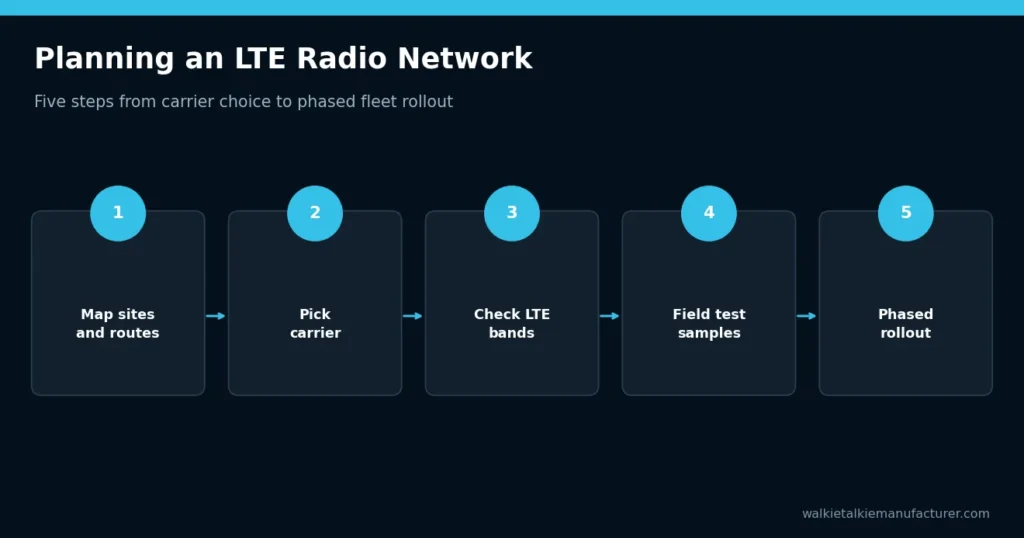
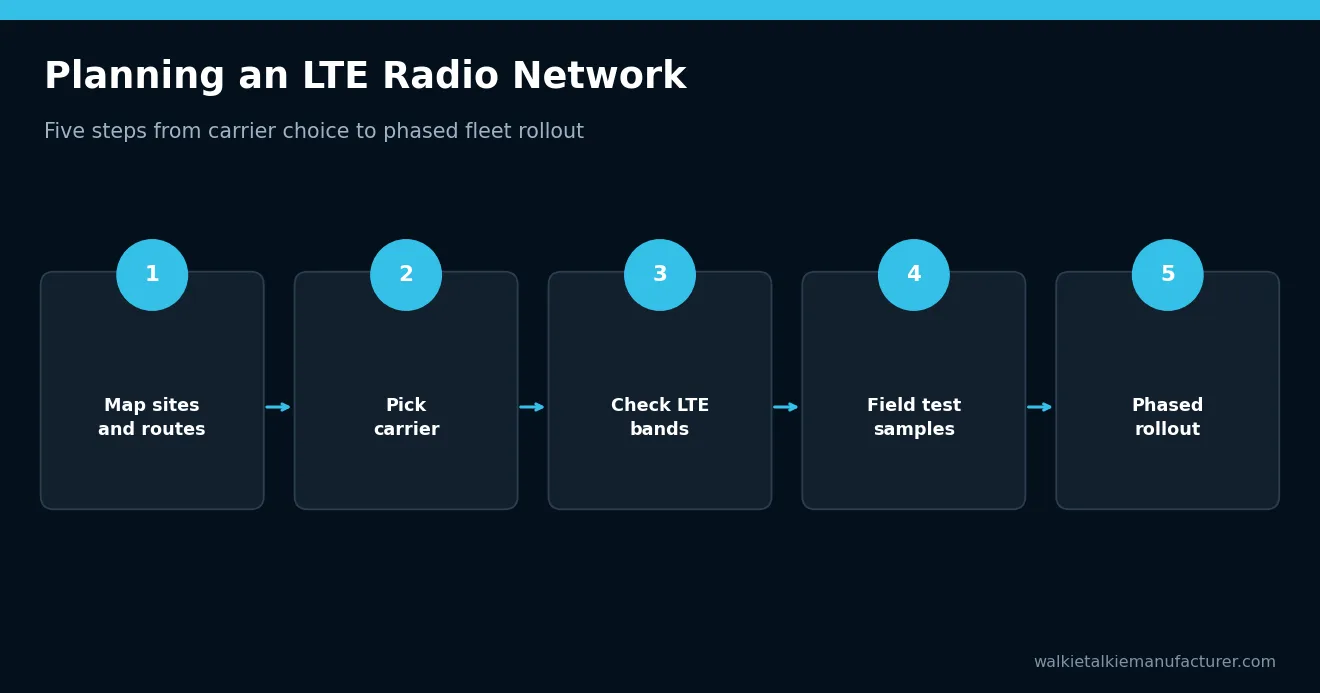
Planning an LTE radio network for a PoC fleet is mostly about the carrier side: which operator covers your sites, which SIM cards and data plans suit push-to-talk, and whether the radios support the right 4G bands. The handset and PoC platform matter too, but most field problems trace back to weak coverage, band mismatches or SIM settings. This guide walks B2B buyers through the decisions to make before ordering 4G network radios in volume.
What an LTE Radio Network Includes
A 4G network radio system has more layers than a conventional repeater system. Each layer can be owned by a different party, so it helps to map them before you buy.
| Layer | What it does | Who usually provides it |
|---|---|---|
| Handsets | Capture and play voice, run the PTT client | Radio manufacturer or distributor |
| SIM cards and data plans | Connect radios to the mobile network | Mobile carrier or IoT SIM provider |
| Carrier network | Carries data between radios and server | Mobile network operator |
| PoC platform | Manages users, groups and call routing | Platform provider, sometimes the distributor |
| Dispatch tools | Monitoring, recording, location | Platform provider |
For background on how the handsets themselves work, read our overview of the 4G PTT radio for B2B buyers.
Choosing a Carrier for Your Radio 4G Fleet
Carrier choice decides where your radios work. National coverage maps are a starting point, but they rarely show indoor performance or conditions at a specific loading dock or basement. Compare operators on the sites your teams actually use.
- Coverage at each fixed site, indoors and outdoors
- Coverage along routes for mobile teams
- Business account support and SIM management tools
- Availability of fixed IP or private APN options if your platform needs them
- Roaming terms if radios cross borders
Some fleets use SIMs from two carriers, assigning each site to the stronger network. This adds admin work but can reduce dead spots.
SIM Card Types and Data Plans
Most LTE radios accept standard consumer or business SIMs. Some buyers use IoT or multi-network SIMs, which can switch between operators, though support depends on the handset firmware and the SIM provider. Check the physical SIM size and whether the model supports dual SIM or eSIM before you order.
PoC voice uses relatively little data compared with video or browsing, but actual consumption depends on the codec, how much users talk, and extra features such as GPS reporting, video or photo sharing. Ask your platform provider for typical per-user usage, then run a pilot to measure your own traffic. Pooled business data plans are often easier to manage than individual plans for large fleets.
Also decide who owns the SIMs. If a distributor supplies them, clarify responsibility for billing, replacements and deactivation.
Matching LTE Bands to the Destination Market
LTE radios must support the frequency bands used by the carriers in the destination country. A radio built for one region may lack a key band elsewhere, leading to weak or no service even where phones work well.
| Check | Why it matters | How to verify |
|---|---|---|
| LTE band list | Must include local carrier bands | Compare spec sheet with carrier band info |
| Fallback networks | Some areas still rely on older networks | Confirm 3G/2G support and local network status |
| Wi-Fi support | Useful indoors or where 4G is weak | Confirm band and PoC client behavior |
| Carrier certification | Some operators approve devices | Ask the carrier and manufacturer |
Manufacturers can often offer regional variants. State the destination market clearly so the right version is quoted.
Testing Coverage Before a Rollout
A short field test prevents expensive surprises. Use sample radios with the SIMs you plan to deploy, not a phone on a different network.
- List every site, floor and route where users need to talk.
- Walk each location with two sample radios on the chosen carrier.
- Make group calls and note delay, dropouts and audio quality.
- Repeat at busy times, such as shift changes or events.
- Record weak spots and decide whether to add Wi-Fi, change carrier or keep some conventional radios.
Our guide to testing walkie talkie samples before a bulk order includes a broader checklist for hardware checks.
APN Settings and Coverage Gaps
Many PoC problems come from configuration rather than coverage. Radios need the correct APN for the SIM, the right server address and valid account credentials for the platform. If you use private APNs or firewalls, the platform ports must be open.
For a large order, ask the manufacturer or distributor whether radios can be preconfigured before shipping, and how settings will be updated later. Remote device management, where available, makes it easier to change groups or push updates without collecting radios. Document every setting in a simple sheet so field staff can restore a radio quickly.
Handling Weak Coverage and Critical Areas
No LTE radio network covers everything. Underground car parks, cold rooms, steel structures and rural areas are common gaps. Options include adding site Wi-Fi that the radios can use, choosing a carrier with stronger local presence, installing coverage solutions approved by the operator, or keeping analog or DMR radios for those zones.
Hybrid radios that combine PoC with conventional radio can bridge the gap for mixed sites. If direct radio is part of the plan, check local licensing rules for the conventional channels.
Security and Data Considerations
Because voice travels over public networks and a hosted server, ask how the platform protects traffic. Useful questions include whether audio and signalling are encrypted in transit, where servers and call recordings are stored, who can access recordings, and how user accounts are removed when staff leave. Some sectors also need data to stay in a particular country.
Handset settings matter as well: lock menus that users should not change, disable unused apps where possible and set a policy for lost devices. For a broader view of how radio traffic can be protected, see two-way radio encryption explained.
Rollout and Ongoing Management
Once coverage and settings are confirmed, roll out in phases. Start with one site or team, collect feedback on audio and delay, then expand. Keep a register of radio serial numbers, SIM numbers, users and talk groups so lost or faulty units can be replaced quickly.
Plan who handles SIM suspension for lost radios, platform account changes and carrier invoices. For sourcing handsets that fit this plan, see our PoC radio manufacturer and OEM options.
What to Send When Requesting a Quote
When asking a manufacturer for LTE radio pricing and model advice, share the network context, not just the handset features:
- Destination countries and preferred carriers
- Whether you need dual SIM, eSIM, Wi-Fi or fallback networks
- PoC platform in use, or a request for recommendations
- Whether radios should be preconfigured with APN and account settings
- Accessories, OEM branding and packaging requirements
- Estimated quantity and sample needs
Send your requirements through our contact form and we will confirm suitable models, band support and compliance document options for your market.
Related Guides
Planning a PoC or 4G radio fleet?
Tell us the countries, network needs and fleet size. We will recommend suitable PoC/LTE models, explain platform options and arrange samples for testing before you order.
Get a Quote →View PoC & 4G RadiosFrequently Asked Questions
Do LTE radios work with any SIM card?
Most LTE radios accept standard SIM cards, but they only work well if the radio supports the carrier’s LTE bands and the SIM is configured with the correct APN. Some carriers restrict data SIMs or require device approval, so test the exact SIM and radio combination before deploying a fleet.
How much data does a PoC radio use?
Push-to-talk voice uses modest data because it is compressed and only sent while someone is talking. Real usage depends on talk time, codec, GPS reporting and features like video. Ask your platform provider for typical figures and measure your own usage during a pilot to choose the right plan.
Can one fleet use SIMs from different carriers?
Yes. Users on different carriers can share the same talk groups because the PoC server connects them over the internet. Many fleets assign each site the carrier with the best local coverage. This adds some administration, so keep a clear record of which SIM is in which radio.
What happens if a site has no 4G coverage?
An LTE-only radio cannot make calls without a data connection. Options include adding Wi-Fi if the radio supports it, switching to a stronger carrier, using operator-approved coverage solutions, or keeping analog or DMR radios for those areas. Hybrid radios can also combine both technologies.
Can radios be preconfigured before delivery?
Many manufacturers and distributors can preload APN settings, server addresses, talk groups and branding before shipment. What can be preconfigured depends on the model, the PoC platform and whether SIMs are provided in advance. Confirm the process and how settings are updated after delivery before placing the order.
Get a Factory Recommendation & Quote
Tell us your product type, quantity, target country, application, coverage, frequency or network and OEM requirements. We will review suitable options, MOQ factors, estimated lead time and the next sample step.
Prefer a direct conversation? Email lorabanzhitao@gmail.com or message WhatsApp +86 173 1689 5054.