
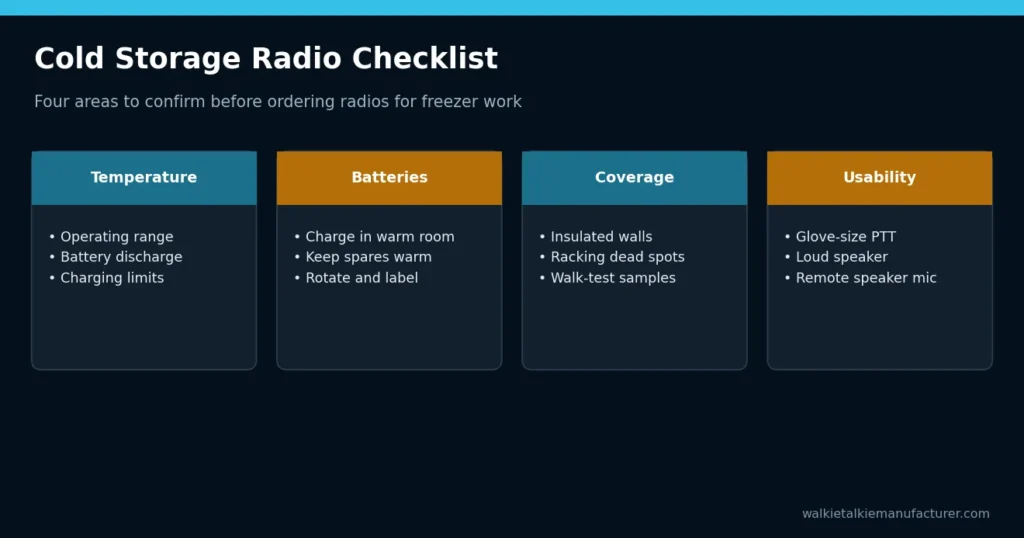
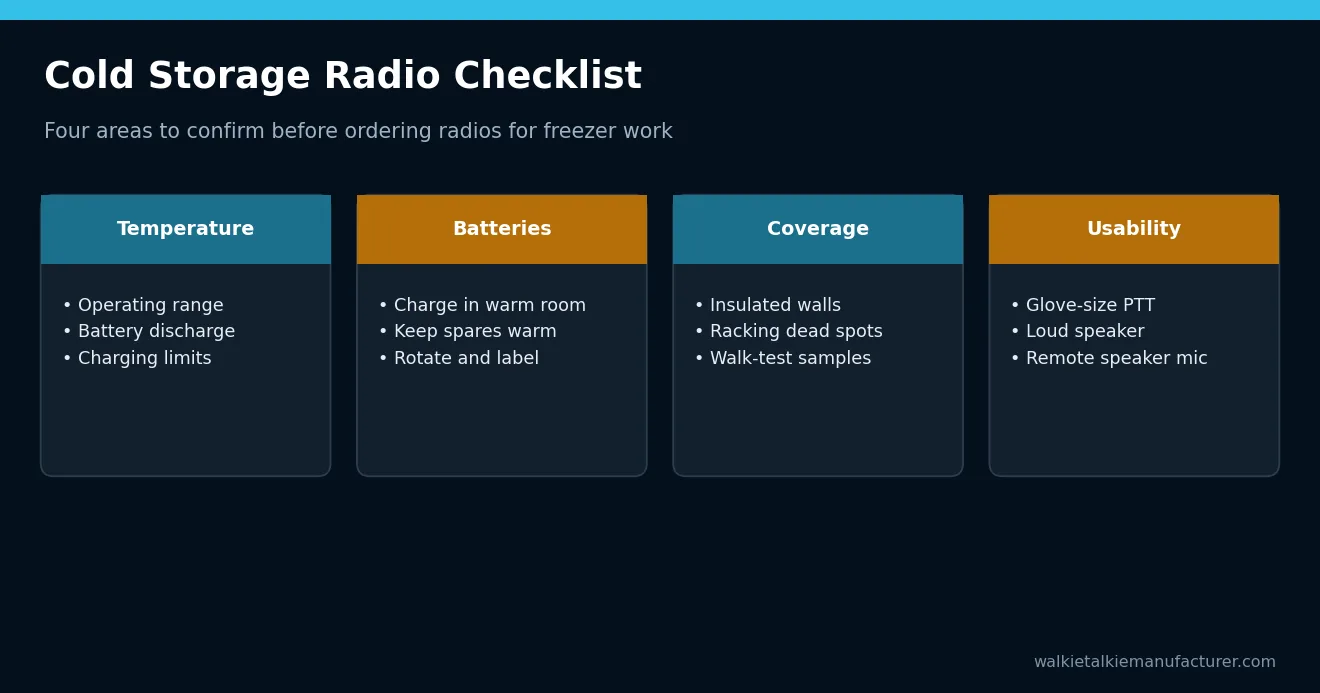
The best walkie talkies for warehousing in cold storage are rugged UHF or PoC radios with a confirmed low operating temperature, glove-friendly controls, sealed housings and a battery routine designed for freezer work. Cold reduces battery performance, insulated walls block radio signals and moving between freezer and dock can cause condensation. This guide explains how to choose, specify and manage radios for chilled and frozen warehouses.
Why Cold Storage Is Hard on Radios
Cold stores combine several challenges that a normal warehouse does not have. Temperatures in freezer rooms are often far below zero, staff wear thick gloves and layers, and doors open and close constantly between frozen rooms, chilled areas and warm loading docks.
- Batteries: lithium-ion cells deliver less usable capacity in the cold, so a radio may run down faster than on a warm floor.
- Displays: LCD screens can respond slowly or look faded at low temperatures.
- Condensation: moving a cold radio into warm, humid air can form moisture on and inside it.
- Signal blocking: insulated panels, metal cladding and dense racking reduce radio coverage.
- Gloves: small buttons and knobs are hard to use with thick gloves.
None of these problems is unusual, but they need to be designed into the radio choice and the daily routine. Operators who treat freezer radios exactly like normal warehouse radios usually see more complaints about flat batteries, missed calls and damaged accessories in the first months of use.
Operating Temperature: What to Confirm
Every radio has a specified operating temperature range, and it varies by model, battery and display. Do not assume that a radio labelled ’rugged’ is suitable for freezer rooms.
| Item | Why it matters | What to ask the manufacturer |
|---|---|---|
| Radio operating range | Defines where the radio is designed to work | Tested low-temperature limit for the model |
| Battery discharge range | Cells may cut out early in cold | Battery type and its rated discharge range |
| Battery charging range | Charging lithium-ion below its rated range can damage cells | Minimum charging temperature for the pack |
| Display behaviour | Slow or faded LCD in freezers | Whether a screenless or low-temperature display option exists |
| Seals and materials | Plastics become brittle in cold | Housing material and drop testing at low temperature |
Ask for these figures in writing for the exact model and battery you plan to buy, and test samples inside your coldest room.
Battery Management for Freezer Work
Battery routines matter more in cold storage than anywhere else. The most common problem is not a faulty battery but a routine that does not suit the cold.
- Charge at room temperature. Keep chargers in a heated office or break room, not on the dock or in chilled areas.
- Keep spares warm. Store spare batteries in a warm area and swap them in when the pack in use runs low.
- Carry the radio under a layer. A radio worn under an outer jacket, with a remote speaker mic outside, stays warmer.
- Rotate packs. Label batteries and track their age so ageing packs are replaced before they fail during a shift.
- Let cold radios warm up. Allow a radio from the freezer to reach room temperature before charging.
Our battery and charging guide for 24/7 shifts covers fleet charging routines in more depth.
Condensation and Moisture Protection
Moisture forms when a cold radio enters warm, humid air, for example when a picker leaves a freezer and walks onto a loading dock. Repeated cycles can let moisture reach connectors, speaker grilles and battery contacts.
A well-sealed housing with a tested ingress protection rating helps, and so does keeping accessory connectors covered when not in use. See IP65 vs IP67 vs IP68 walkie talkies for what the ratings mean. Staff should also avoid charging a radio that is still cold or damp; wipe it dry and let it reach room temperature first.
Coverage Through Insulated Walls and Racking
Cold stores are built to keep heat out, and the same insulated panels and metal skins also reduce radio signals. Coverage between the freezer, chilled rooms, dock and office can be much weaker than the distance suggests.
| Challenge | Typical effect | Common solution |
|---|---|---|
| Insulated sandwich panels | Signal loss between rooms | UHF radios; test at doors and deep in the room |
| Dense, high racking | Dead spots between aisles | Repeater placed with a clear view of aisles |
| Separate buildings or yards | Weak link from office to store | Repeater or PoC with site Wi-Fi or cellular |
| Weak cellular indoors | PoC radios lose connection | Wi-Fi coverage or conventional radios for inside |
UHF normally performs better than VHF inside buildings like these, as explained in UHF vs VHF for warehouses. If you plan PoC radios, check both cellular and Wi-Fi coverage inside the freezer before ordering.
Controls, Audio and Accessories for Gloved Staff
Staff in freezers wear insulated gloves, hats and hoods. A radio that works well on a normal warehouse floor may be difficult to use in these conditions.
- Large PTT button and channel knob that can be used with gloves.
- Loud speaker, because hoods and hats reduce what users hear.
- Remote speaker microphone so the radio can stay under a jacket.
- Headsets or earpieces that fit under hats or hoods; confirm cable flexibility in cold.
- Secure holster so radios are not dropped on frozen floors.
Accessory cables and plastics can stiffen in the cold, so include accessories in your low-temperature sample test. Our accessories range covers speaker mics, headsets and holsters by connector type.
Choosing the Best Warehouse Walkie Talkie for Cold Storage
Most cold storage operators end up with one of two setups. The first is UHF analog or DMR radios, sometimes with a repeater, for sites where all work happens in one facility. The second is PoC radios for distribution companies that also need to reach drivers and other depots.
For general warehouse selection advice, see walkie talkies for warehouses. For cold storage, add three steps to your normal process: confirm low-temperature specs in writing, test samples inside the coldest room for a full shift, and design the charging routine before the radios arrive.
If the site already uses radios elsewhere, check compatibility before choosing a new model for the freezer area. Staff on the dock, in the office and in the freezer need to talk to each other, so the cold-rated radios must share frequencies, codes or talk groups with the rest of the fleet. Buying from one supplier for the whole site makes this simpler.
What to Send When Requesting a Quote
For an accurate quotation for cold storage radios, include:
- Lowest working temperature and how long staff stay in the freezer at a time.
- Site layout: freezer rooms, chilled areas, docks, offices and yards.
- Number of users per shift and shift pattern.
- Preferred technology: analog, DMR or PoC, and any existing radios to match.
- Accessories needed for gloved and hooded staff, plus spare batteries and chargers.
- Destination country and required compliance documents.
Send these details through our contact page and we will confirm which models have suitable temperature specifications and arrange samples for testing.
Related Guides
Equipping a warehouse or logistics team?
Share your site size, shift pattern and number of users. We will recommend radios, accessories and multi-unit charging for round-the-clock use.
Get a Quote →Radios for Warehouses & LogisticsFrequently Asked Questions
Do walkie talkies work in freezer warehouses?
Yes, if the radio and battery are rated for the temperature and the routine suits the cold. Batteries deliver less capacity in freezers and displays can slow down. Choose models with a confirmed low operating temperature, keep spare batteries warm and test samples inside your coldest room before ordering a fleet.
Why do radio batteries run down faster in cold storage?
Low temperatures slow the chemical reactions inside lithium-ion cells, so they deliver less usable capacity. The battery often recovers when warmed, but runtime during the shift is shorter. Keeping the radio under a jacket, using a remote speaker mic and swapping in warm spare batteries all help.
Can I charge radios inside a cold store?
It is generally best not to. Charging lithium-ion batteries below their rated charging temperature can damage the cells. Keep chargers in a heated area, let radios reach room temperature before charging and follow the manufacturer’s charging temperature range for the battery.
Which is better for cold storage, UHF or VHF?
UHF usually performs better inside buildings with insulated walls, metal cladding and racking, because its shorter wavelength passes through openings more effectively. VHF can suit large open outdoor yards. Most cold storage sites choose UHF, but a walk test with samples is the best way to confirm coverage.
How do I stop condensation damaging radios?
Choose sealed radios with a tested ingress protection rating, keep accessory connector covers closed and avoid charging a cold or damp radio. When a radio moves from a freezer to a warm dock, wipe it dry and let it warm up gradually before plugging it into a charger.
Get a Factory Recommendation & Quote
Tell us your product type, quantity, target country, application, coverage, frequency or network and OEM requirements. We will review suitable options, MOQ factors, estimated lead time and the next sample step.
Prefer a direct conversation? Email lorabanzhitao@gmail.com or message WhatsApp +86 173 1689 5054.