
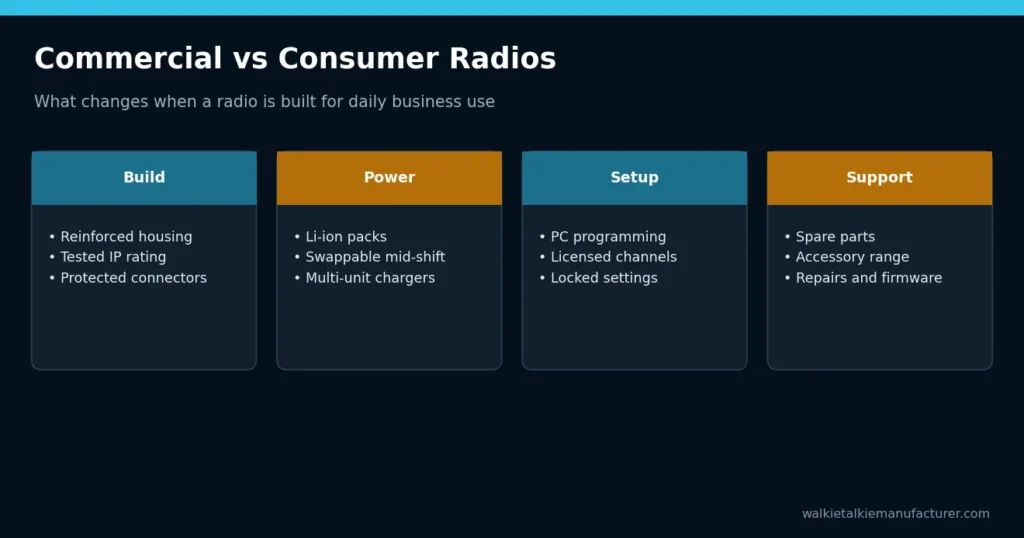
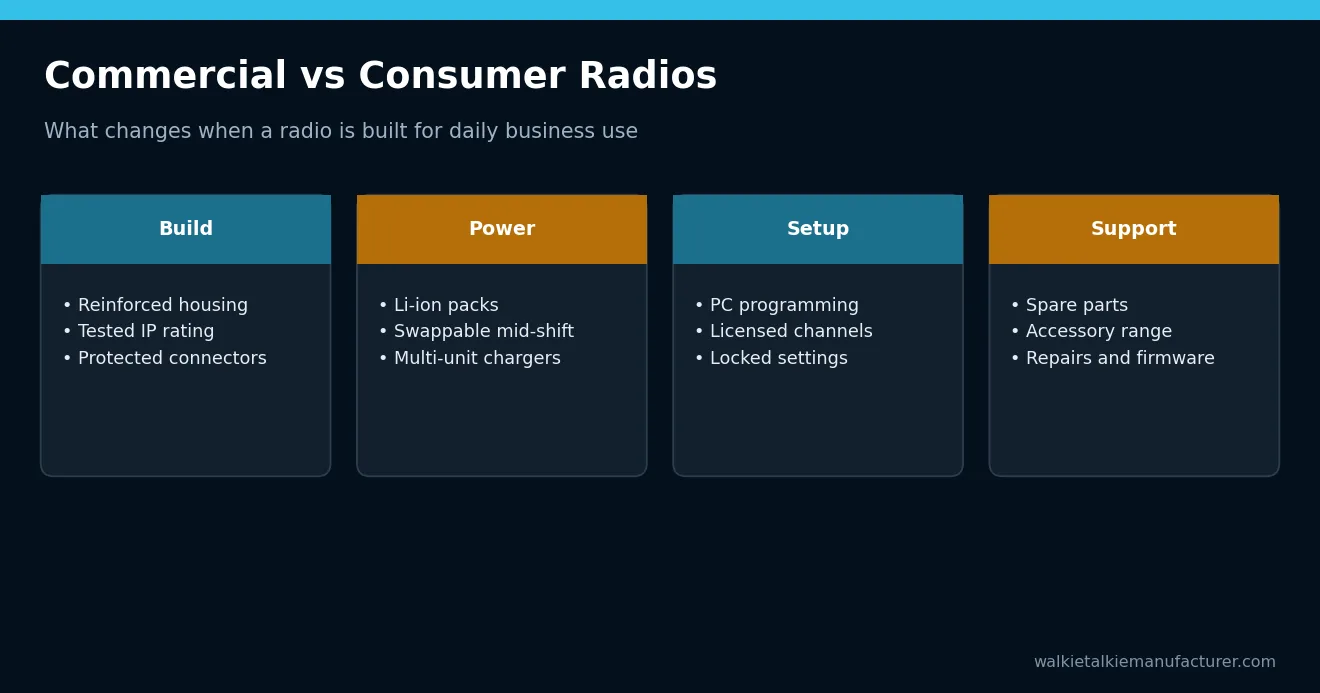
Commercial walkie talkies are built for daily shift work, while consumer radios are designed for occasional family or leisure use. The main differences are durability, battery design, programmability, accessory support, licensing options and after-sales service. For most businesses, commercial radios cost less over their working life because they last longer and can be repaired. This guide compares both and explains what to check when buying wholesale walkie talkies.
Commercial vs Consumer Walkie Talkies: The Core Difference
Consumer radios are usually sold in pairs or small packs in retail stores. They are designed to be cheap, simple and light. Commercial radios, sometimes called business or professional radios, are designed for a user who carries the radio for a full shift, day after day.
That difference affects every part of the product: housing materials, button design, battery chemistry, charger design, connectors, programming and support. It also affects where the radio can be used legally, because commercial models are often available for licensed business frequencies as well as license-free services.
The price gap can look large when you compare a single pair of radios. It looks different when you compare a fleet over several years, including replacements, batteries, lost working time and the cost of staff not being able to reach each other during an incident.
Side-by-Side Comparison
The table below compares typical characteristics. Individual models vary, so always check the specification of the exact model you are considering.
| Feature | Consumer walkie talkies | Commercial walkie talkies |
|---|---|---|
| Housing | Lightweight plastic | Reinforced housing, often with metal chassis |
| Batteries | Often AA/AAA or small packs | Replaceable Li-ion packs sized for shifts |
| Charging | Single desktop or USB | Single and multi-unit chargers for fleets |
| Programming | Fixed channels, limited menus | PC programming for channels, codes, features |
| Accessories | Few, often proprietary | Speaker mics, earpieces, headsets, holsters |
| Frequencies | License-free services only | License-free or licensed business bands |
| Support | Replace rather than repair | Spare parts, repairs, firmware support |
Durability and Environmental Protection
Business radios are dropped, knocked, rained on and left in vehicles. Commercial models usually have tougher housings, protected connectors and better sealing. Many are available with tested ingress protection ratings for dust and water.
Ratings differ by model, so ask for the tested rating and the test standard rather than relying on marketing labels. Our guide to IP65 vs IP67 vs IP68 walkie talkies explains what each level means in practice.
Batteries, Charging and Shift Use
Consumer radios often run on disposable cells or small rechargeable packs. That is fine for weekend use but expensive and unreliable for daily work.
Commercial radios use replaceable lithium-ion packs, which can be swapped mid-shift and replaced when they age. Multi-unit chargers let a supervisor charge a whole fleet in one place. Battery life in real use depends on transmit time, volume, temperature and features such as GPS or Bluetooth, so compare radios by testing them in your own working pattern rather than by the number on the box.
Battery ageing is another difference. All rechargeable batteries lose capacity over time, and a fleet radio may need a new pack long before the radio itself wears out. With a commercial radio you simply order a replacement pack. With many consumer radios, a tired battery means a new radio.
Programming, Licensing and Features
Commercial radios can be programmed with specific frequencies, bandwidth, CTCSS/DCS codes, scan lists and button functions. This allows a distributor or IT team to set up a fleet consistently and change it later.
| Capability | Why businesses need it |
|---|---|
| Custom channel plans | Separate groups such as security, maintenance, reception |
| Licensed frequencies | Less interference than shared license-free channels |
| Digital modes (DMR) | Individual IDs, text, better privacy, more capacity |
| Programmable buttons | Quick access to emergency, scan or monitor functions |
| Locked settings | Stops users changing channels by mistake |
Licensing depends on the country. In the US, FRS is license-free and business radios under Part 90 usually need a license; in the EU, PMR446 is license-free. See licensed vs license-free walkie talkies for details. For digital commercial radios, see our DMR radio manufacturing page.
Audio, Accessories and Hands-Free Use
In most workplaces the radio is only half of the system. Security staff need discreet earpieces, maintenance teams need speaker mics on the shoulder, and staff in loud areas may need headsets with hearing protection. Consumer radios rarely support this range, and where they do, the accessories are often low quality.
Commercial radios use standard accessory connectors, so one radio model can be paired with several accessory types for different roles. Audio is also tuned differently: commercial models typically offer louder speakers and better microphone noise handling, which matters in kitchens, warehouses and outdoor sites.
- Speaker microphones: keep the radio on the belt and talk at shoulder level.
- Earpieces: keep traffic private in hotels, retail and security work.
- Headsets: combine hearing protection and communication in loud areas.
- Holsters and clips: keep radios secure during physical work.
Before ordering, confirm which accessories are available for the model’s connector and whether they are tested with the radio.
When Consumer Radios Are Good Enough
Consumer radios are not always the wrong choice. They can be reasonable for:
- Very occasional use, such as an annual event run by volunteers.
- Short-term backup radios kept in a drawer.
- Low-risk leisure activities where breakage is not a problem.
If radios will be used every day, by several people, or in any safety-related role, commercial radios are usually the better choice. Even for occasional users, check that consumer radios are legal in your country: radios sold online are sometimes made for another market’s license-free service.
Buying Wholesale Walkie Talkies for Resale or Fleets
Distributors and large end users often buy commercial radios wholesale directly from a manufacturer. That brings OEM options such as logo, housing color, packaging and channel pre-programming, but also more responsibility for checking the product and the paperwork.
- Request samples and test them before a bulk order.
- Check that the model has compliance documents for your market; support depends on model and destination.
- Confirm spare batteries, accessories and parts availability.
- Agree how firmware updates, repairs and returns will be handled.
Buying direct also means you become the first line of support for your customers. Plan a small stock of spare batteries, antennas and accessories, and keep the programming software and cables so you can reprogram radios locally instead of sending them back to the factory.
Our walkie talkie wholesale pricing guide explains how order size and customization affect quotations. You can also view our commercial analog radio range.
What to Send When Requesting a Quote
To quote commercial walkie talkies accurately, a manufacturer needs:
- Destination market and whether you need license-free or licensed frequencies.
- Analog, DMR or PoC preference, and required features.
- Quantity range and whether it is a one-off or repeat order.
- Accessories: batteries, chargers, earpieces, speaker mics, holsters.
- OEM requirements: logo, color, packaging, manuals, programming.
- Required compliance documents for your market.
Share these through our contact page and we will recommend suitable models and arrange samples.
Related Guides
Not sure which radio fits your site?
Describe your site, coverage needs and number of users. Our team will recommend suitable radios and accessories and send samples for testing before bulk orders.
Get a Quote →Browse Our RadiosFrequently Asked Questions
What is the difference between commercial and consumer walkie talkies?
Commercial radios are built for daily professional use with stronger housings, replaceable Li-ion batteries, programmable channels, accessory connectors and repair support. Consumer radios are designed for occasional leisure use, with simpler features, fixed channels and limited accessories. Commercial models also often support licensed business frequencies.
Are commercial walkie talkies worth the higher cost?
For daily business use, usually yes. Consumer radios often need replacing sooner, have fewer accessories and weaker batteries. Commercial radios can be repaired, fitted with new batteries and reprogrammed, which lowers cost over several years. The right choice depends on how often and how hard the radios will be used.
Do commercial walkie talkies need a license?
It depends on the frequency and the country. Commercial radios can be made for license-free services such as PMR446 in the EU or for licensed business bands, which usually need a license. Always confirm the local rules before ordering, and check the model has documents for your market.
Can I buy commercial walkie talkies wholesale?
Yes. Distributors and larger end users can buy wholesale from manufacturers, often with OEM options such as logo, housing color and packaging. Order terms depend on the model and customization, so request samples and a written quotation that lists accessories, compliance documents and after-sales support.
Can consumer and commercial radios talk to each other?
Sometimes. If both radios operate on the same license-free frequency with matching privacy codes and bandwidth, they can communicate. Commercial radios on licensed business frequencies cannot talk to consumer radios unless programmed with a shared license-free channel where local rules allow.
Get a Factory Recommendation & Quote
Tell us your product type, quantity, target country, application, coverage, frequency or network and OEM requirements. We will review suitable options, MOQ factors, estimated lead time and the next sample step.
Prefer a direct conversation? Email lorabanzhitao@gmail.com or message WhatsApp +86 173 1689 5054.