
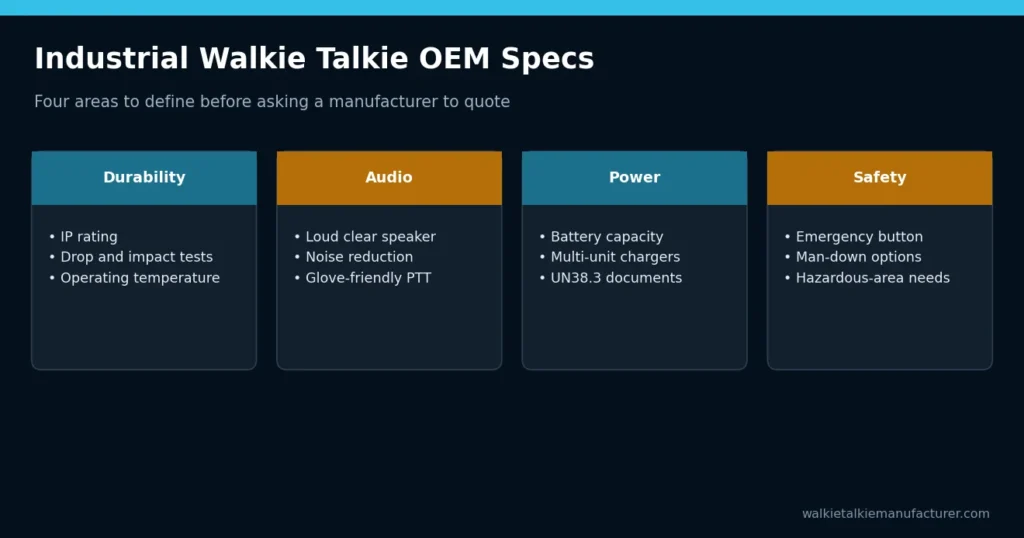
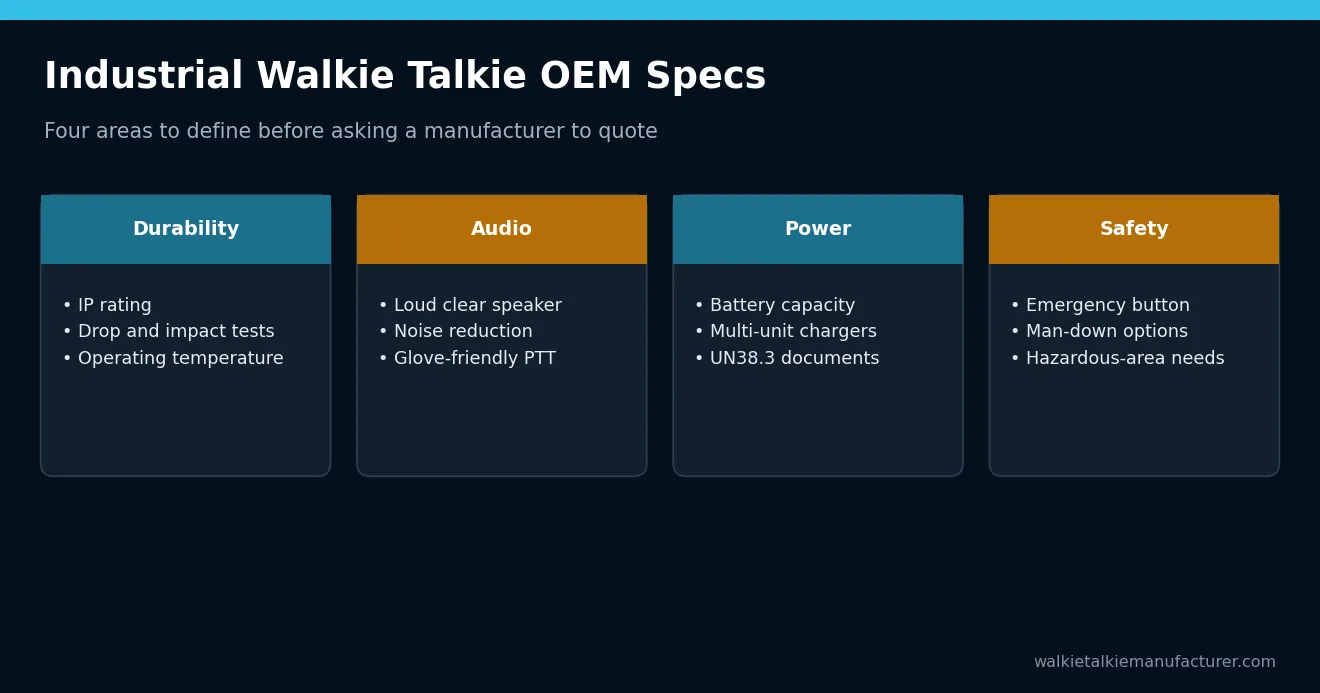
When you work with an industrial walkie talkie manufacturer, the quality of your radios depends on how clearly you specify them. The best two-way radios for industrial use are not defined by a brand, but by a written specification covering ruggedness, IP rating, audio output, batteries, safety features, accessories, programming and compliance documents. This guide lists the OEM specs industrial buyers should define, explains why each matters, and shows how to turn them into a quote request a factory can price accurately.
What Makes a Walkie Talkie Industrial
Industrial radios are used for years in environments that consumer radios are not designed for: dust, rain, oil, drops onto concrete, temperature swings and loud machinery. They are also used intensively, often across several shifts per day, and are usually part of a managed fleet with shared chargers and programmed channel plans.
For buyers, “industrial” should translate into measurable requirements rather than a marketing label. Two radios can look similar on a website yet differ greatly in housing material, sealing, battery cell quality, audio design and accessory connector strength. A written specification lets you compare manufacturers on the same basis.
A specification also protects you after the first order. When the factory changes a component supplier or updates firmware, you have a clear reference to check the new batch against. Without one, gradual changes in audio quality, battery performance or fit can go unnoticed until customers start returning radios.
Best Two-Way Radios for Industrial Use: Core Specs
The table below lists the core specifications most industrial buyers define. Required values depend on the site and application, so confirm feasibility with the manufacturer for the selected model.
| Specification | What to define | Why it matters |
|---|---|---|
| Technology | Analog, DMR, PoC or hybrid | Coverage, features, compatibility |
| Frequency band | UHF or VHF, exact range | Building type and licensing |
| Ingress protection | Required IP rating | Dust, rain, washdown |
| Drop and impact | Test method to verify | Concrete floors, vehicles |
| Audio | Speaker loudness, noise reduction | Noisy work zones |
| Battery | Chemistry, capacity, spare packs | Shift length and swaps |
| Accessory connector | Type and retention strength | Headsets and speaker mics |
| Operating temperature | Range needed on site | Cold stores, hot plants |
For an application view of radios in factories, see our overview of the best walkie talkies for manufacturing.
Durability and Sealing
Housing and mechanical design
Ask about housing materials, reinforced corners, knob and antenna protection, and how the battery latch is designed. Weak battery latches are a common failure point after repeated drops.
Ingress protection
IP ratings describe protection against dust and water under defined test conditions. A plant with washdown, outdoor yards or heavy dust may need a higher rating than an indoor assembly line. Remember that sealing depends on correct assembly; ask how the factory tests sealing on production units, not only on certified samples.
Drop and environmental testing
Some buyers reference military-style test methods for drop, vibration and temperature. If you need this, specify the tests and ask for reports from the manufacturer for the selected model rather than accepting a general claim.
Audio, Controls and Usability
- Speaker output: loud and clear without distortion at maximum volume.
- Noise reduction: digital noise suppression on transmit, if available on the model.
- Glove-friendly controls: large PTT, textured knobs, well-spaced side buttons.
- Programmable keys: quick access to emergency, scan, channel or talk group functions.
- Vibration and LED alerts: useful when calls cannot be heard.
- Display or no display: screen models help supervisors; simple models reduce user errors.
Usability is often decided by small details. Ask for samples and test with the actual workers who will use the radios, including with gloves and hearing protection.
Power: Batteries and Charging
Battery performance depends on capacity, cell quality, transmit duty cycle and temperature. Rather than asking for a number of hours, define the shift pattern and let the manufacturer propose battery options, then verify them in a sample test.
| Item | What to specify |
|---|---|
| Battery chemistry | Typically lithium-ion; confirm cell source |
| Capacity options | Standard and high-capacity packs |
| Chargers | Single, multi-unit, vehicle; local plug type |
| Charging behavior | Indicator LEDs, overcharge protection |
| Shipping documents | UN38.3 test summary and MSDS, as required |
For fleets that run around the clock, plan charging as part of the specification: how many multi-unit chargers are needed, where they will be placed, and whether spare batteries will be charged separately. Ask whether batteries carry date codes, which help rotate stock and track aging packs.
Support for battery documents depends on the selected model and destination market.
Safety Features and Hazardous Areas
Industrial buyers often need features that protect workers, not just communication. Common options include emergency buttons, man-down (tilt or no-motion) alarms, lone worker timers and GPS on selected models. These features depend on the model, firmware and, for PoC radios, the dispatch platform.
If radios will be used in explosive atmospheres, such as chemical plants, refineries, grain handling or some mining areas, standard radios are not suitable. These locations require intrinsically safe equipment certified under schemes such as ATEX, IECEx or UL 913 for the specific zone or class. Read our guide to intrinsically safe walkie talkies under ATEX, IECEx and UL 913 before specifying radios for classified areas, and confirm with the manufacturer which models, if any, carry the required certification.
OEM Customization and Programming
Industrial buyers and distributors often order OEM or private label radios. Typical customization options include:
- Logo on the front housing and battery, and custom housing colors.
- Pre-programmed channels, talk groups, scan lists and button functions.
- Firmware settings such as power levels, timeouts and emergency behavior.
- Branded packaging, labels and user manuals in the local language.
- Accessory bundles such as speaker mics, earpieces and multi-unit chargers.
Document programming in a code plug or configuration file that the manufacturer keeps on record. This ensures that reorders, replacement radios and spares arrive with identical settings, which matters on sites where a single misprogrammed radio can disrupt a channel.
Our OEM walkie talkie buying guide explains how customization affects sampling and production planning. Feasibility of each option depends on the model and order volume.
Verifying an Industrial Walkie Talkie Manufacturer
A good specification only works with a factory that can build to it consistently. Before a bulk order, confirm who actually manufactures the radio, how incoming components and finished units are tested, and how production batches are traced.
- Request sample units built to your specification, not generic samples.
- Test samples on site: coverage, audio, battery life across a shift, drops and sealing.
- Ask for test reports and compliance documents relevant to your market.
- Review the factory’s quality control process and after-sales procedures.
- Agree a golden sample that production units must match.
Our walkie talkie factory audit checklist provides a structured list of what to check. For radios and OEM options tailored to factories, see our page on walkie talkies for manufacturing.
What to Send When Requesting a Quote
To receive an accurate quotation from an industrial walkie talkie manufacturer, prepare:
- Application and environment: indoor or outdoor, dust, water, temperature, noise, hazardous zones.
- Technology (analog, DMR, PoC) and frequency band or licensed frequencies.
- Required IP rating, durability tests and safety features.
- Estimated quantities, accessory bundles and spare batteries.
- OEM needs (logo, colors, packaging, programming) and destination market documents.
Send your specification through our contact page and our team will confirm which models fit and what samples we can provide.
Related Guides
Equipping a factory or plant floor?
Tell us the site size, noise level and number of users. We will recommend radios and noise-ready accessories and send samples for a shift test.
Get a Quote →Radios for ManufacturingFrequently Asked Questions
What are the best industrial walkie talkies?
The best industrial walkie talkies are those that match your site’s requirements for coverage, durability, sealing, audio, battery life and safety features. Rather than choosing by brand, write a specification, test samples on site during real production, and compare manufacturers on how well their radios meet that specification.
Which IP rating does an industrial radio need?
It depends on the environment. Dusty indoor areas, outdoor sites exposed to rain, and washdown areas each call for different levels of protection. Define the conditions, choose a rating that covers them with some margin, and ask the manufacturer how sealing is verified on production units, not only on test samples.
Are industrial walkie talkies safe for explosive atmospheres?
Not by default. Only radios certified as intrinsically safe under schemes such as ATEX, IECEx or UL 913, for the specific zone or class, should be used in explosive atmospheres. Standard industrial radios, however rugged, are not suitable. Confirm the certification of any model directly with the manufacturer.
Can an industrial radio be customized with our brand?
Often yes. OEM options usually include logos, housing colors, pre-programmed channels, firmware settings, branded packaging and manuals. What is possible depends on the model and order volume, so discuss the options early and confirm them in samples before production starts.
How do I compare two industrial walkie talkie manufacturers?
Send both the same written specification and request samples built to it. Test them on site for coverage, audio, battery performance, durability and usability, then compare documentation, quality control processes and after-sales support. A factory audit or third-party inspection adds further confidence before a bulk order.
Get a Factory Recommendation & Quote
Tell us your product type, quantity, target country, application, coverage, frequency or network and OEM requirements. We will review suitable options, MOQ factors, estimated lead time and the next sample step.
Prefer a direct conversation? Email lorabanzhitao@gmail.com or message WhatsApp +86 173 1689 5054.