

A hybrid DMR + PoC radio combines two networks in one handset: DMR two way radio for direct, on-site communication, and PoC (push-to-talk over cellular) over 4G LTE for wide-area calls. It suits organizations that need reliable local talk on a site and also want to reach drivers, managers or other branches beyond radio range. If you are looking for a DMR PoC radio manufacturer, this guide explains when a hybrid is worth it and what to specify.
What a Hybrid DMR + PoC Radio Does
A hybrid radio contains a DMR (Digital Mobile Radio) transceiver and an LTE module running a PoC client. The DMR side works radio-to-radio or through a repeater on licensed or locally permitted channels. The PoC side sends voice over mobile data to a server, reaching users anywhere with coverage.
Depending on the model and platform, users may switch manually between modes, monitor both, or rely on a gateway that links DMR talk groups with PoC groups. How the two modes interact is the most important thing to understand before buying, because it varies widely between products.
For background on the individual technologies, see our DMR vs analog vs PoC comparison.
When One Radio Needs Both Networks
A hybrid is useful when neither network alone covers every situation. Typical scenarios include:
- A factory or port with dense DMR coverage on site, plus supervisors and drivers who travel off site
- Security companies whose guards need local talk at a client site but must also reach a central control room
- Utilities and maintenance teams working in areas with patchy mobile coverage
- Events and venues where mobile networks may be congested at peak times
- Organizations migrating from DMR to PoC that need both during a transition
If all your users are on one site with good radio coverage, a standard DMR radio is usually simpler. If everyone is spread across cities with strong 4G, an LTE-only radio may be enough.
A useful test is to list the calls that fail today. If most missed calls happen when staff leave the site, a hybrid can help. If they happen inside buildings on site, better repeater coverage or antennas may solve the problem more cheaply.
DMR Two Way Radios vs PoC vs Hybrid
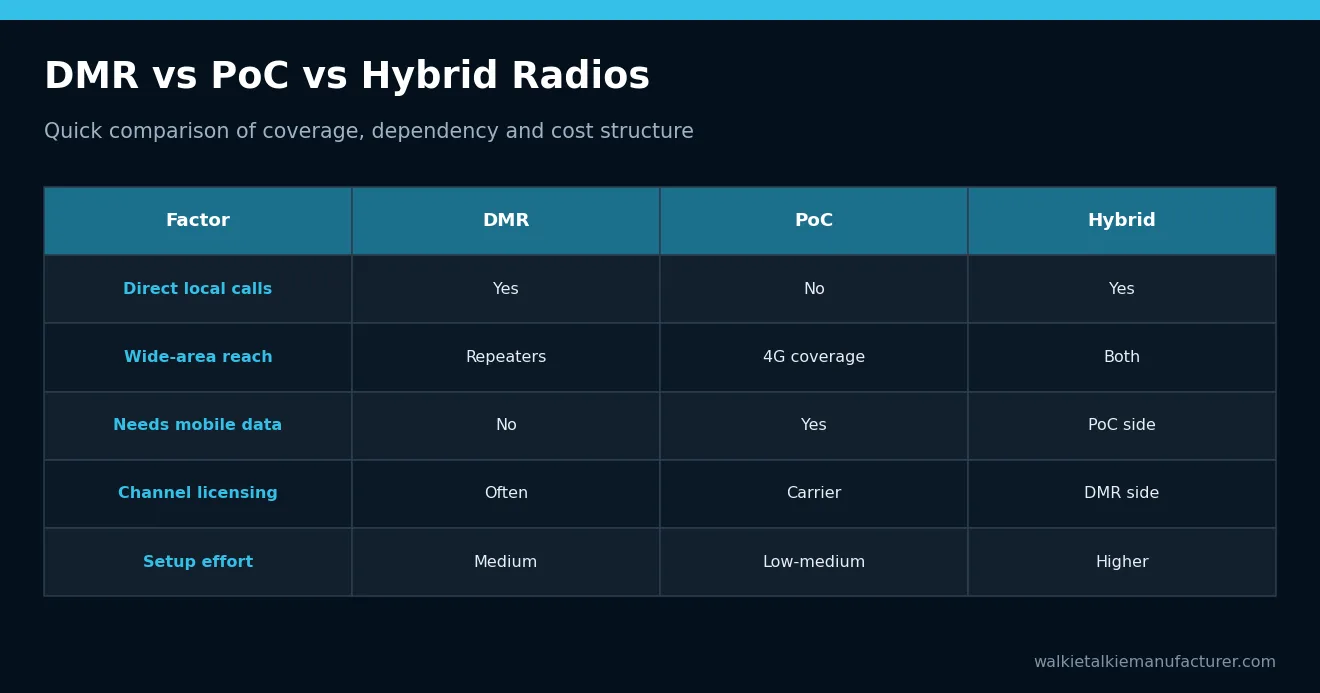
The table compares the three approaches on factors buyers often weigh.
| Factor | DMR only | PoC only | Hybrid DMR + PoC |
|---|---|---|---|
| Local direct calls | Yes | No | Yes |
| Wide-area reach | Via repeater networks | Via mobile coverage | Both |
| Works without mobile network | Yes | No | DMR side only |
| Recurring data costs | Usually none | Yes | Yes for PoC users |
| Licensing | Often required | Carrier handles spectrum | Required for DMR channels where applicable |
| Device complexity | Lower | Medium | Higher |
A hybrid adds flexibility but also more configuration, so budget time for programming and user training.
How DMR and PoC Groups Connect
There are three common ways hybrid systems link the two worlds, and each has trade-offs.
- Manual switching: the user selects DMR or PoC mode. Simple, but calls in the other mode may be missed.
- Dual monitoring: the radio listens on both and plays whichever call is active. Behavior during simultaneous calls should be tested.
- Gateway interconnect: a gateway bridges selected DMR channels or talk groups to PoC groups so users on either side hear each other. This adds hardware and setup.
Ask the manufacturer which methods the proposed model supports, with which PoC platforms, and whether a gateway is required. A short demonstration or sample test with your real configuration is the best way to confirm it.
Key Specs to Define
Hybrid radios have more variables than single-mode radios. Put these in your specification:
| Area | What to define | Why it matters |
|---|---|---|
| DMR frequency band | UHF or VHF range for your license | Must match permitted channels |
| DMR tier and modes | Tier II conventional, repeater support | Compatibility with existing fleet |
| LTE bands | Bands of local carriers | PoC coverage |
| PoC platform | Supported platforms and accounts | Group management and dispatch |
| Interworking | Switching, dual watch or gateway | User experience |
| Ruggedness and audio | IP rating, speaker, accessories | Site conditions |
If you already run DMR two way radios, list the existing models and settings so the manufacturer can check interoperability, such as color codes, talk groups and any encryption in use.
Licensing and Compliance Points
The PoC side normally uses the carrier’s licensed spectrum, so you do not license it yourself. The DMR side is different: business radio channels usually need a license or authorization depending on the country. In the US, most business radios operate under FCC Part 90 and require a license for the frequencies used. Our guide on licensed vs license-free walkie talkies covers the basics.
Compliance documents also cover both radio functions. Support for FCC, CE RED, RoHS and battery transport documents depends on the selected model and the destination market, so confirm this with the manufacturer early.
If radios are sold into several countries, ask whether one hardware version can cover them all or whether regional variants are needed for DMR frequency ranges and LTE bands. Regional variants are common and affect stock planning for distributors.
Costs and Management Considerations
Hybrid radios typically cost more than single-mode radios because they contain two radio systems and more complex software. Total cost also includes data plans and platform accounts for the PoC side, plus repeater and licensing costs for DMR if you do not already have them.
Management takes more effort as well: two sets of channel or group plans, SIM cards, firmware for both functions and user training. Many buyers limit hybrids to supervisors, drivers or roaming staff, and equip fixed-site workers with standard DMR radios. This mixed fleet approach often gives the coverage benefit at lower cost.
Plan the group structure before programming. Decide which DMR channels or talk groups map to which PoC groups, who can hear cross-network traffic, and which groups should stay local only. Our guide to channel and talk group planning provides a practical framework.
Choosing a DMR PoC Radio Manufacturer
Because hybrids combine two technologies, supplier expertise matters. Look for a manufacturer that can explain its interworking approach clearly, programs both the DMR and PoC sides, supports the platform you plan to use, and provides programming software and documentation.
- Can they demonstrate the hybrid mode with your platform?
- Do they supply programming software and training for distributors?
- Can they preconfigure radios and brand them for your market?
- What compliance documents can they support for your destination?
- How are firmware updates handled after delivery?
See our DMR radio manufacturer page for model families and OEM options.
What to Send When Requesting a Quote
To get a relevant proposal for hybrid DMR + PoC radios, include:
- Destination country, DMR frequency band and existing license details if any
- Existing DMR radios and repeaters you need to work with
- Mobile carriers and PoC platform, or a request for recommendations
- Preferred interworking method: switching, dual watch or gateway
- Accessories, branding and packaging needs
- Estimated quantity and sample requirements
Send the details through our contact page and we will recommend suitable models and explain compliance support for your market.
Related Guides
Planning a PoC or 4G radio fleet?
Tell us the countries, network needs and fleet size. We will recommend suitable PoC/LTE models, explain platform options and arrange samples for testing before you order.
Get a Quote →View PoC & 4G RadiosFrequently Asked Questions
What is a hybrid DMR PoC radio?
It is a handset that combines a DMR digital radio transceiver with a 4G LTE push-to-talk over cellular function. Users can talk directly on site using DMR and reach wider teams over the mobile network using PoC. How the two modes work together depends on the model, firmware and platform.
Do I need a license for a hybrid radio?
The PoC side uses the mobile carrier’s spectrum, so no separate radio license is usually needed for it. The DMR side typically requires a license or authorization for business channels, depending on the country. In the US, business radios generally operate under FCC Part 90 licensing rules.
Can hybrid radios talk to my existing DMR fleet?
Often, yes, if the DMR side uses a compatible band, tier and settings such as color codes and talk groups. Encryption and proprietary features may limit compatibility. Share your existing radio models and programming with the manufacturer and test samples with your current fleet before ordering.
Are hybrid radios better than carrying two devices?
For many users, one hybrid handset is easier to carry, charge and manage than a separate radio and phone. However, hybrids are more complex and usually cost more. Many organizations issue hybrids only to supervisors and roaming staff while fixed-site workers keep standard DMR radios.
Can hybrid DMR PoC radios be private labeled?
Many manufacturers offer OEM options such as logo, housing color, packaging, manuals and preset programming for hybrid models. Firmware and platform customization may also be possible. Requirements and compliance support vary by model and destination market, so discuss them with the manufacturer before sampling.
Get a Factory Recommendation & Quote
Tell us your product type, quantity, target country, application, coverage, frequency or network and OEM requirements. We will review suitable options, MOQ factors, estimated lead time and the next sample step.
Prefer a direct conversation? Email lorabanzhitao@gmail.com or message WhatsApp +86 173 1689 5054.