
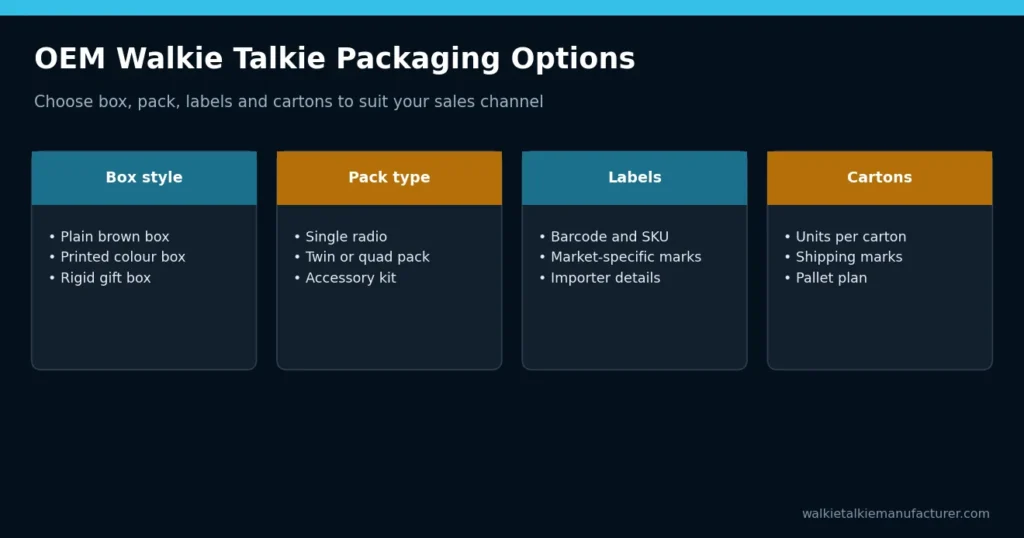
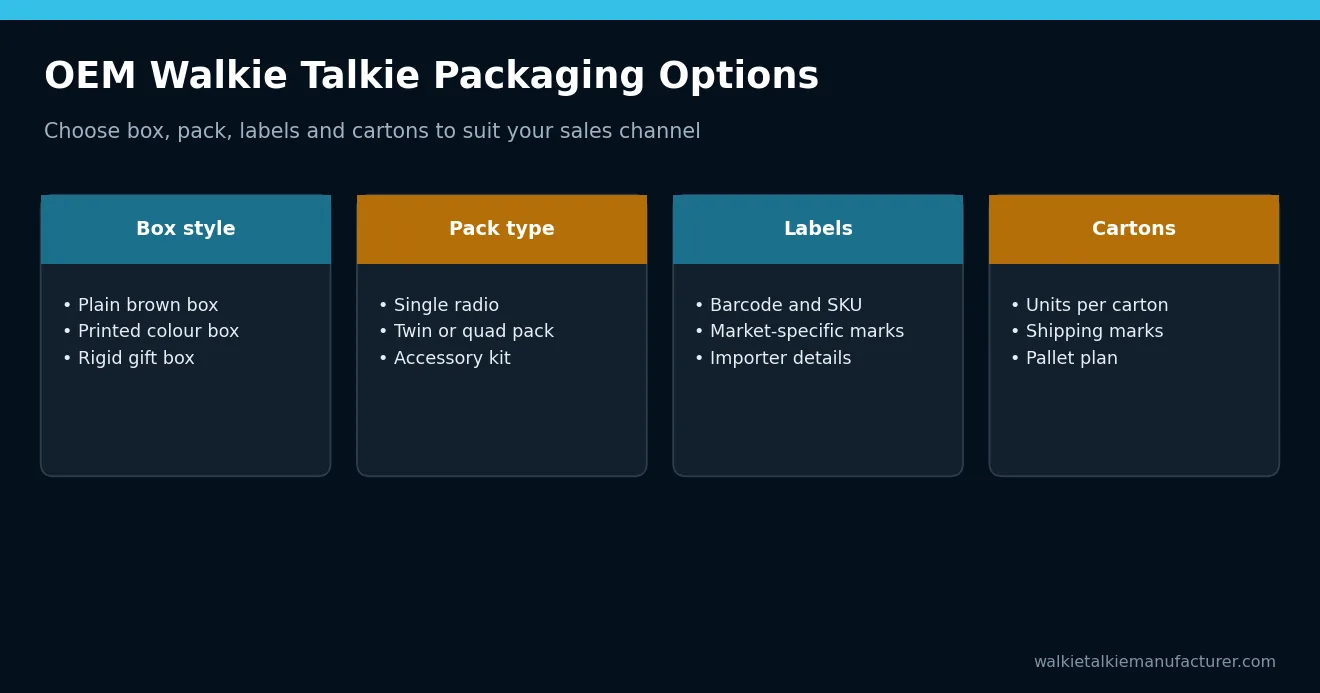
Walkie talkie packaging for retail and distribution must protect radios in transit, present your brand on the shelf or in a catalogue, and carry the right labels for your market. When buying radio packaging through an OEM manufacturer, you choose the box style, pack configuration, inserts, printing, barcodes, manuals and master cartons. This guide explains the common options, what each one suits and which details to approve before mass production so your packaged radios arrive ready to sell.
Why Packaging Matters for Radio Buyers
Packaging is often treated as the last detail of an OEM order, but it affects freight cost, damage rates, retail acceptance and how professional your brand looks. A radio that works perfectly can still be returned if it arrives in a crushed box or without the correct label.
Distributors also use packaging to separate product lines. A plain, sturdy box may suit a B2B fleet sold through dealers, while a printed colour box with feature icons suits retail channels and online marketplaces.
Packaging is one part of a larger private label decision. Our OEM walkie talkie buying guide covers the other choices, from housing colour and logo to firmware and manuals.
Box Styles for Walkie Talkie Packaging
| Box style | Best for | Considerations |
|---|---|---|
| Plain brown box | B2B fleets, replacement units | Low cost; add a printed label |
| Printed colour box | Retail, e-commerce, distributors | Artwork approval, higher cost |
| Rigid gift box | Premium lines, corporate gifts | Heavier, more carton space |
| Window box or blister | Retail display of consumer radios | Less protection; check store rules |
| Bulk tray pack | Rental companies, large fleets | Fewer boxes, faster unpacking |
The right choice depends on where the radio is sold and who opens the box. A rental company opening 200 radios wants fast unpacking and minimal waste; a retailer wants shelf appeal and theft resistance.
Pack Configurations: Single, Twin and Kit
Consumer license-free radios are often sold in twin or multi-packs, while professional radios are usually sold singly with accessories. Decide the configuration early because it changes the insert design, carton count and pricing structure.
- Single pack: one radio, battery, antenna, belt clip, charger and manual.
- Twin or quad pack: multiple radios with shared or individual chargers.
- Kit pack: radio plus earpiece or speaker microphone for a specific use.
- Fleet pack: radios without chargers, paired with a separate multi-unit charger.
If accessories are part of your bundle, check connector compatibility and available options on our walkie talkie accessories supplier page.
Inserts and Protection Inside the Box
Inserts hold the radio and accessories in place and absorb shock. Common materials include folded cardboard, moulded paper pulp, EVA foam and plastic trays. Paper-based inserts are increasingly preferred because they are easier to recycle and meet retailer sustainability requirements in some markets.
Ask the manufacturer to show a packed sample and to explain how the battery and antenna are secured. Loose accessories rattling inside a box are a common cause of scratched housings and customer complaints.
Transit testing
Many buyers ask for simple drop and vibration checks on packed cartons. Industry transit test procedures such as those published by ISTA can be referenced in your specification if your customers or retailers require them; confirm with the manufacturer which tests can be arranged.
Labels, Barcodes and Regulatory Markings
Labelling requirements depend on the destination market and sales channel. Prepare these items before artwork is finalised:
| Item | Who usually provides it | Notes |
|---|---|---|
| Barcode (EAN or UPC) | Buyer, from their own registration | Needed by most retailers |
| Model and SKU label | Buyer and manufacturer together | Match your ERP and catalogue |
| Regulatory marks | Depends on model approval | Only print marks the model supports |
| Recycling and disposal symbols | Market specific | For example WEEE symbol in the EU |
| Importer name and address | Buyer | Required in some markets |
| Battery handling marks | Depends on packing method | Relevant to lithium shipments |
Never ask a factory to print a certification mark that the specific model does not support. For EU and Japan requirements, see our article on CE, RoHS and PSE certification for walkie talkie imports.
Manuals, Inserts and Printed Materials
Users expect a manual in their own language, and some markets require safety information to be supplied in the local language. Private label manuals can carry your logo, support contact details, channel tables and warranty terms that you define.
Other printed materials worth considering include quick-start cards, frequency and licence notices, registration cards and dealer information. Keep file names and version numbers on every artwork file so repeat orders use the correct revision.
If you sell in several countries, consider a multilingual manual or a short printed guide with a link to full manuals on your website. This reduces the number of box variants you need to stock while still giving each user clear instructions for charging, channel selection and safe battery use.
Matching Packaging to Each Sales Channel
The same radio may need different packaging depending on where it is sold. Planning this early avoids reprinting boxes or relabelling stock in your warehouse later.
Retail stores
Retail buyers look for clear product photos, feature icons, a visible model name and a barcode that scans first time. Some chains specify box dimensions, hang tabs or security tag positions, so ask for their packaging manual before artwork starts.
E-commerce and marketplaces
Online orders are handled individually and often shipped in the retail box itself, so strength matters more than shelf appeal. Some marketplaces have their own rules on packaging, labelling and battery shipments, which should be checked before launch.
Dealers and business fleets
Dealers who programme radios before delivery prefer boxes that open and close easily without damage. For fleet customers such as factories, simple packaging with fleet labels can reduce waste. See how fleets are specified on our walkie talkies for manufacturing page.
- Keep one master artwork with channel-specific label variants.
- Use SKU suffixes to distinguish retail and fleet packs.
- Store approved samples of each version for future quality checks.
Master Cartons, Pallets and Shipping Marks
The master carton is the outer box that protects retail boxes during shipping. Its dimensions, number of units and weight determine how many cartons fit on a pallet or in a container, which directly affects freight cost per radio.
- Agree units per master carton and carton dimensions.
- Confirm gross weight limits for manual handling in your warehouse.
- Define shipping marks: brand, order number, carton number, destination.
- Decide whether cartons need your barcode or SKU label.
- Check pallet requirements, including height and wood treatment rules.
Warehouse teams appreciate consistent carton sizes across product lines, so consider standardising master cartons for radios, chargers and accessories where possible.
What to Send When Requesting a Quote
For an accurate packaging quotation, share:
- Radio model or type and pack configuration
- Box style, material and printing method you prefer
- Artwork files or brand guidelines, plus barcode numbers
- Destination market and language for manuals and labels
- Sales channel: retail, e-commerce, dealer or fleet
- Units per master carton and pallet preferences
Send your packaging brief through our contact page. We will confirm available options, sample packaging and which labels depend on the selected model and market.
Related Guides
Sourcing radios for your brand or distribution business?
We support OEM and private label orders: logo, housing color, packaging, firmware and channel programming. Send your target market and quantities for a quote and samples.
Get a Quote →Browse Our RadiosFrequently Asked Questions
Can I use my own logo on walkie talkie packaging?
Yes. OEM and private label orders usually allow your logo, colours and artwork on the box, manual and labels. Packaging customisation options depend on the order quantity and packaging type, so confirm with the manufacturer. Approve digital proofs and a printed sample before mass production starts.
Who provides the barcode for private label radios?
The brand owner usually provides the barcode, because EAN or UPC numbers are registered to the company selling the product. The manufacturer prints the barcode on the box or label using the numbers and format you supply. Test scan a printed sample before approving production.
Is eco-friendly packaging available for walkie talkies?
Many manufacturers can offer paper pulp or cardboard inserts, reduced plastic, recycled board and soy-based inks. Availability and cost depend on the supplier and box design. If retailers in your market have sustainability requirements, include them in your packaging brief so they can be checked before artwork is finalised.
What should be printed on a walkie talkie retail box?
Typical content includes brand, model, key features, box contents, barcode, regulatory and recycling marks where applicable, importer or brand contact details and safety information. Exact requirements depend on the destination market and the model’s approvals, so check local rules and only print marks the product supports.
Does packaging affect shipping costs?
Yes. Box size, insert design and units per master carton determine how many radios fit on a pallet or in a container. Oversized gift boxes can raise freight cost per unit noticeably. Ask for carton dimensions and weights early and compare options before finalising the design.
Get a Factory Recommendation & Quote
Tell us your product type, quantity, target country, application, coverage, frequency or network and OEM requirements. We will review suitable options, MOQ factors, estimated lead time and the next sample step.
Prefer a direct conversation? Email lorabanzhitao@gmail.com or message WhatsApp +86 173 1689 5054.