
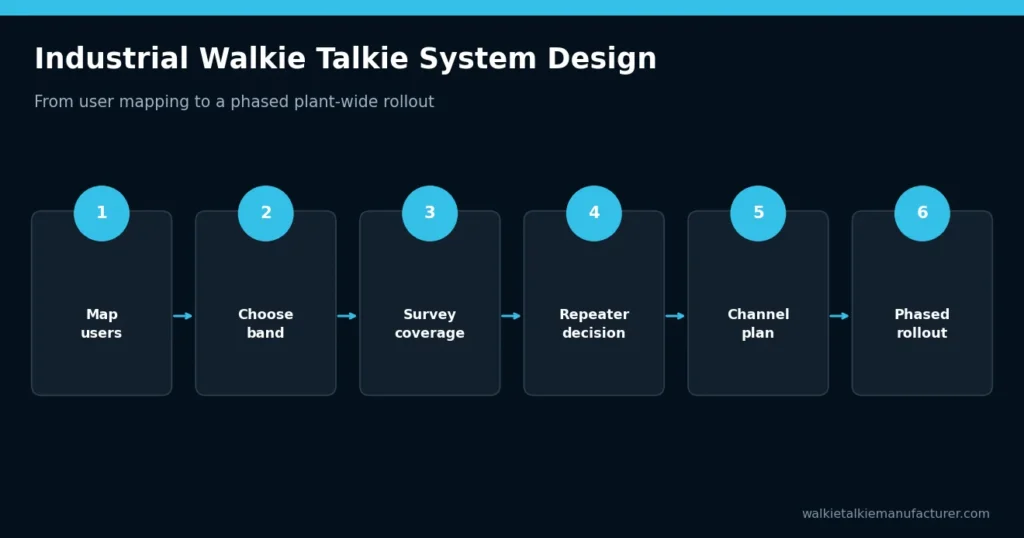
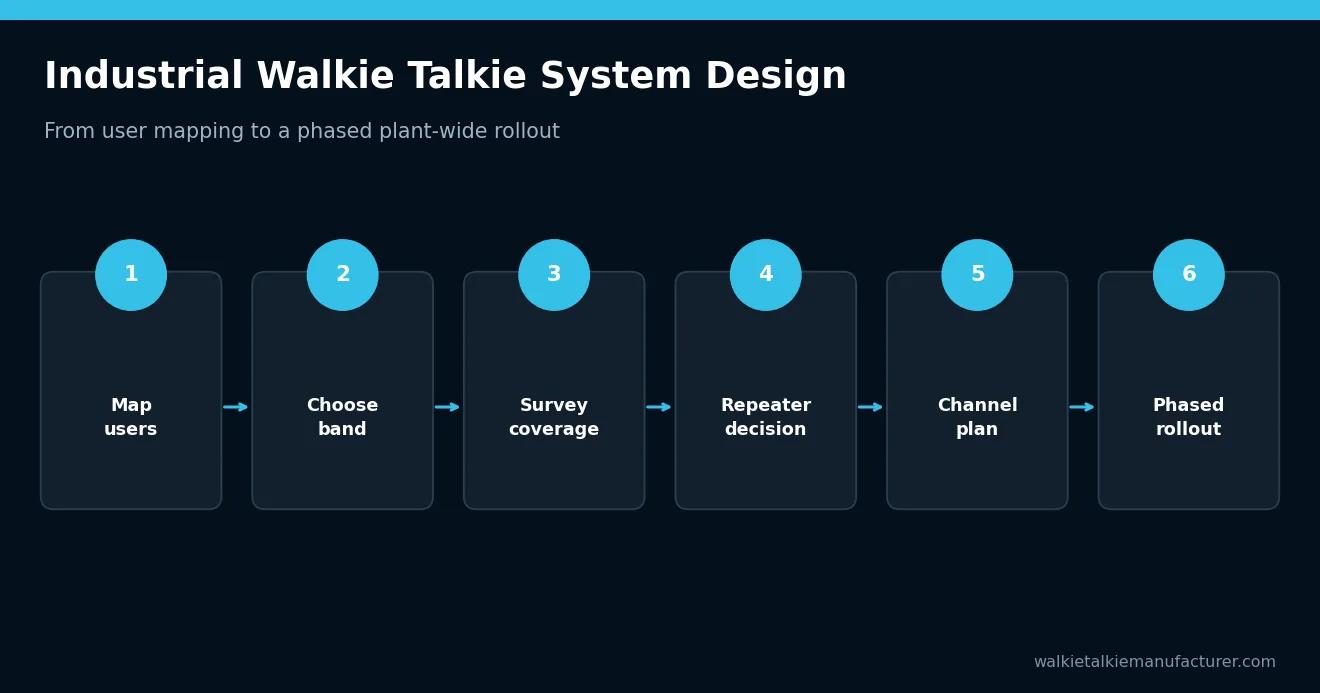
An industrial walkie talkie system is more than a box of radios. It combines portable radios, possibly a repeater, a channel or talk group plan, accessories, charging and programming into one design that fits the plant’s layout and workflows. Most plants choose industrial UHF radios for steel buildings, add a repeater only when a site survey shows gaps, and separate teams into channels by function. This guide walks through each design step, from user mapping to rollout.
Step 1: Map Users and Workflows
Start with people, not radios. List every team that will use the system, how many users each team has, and who needs to talk to whom. A maintenance technician may need to reach production, safety and the control room, while a forklift driver only needs dispatch and the warehouse lead.
| Team | Users | Talks to | Special needs |
|---|---|---|---|
| Production | Line leads, operators | Maintenance, quality | Noise, gloves |
| Maintenance | Technicians | All teams | Roaming whole site |
| Warehouse / logistics | Drivers, pickers | Dispatch, shipping | Vehicle use |
| Security | Guards, gatehouse | Management, emergency | Night shifts, outdoors |
| Safety / EHS | Officers | All-call | Emergency priority |
Count radios per role, then add a spare pool for breakdowns, visitors and contractors. Decide which radios are personal and which are shared between shifts, because shared radios need central charging, clear labeling and a check-out routine. Supervisors and maintenance staff who roam the whole site usually need radios that can scan several channels.
This map becomes the basis for channel planning, radio counts, accessory choices and programming. It also shows which users need emergency or lone worker features.
Step 2: Choose Industrial UHF or VHF Radio
Band choice is driven by the building. UHF signals generally cope better with steel structures, concrete walls and dense indoor layouts, which is why most plants and warehouses choose industrial UHF radio. VHF can be a better fit for large open outdoor sites with few obstructions, such as quarries, yards or farms.
Mixed sites often still choose UHF for everything to keep one fleet and one accessory range. Available frequencies and licensing also matter, because the band you can legally use may narrow the choice. Our comparison of UHF vs VHF for warehouses and industrial sites explains the trade-offs in more depth.
Step 3: Survey Coverage Before Buying Infrastructure
Real-world coverage inside a plant cannot be predicted reliably from a spec sheet. Walls, tanks, racking, mezzanines, basements and cold rooms all block or reflect signals. A simple survey with two sample radios gives far better information than any range figure.
- Place one radio at a central, typical location such as the control room.
- Walk the site with a second radio, testing clear two-way calls at each area.
- Include basements, stairwells, freezers, outdoor yards and parking areas.
- Mark each location as clear, weak or no contact on a site plan.
- Repeat at busy production times, when machinery and vehicles are active.
Keep the survey results with the system documentation. They become the baseline for future changes, such as a new production hall or extra racking, which can change coverage in ways nobody expects until radios stop working in a particular corner.
If all areas are clear, a direct radio-to-radio system may be enough. If gaps remain, consider antenna placement, a higher-mounted base station or a repeater.
Step 4: Decide Whether You Need a Repeater
A repeater receives a signal on one frequency and retransmits it on another from a better position, usually with a high-mounted antenna. It can extend coverage to difficult areas and between buildings, but it adds cost, licensing and maintenance.
| Situation | Typical approach |
|---|---|
| Single building, good survey results | Direct mode, no repeater |
| Large building with dead spots | One repeater with a well-placed antenna |
| Several buildings on one campus | Repeater, possibly with outdoor antenna |
| Multiple sites in different cities | Linked repeaters or PoC radios |
| Basements, tunnels, dense steel areas | Repeater plus additional antenna solutions |
Our walkie talkie repeater buying guide covers repeater types, placement and what to ask the supplier. For multi-site operations, network-based PoC radios can connect locations without building a radio network.
Step 5: Build the Channel and Talk Group Plan
Channels keep teams from talking over each other. A typical plant starts with a small number of channels grouped by function, plus a common channel for site-wide announcements and emergencies.
- Production channel for line leads and operators.
- Maintenance channel that technicians scan while working with other teams.
- Logistics channel for warehouse, dock and dispatch.
- Security channel for guards and the gatehouse.
- Site-wide or emergency channel monitored by all radios.
With digital radios, talk groups and private calls allow finer control on fewer frequencies. Keep channel names consistent on every radio and document the plan. See our guide to channel and talk group planning for naming and scanning tips.
Step 6: Pick Analog, DMR or a Hybrid Approach
Analog radios are simple and widely compatible, which suits smaller plants or sites with existing analog fleets. Digital DMR radios often offer clearer audio toward the edge of coverage, better battery efficiency in many models, talk groups, private calls, text messages and optional features such as emergency alarms.
Many DMR radios can also operate in analog mode, which helps when a plant migrates in phases. If you are planning a new fleet or migration, our DMR radio manufacturing page outlines the models and OEM options available. Feature availability depends on the selected model and firmware.
Step 7: Complete the Industrial Walkie Talkie System
The system design should specify accessories per team, not as an afterthought. Operators in loud areas may need headsets or noise-cancelling speaker mics; maintenance technicians often prefer lapel mics; security staff usually use discreet earpieces.
- Multi-unit chargers located at shift-change points.
- Spare batteries for teams working long or overlapping shifts.
- Man-down or lone worker functions for isolated roles, where supported by the model.
- Emergency buttons programmed to alert supervisors or the control room.
- Intrinsically safe radios for hazardous areas, if the site has classified zones.
Plan where chargers will sit, who is responsible for them, and how faulty radios are reported and swapped. These routines keep the system working long after installation, when the original project team has moved on.
For a broader view of radios in factories, see our overview of walkie talkies for manufacturing.
Step 8: Roll Out in Phases
A phased rollout reduces risk. Start with one or two departments, gather feedback on coverage, audio and accessories, then adjust programming before expanding site-wide.
- Pilot with a representative team for a few weeks.
- Adjust channels, scan lists and accessory choices based on feedback.
- Train users on etiquette, emergency features and battery care.
- Deploy to remaining teams with pre-programmed radios and labeled chargers.
- Keep a spare pool of programmed radios for fast swaps.
Training is often underestimated. Short sessions on how to call, how to use the emergency button and how to swap batteries prevent most early complaints, and they help new users trust the system from day one.
Record radio serial numbers, assigned users and programming versions. This makes troubleshooting and future expansion far easier.
What to Send When Requesting a Quote
To design and quote an industrial walkie talkie system, the manufacturer needs:
- Site plan or description: building size, number of floors, basements, outdoor areas.
- User map: teams, number of users and who needs to talk to whom.
- Survey results or known dead spots, and any existing radios or repeaters.
- Preferred technology (analog, DMR or PoC) and licensed frequencies if available.
- Noise levels, hazardous zones, accessory needs and destination market.
Send this information through our contact page and we will propose radios, accessories and, if needed, repeater options for your plant.
Related Guides
Equipping a factory or plant floor?
Tell us the site size, noise level and number of users. We will recommend radios and noise-ready accessories and send samples for a shift test.
Get a Quote →Radios for ManufacturingFrequently Asked Questions
What is an industrial walkie talkie system?
It is a complete two-way radio setup designed for an industrial site: portable radios, optional repeaters or base stations, a channel or talk group plan, accessories, charging stations and programming. The design matches coverage and features to the plant’s layout, noise levels, teams and safety requirements.
Is UHF or VHF better for an industrial plant?
UHF is usually preferred inside plants and warehouses because it tends to handle steel structures, concrete and dense layouts better. VHF can suit large open outdoor sites. Licensing, available frequencies and a coverage test with sample radios should confirm the final choice.
Does every plant need a repeater?
No. Many single-building plants work well in direct radio-to-radio mode. A repeater is useful when a coverage survey shows dead spots, when the site spans several buildings or large outdoor areas, or when radios must reach basements and dense steel areas.
How many channels does a plant need?
Most plants start with a few channels organized by function, such as production, maintenance, logistics and security, plus a site-wide or emergency channel. The right number depends on users, traffic and workflows. Digital radios can add talk groups and private calls without needing many extra frequencies.
Can we mix analog and digital radios in one system?
Often yes, during a transition. Many DMR radios support analog mode, so they can talk to existing analog radios on shared channels. Digital-only features will not work with analog radios. Plan the migration carefully and confirm compatibility with the manufacturer before ordering.
Get a Factory Recommendation & Quote
Tell us your product type, quantity, target country, application, coverage, frequency or network and OEM requirements. We will review suitable options, MOQ factors, estimated lead time and the next sample step.
Prefer a direct conversation? Email lorabanzhitao@gmail.com or message WhatsApp +86 173 1689 5054.