
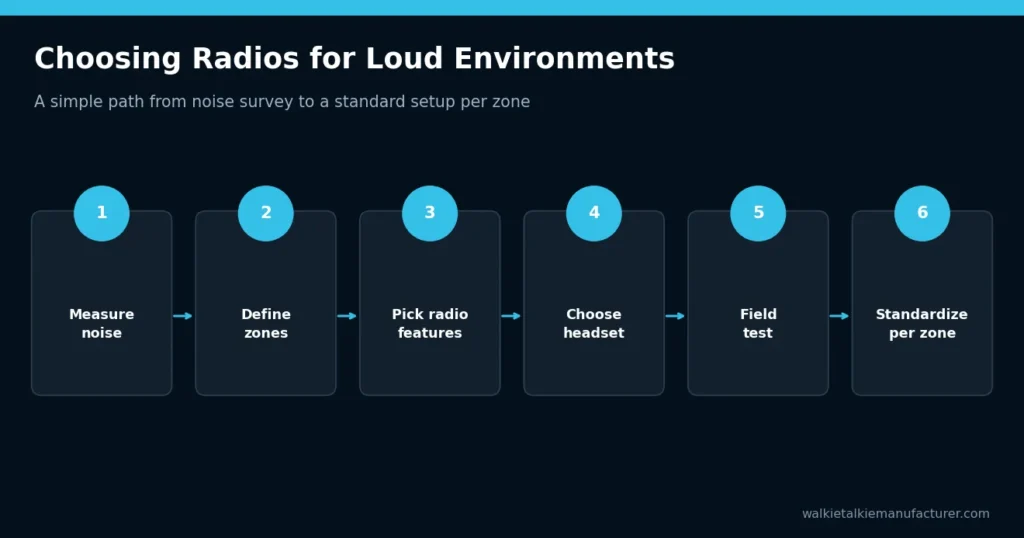
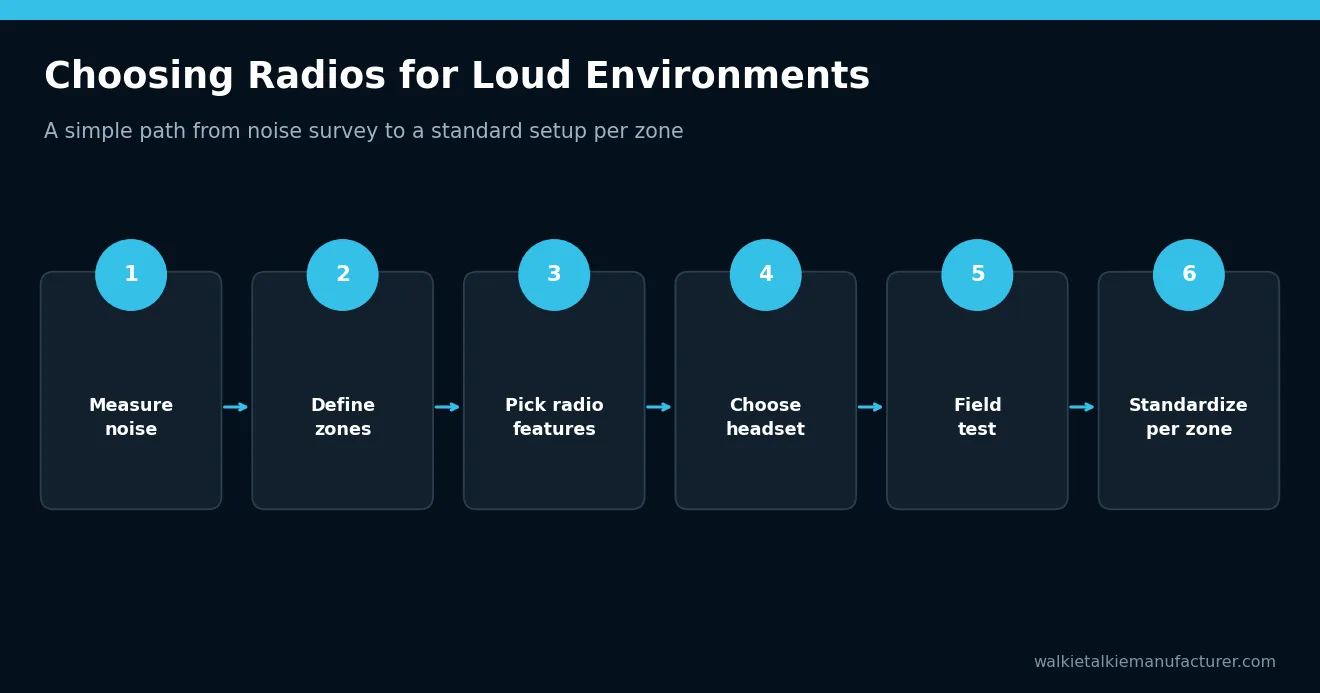
The best two-way radios for loud environments combine a loud, clear speaker, digital noise reduction on the microphone, and a headset that protects hearing while delivering radio audio directly to the ear. In very noisy plants, ports, mines and workshops, the headset and microphone matter as much as the radio itself. This guide explains how noise affects radio communication, which features to specify, how hearing protection headsets work, and how to test a setup before buying for the whole team.
How Noise Breaks Radio Communication
Noise causes two separate problems. On the receive side, the listener cannot hear the radio speaker over machinery, so messages are missed or misunderstood. On the transmit side, the microphone picks up background noise along with the voice, so everyone else on the channel hears a compressor, engine or grinder instead of clear speech.
Turning the volume up solves neither problem well. A loud speaker competes with noise that may already be at harmful levels, and a loud transmitting environment still reaches the microphone. The effective fix is to separate voice from noise at both ends: close to the ear for listening and close to the mouth for speaking.
A third problem is attention. In noisy work, staff often do not notice an incoming call at all. Visual and vibration alerts help here, and they are often overlooked in specifications.
Noise Levels and Hearing Protection Rules
Noise exposure is regulated in many countries. In the US, OSHA 29 CFR 1910.95 sets an action level of 85 dBA as an 8-hour time-weighted average, at which employers must run a hearing conservation program. Other regions have similar limits. The table below gives rough examples of noise levels to help frame requirements; actual levels must be measured on site.
| Environment | Typical noise character | Communication approach |
|---|---|---|
| Warehouse, light assembly | Moderate, intermittent | Speaker mic or earpiece |
| Production line, workshop | Loud, continuous | Headset or noise-reducing mic |
| Stamping, metal fabrication | Very loud, impulsive | Hearing protection headset |
| Ports, airport ramps | Engines, wind, traffic | Over-ear headset, boom mic |
| Mining, tunnels | Machinery, echo | Helmet-mount headset |
If a site is near or above the action level, communication accessories should be chosen together with the hearing protection program, not separately.
Radio Features That Matter in Noise
- Loud, clear speaker: audio output varies by model; test at maximum volume for distortion rather than relying on a number on the spec sheet.
- Digital noise reduction: many digital radios filter background noise from transmitted audio; performance depends on the model and settings.
- Vibration alert: the radio vibrates on incoming calls, useful when the ring or voice cannot be heard.
- Bright LEDs and display: show channel activity and calls at a glance.
- Programmable buttons: fast access to emergency, call or channel functions with gloves on.
- Rugged accessory connector: headsets are plugged and unplugged constantly and must stay firmly connected.
Digital platforms such as DMR often include audio processing that helps in noisy work. Our DMR radio manufacturing page covers the radio models and customization options available.
Headsets With Hearing Protection
A hearing protection headset combines passive attenuation (ear cups that block noise) with a speaker in each cup that delivers radio audio. A boom microphone sits in front of the mouth to capture voice clearly.
Passive headsets
Ear cups block noise, and radio audio is played inside the cup. Simple and reliable, but users may feel cut off from nearby colleagues and warning sounds.
Level-dependent (talk-through) headsets
External microphones let quieter ambient sounds such as speech and alarms through, while limiting loud noise. Staff can talk face to face without removing the headset, which improves compliance because workers are less tempted to lift a cup.
Mounting styles
Headband, neckband and helmet-mount versions are available. Helmet-mount units attach to hard hat slots, while neckband designs suit users who wear face shields or welding helmets.
Microphone Choices for Loud Sites
| Microphone | Voice pickup in noise | Typical use |
|---|---|---|
| Radio’s built-in mic | Weak | Quiet to moderate areas |
| Standard speaker mic | Moderate | Warehouses, outdoor sites |
| Noise-cancelling speaker mic | Good | Plants, construction, logistics |
| Headset boom mic | Very good | Loud machinery areas |
| Throat or bone-conduction mic | Good in extreme noise | Specialist, check comfort |
For a deeper look at transmit-side noise, read our guide to noise-cancelling speaker microphones. The right choice depends on whether users also need hearing protection; if they do, a headset with a boom microphone usually solves both needs at once.
Industry Examples
Different sectors combine these tools in different ways:
- Manufacturing plants: supervisors often use noise-cancelling speaker mics, while line operators in the loudest zones use headsets. See our overview of walkie talkies for manufacturing.
- Mining and tunnels: helmet-mount headsets and cap-lamp compatibility are common; hazardous areas may also require intrinsically safe equipment. Our guide to walkie talkies for mining and tunnels covers coverage and safety topics.
- Ports and airport ramps: wind noise is a major issue, so boom microphones with windscreens help.
- Event production: single-muff headsets let crew hear both the radio and stage cues.
Warehouses and cold stores usually sit in the middle of the range. Forklift drivers and pickers often manage with a rugged speaker mic, while staff near conveyors, compressors or dock doors may need a headset. Grouping users by zone rather than by job title keeps the accessory plan realistic.
In every case, the goal is the same: the right audio at each workstation, not a single accessory for everyone.
Common Mistakes to Avoid
- Buying one accessory for every zone: quiet offices and loud production areas need different audio solutions.
- Relying on maximum volume: very high speaker volume in a loud area adds to noise exposure and still may not be understood.
- Ignoring the transmit side: a headset that sounds good to the wearer may still send noisy audio to everyone else.
- Skipping comfort checks: staff remove uncomfortable headsets, which defeats both communication and hearing protection.
- Forgetting spares: ear cushions, windscreens and cables wear out and should be stocked from the start.
Another frequent issue is mixing incompatible accessories across a fleet. If some radios come from a different model family, connectors and audio levels may differ, so a headset that works on one radio may sound quiet or distorted on another. Standardizing radio models in loud zones makes accessory management far simpler.
How to Test a Setup Before Buying
- Measure or obtain noise levels for each work zone.
- Select two or three radio and accessory combinations per zone.
- Run tests during real production, not during a quiet shift.
- Have users transmit short standard phrases and score how clearly others understand them.
- Check comfort after a full shift, including with hard hats, glasses and gloves.
- Record which combination works best and standardize it for that zone.
Include both sides of the conversation in the test: a supervisor in a quiet office must also hear the operator clearly. Accessories for the trial can be sampled with radios from our walkie talkie accessories range.
What to Send When Requesting a Quote
To recommend radios and headsets for a loud environment, the manufacturer needs:
- Noise levels or a description of each work zone and the equipment running there.
- Number of users per zone and whether radios are shared between shifts.
- Hearing protection requirements and any helmets, face shields or PPE worn.
- Preferred radio type (analog, DMR or PoC) and any existing radios to stay compatible with.
- Hazardous-area requirements, if any, and destination market.
Send your details through our contact page and we will suggest radio and headset combinations for on-site trials.
Related Guides
Equipping a factory or plant floor?
Tell us the site size, noise level and number of users. We will recommend radios and noise-ready accessories and send samples for a shift test.
Get a Quote →Radios for ManufacturingFrequently Asked Questions
What are the best radios for noisy environments?
Radios with a loud, clear speaker, digital noise reduction, vibration alerts and a robust accessory connector perform best, but the accessory matters just as much. In very loud areas, a hearing protection headset with a boom microphone usually outperforms any radio used on its own. Test combinations on site before choosing.
Can a walkie talkie headset replace hearing protection?
Only if the headset is designed and rated as hearing protection. Many communication headsets offer little attenuation. Where noise requires hearing protection, choose a headset with a stated attenuation rating that fits the site’s hearing conservation program, and confirm it meets local regulations.
What is a level-dependent headset?
A level-dependent or talk-through headset uses external microphones to pass quieter ambient sounds, such as nearby speech and alarms, into the ear cups while limiting loud noise. It helps workers stay aware of their surroundings and talk face to face without removing the headset.
Does digital radio sound better in noise than analog?
Digital radios often include noise reduction that removes background noise from transmitted voice, and digital audio stays clear until close to the edge of coverage. Results depend on the model and settings. Analog radios can work well too when paired with good noise-cancelling microphones or headsets.
How do I know which work zones need headsets?
Start with measured noise levels for each zone. Areas near or above the local hearing protection threshold usually need headsets that combine attenuation and communication. Moderate zones may be fine with noise-cancelling speaker mics or earpieces. A short on-site trial confirms the choice.
Get a Factory Recommendation & Quote
Tell us your product type, quantity, target country, application, coverage, frequency or network and OEM requirements. We will review suitable options, MOQ factors, estimated lead time and the next sample step.
Prefer a direct conversation? Email lorabanzhitao@gmail.com or message WhatsApp +86 173 1689 5054.