
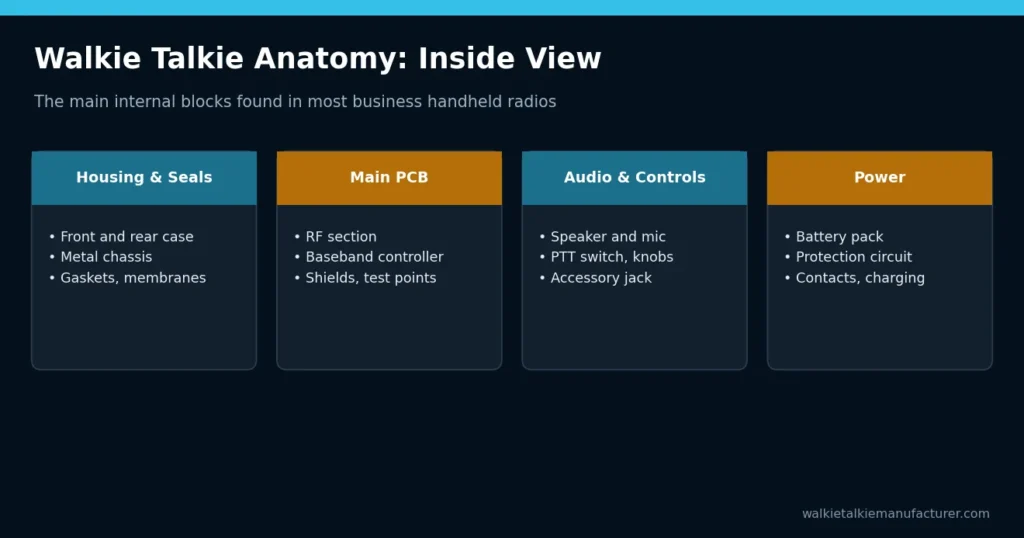
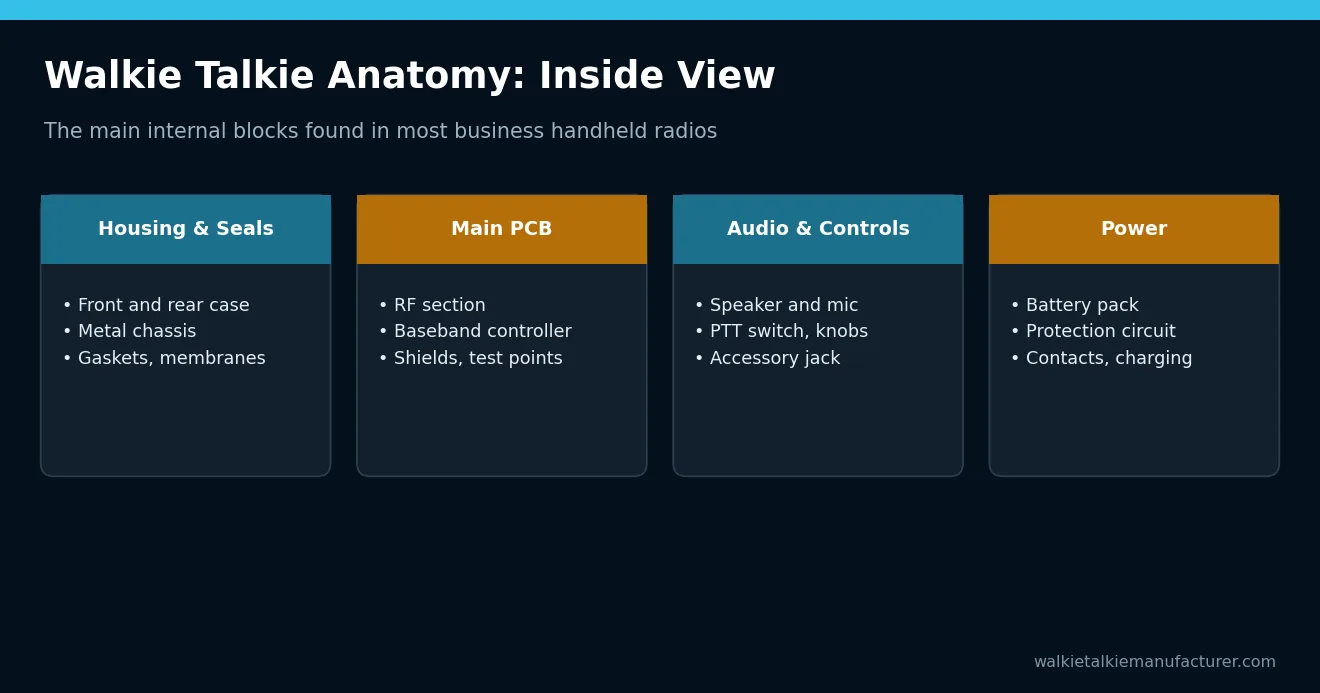
A walkie talkie teardown shows that a handheld radio is built from a few main blocks: a housing with seals, a main circuit board with RF and baseband sections, an antenna connection, a speaker and microphone, controls and a battery pack. Looking inside helps buyers understand walkie talkie anatomy, learn the radio parts names used in spec sheets and judge build quality. This guide walks through each layer and explains what to look for when evaluating samples from a manufacturer.
Why Buyers Look Inside a Radio
Two radios can share the same outer shape and headline specs yet differ considerably in reliability. A controlled teardown of a sample, done with the supplier’s agreement, shows how carefully the radio is assembled: the quality of seals, soldering, cable routing and component protection.
Distributors also benefit from knowing the internal layout because it affects repairability and which spare parts to stock. For an overview of the external parts and their functions, start with walkie talkie parts explained; this article focuses on what sits under the housing.
Walkie Talkie Anatomy: The Main Internal Blocks
Most business handheld radios, whether analog, DMR or PoC, contain similar building blocks.
| Block | Radio parts names | Function |
|---|---|---|
| Housing and chassis | Front case, rear case, metal chassis, gaskets | Structure, protection, heat spreading |
| Main PCB | Mainboard, RF section, baseband / controller | Radio functions and processing |
| Antenna path | Antenna connector, matching network, RF shield | Transmits and receives signals |
| Audio | Speaker, microphone, audio amplifier | Voice in and out |
| Controls | PTT switch, knobs, encoder, keypad, LEDs | User interface |
| Power | Battery pack, contacts, charging circuit, regulators | Supplies and manages power |
| Connectivity (PoC) | LTE module, SIM slot, GNSS, Wi-Fi, Bluetooth | Cellular and wireless functions |
The exact layout depends on the model, but these blocks appear in nearly every design.
Housing, Chassis and Seals
The outer housing is usually an engineering plastic, sometimes with a rubberized overmold for grip. Inside, many professional radios use a die-cast metal chassis that stiffens the structure and helps spread heat from the transmitter.
Seals decide how well the radio resists dust and water. Look for continuous gaskets around the case joint, sealed knobs and PTT, and protected speaker and microphone openings, often with a water-repellent membrane. The protection achieved depends on the design and testing; our guide to IP65 vs IP67 vs IP68 walkie talkies explains what the ratings mean.
- Gaskets seated evenly without twists or gaps
- Screws of consistent type and torque
- Membranes intact and properly bonded
- No sharp edges that could cut cables or seals
The Main PCB: RF and Baseband
The main circuit board is the heart of the radio. It typically has two functional areas. The RF section handles transmitting and receiving: oscillators, filters, the power amplifier and the receiver front end. It is usually covered by metal shields to reduce interference. The baseband or controller section handles channel logic, audio processing, digital protocols such as DMR, and the user interface.
In PoC radios, a cellular module replaces or supplements the conventional RF section, and an application processor runs the operating system and PTT client. Hybrid radios contain both.
Signs of careful manufacturing include clean, consistent solder joints, protective coating where specified, labeled test points and firmly fitted shields.
Antenna Connection and RF Path
The antenna connector links the external antenna to the RF section through a short path that must be well matched to avoid losses. Common designs use a threaded connector on top of the radio. Inside, check that the connector is firmly anchored to the chassis, because a loose connector can cause intermittent range problems.
Some radios use internal antennas for Wi-Fi, Bluetooth, GNSS and LTE, placed carefully in the housing. Their position and any nearby metal affect performance, which is one reason sample testing in real conditions is important.
A simple field check supports what you see inside: compare two samples side by side at the same distance and location, then swap antennas between them. If the difference follows the antenna, the issue is external; if it stays with the radio, the internal RF path deserves a closer look.
Audio Components: Speaker and Microphone
The speaker is typically a round or oval driver sealed against the front case, with a protective grille and membrane. Its size and the audio amplifier determine how loud and clear the radio sounds. The microphone is small and positioned behind a port on the front; some radios include a second microphone for noise reduction.
During a teardown, check how the speaker is secured and sealed, whether the microphone port has a membrane, and whether audio cables are routed away from sharp edges and heat sources. Audio problems are a frequent source of complaints, so these details matter.
Note the speaker size, the position of the microphone port and how close both are to the accessory jack. These details explain why some radios sound clearer in wind or noise than others, and they help when choosing matching speaker microphones.
Controls, Battery and Power Circuits
The PTT switch, knobs, side keys and LEDs connect to the main board through flexible cables or a small daughterboard. Robust mechanical fixing matters because the PTT is pressed thousands of times per shift across a fleet.
The battery pack is usually a separate sealed module containing lithium-ion cells, a protection circuit and contacts. On the radio side, power regulators and a charging circuit manage supply to each block.
| Area | What to inspect | Why it matters |
|---|---|---|
| PTT and keys | Switch fixing, flex cable strain relief | Most-used mechanical parts |
| Battery contacts | Plating quality, spring force | Poor contact causes resets |
| Battery pack | Cell fixing, protection circuit, labeling | Safety and shipping documents |
| Accessory jack | Seal and connector fixing | Common point of wear and water entry |
Battery packs shipped internationally need proper documentation such as UN38.3 test summaries; support depends on the selected model and destination market.
Using a Teardown in Supplier Evaluation
A teardown complements, rather than replaces, a factory audit and functional testing. Use it to compare samples from different suppliers against the same checklist, and to confirm that bulk production matches the approved sample.
- Agree with the supplier that samples may be opened for evaluation.
- Photograph each layer as you disassemble the radio.
- Record findings on seals, soldering, shielding, cable routing and labels.
- Compare against a second sample or a production unit later.
- Discuss any concerns with the manufacturer before placing a bulk order.
Our walkie talkie factory audit checklist covers the production side. To explore models for evaluation, see our analog radio manufacturer page.
What to Send When Requesting a Quote
If build quality is a priority, say so in your request and include:
- Radio type and target environment, including water and dust exposure
- Required protection rating and ruggedness expectations
- Whether you plan to open samples for evaluation
- Spare parts you want to stock, such as housings, knobs or batteries
- Branding, packaging and compliance documents required
- Estimated quantity and sample needs
Send the details through our contact page and we will recommend suitable models and share available documentation for your market.
Related Guides
Need accessories that fit your radios?
Send the radio models you use and the quantities you need. We will match earpieces, speaker mics, batteries, chargers and antennas and quote them together.
Get a Quote →View AccessoriesFrequently Asked Questions
What is inside a walkie talkie?
A handheld radio contains a housing with seals, a main circuit board with RF and baseband sections, an antenna connector, a speaker and microphone, controls such as the PTT switch and knobs, and a battery pack with protection circuitry. PoC radios also include an LTE module, SIM slot and processor.
Is it safe to open a walkie talkie?
Opening a radio can damage seals and void support arrangements, and battery packs should never be opened or punctured. If you want to inspect internal build quality, agree with the supplier first, use dedicated evaluation samples and have a trained technician do the work.
What are the main radio parts names I should know?
Useful terms include housing, chassis, gasket, main PCB, RF section, baseband or controller, power amplifier, antenna connector, speaker, microphone, PTT switch, channel encoder, accessory jack, battery pack and battery contacts. Knowing them helps when reading spec sheets and discussing repairs with suppliers.
What does a teardown reveal about quality?
It shows the care taken in assembly: seal fitting, solder quality, RF shielding, cable routing, screw consistency and how components are secured. These details influence long-term reliability, water resistance and repairability. A teardown should be combined with functional testing and a factory audit for a complete picture.
Are the internal parts of analog, DMR and PoC radios different?
The mechanical parts are similar, but the electronics differ. Analog and DMR radios use a conventional RF section and baseband controller, with DMR adding digital processing. PoC radios use an LTE cellular module and an application processor. Hybrid radios include both types of electronics.
Get a Factory Recommendation & Quote
Tell us your product type, quantity, target country, application, coverage, frequency or network and OEM requirements. We will review suitable options, MOQ factors, estimated lead time and the next sample step.
Prefer a direct conversation? Email lorabanzhitao@gmail.com or message WhatsApp +86 173 1689 5054.