
Walkie talkie parts that distributors should stock are the ones that wear out or get lost in daily use: batteries, antennas, belt clips, knobs, charger cradles and audio accessories. Internal boards and housings matter too, but they are usually handled as repair or exchange items. This guide explains which parts of a walkie talkie fail first, how to size a spare parts kit for your fleet, and what to agree with the manufacturer before placing a bulk order.
Why Spare Parts Decide Whether Customers Reorder
For a distributor, the radio sale is only the start. End users in warehouses, security and hospitality judge you on how fast a broken clip or dead battery gets replaced. If a site waits weeks for a simple antenna, radios sit in a drawer and the customer starts looking for another supplier.
Stocking the right walkie talkie parts reduces returns, keeps service revenue in-house and makes your price comparison less important than your support. It also protects your margin: many field faults are part swaps that a trained technician can do in minutes, rather than a full unit exchange shipped back to the factory.
If you need a refresher on what each component does, see our complete guide to walkie talkie parts. This article focuses on which parts to keep on the shelf.
Parts of a Walkie Talkie That Wear Out First
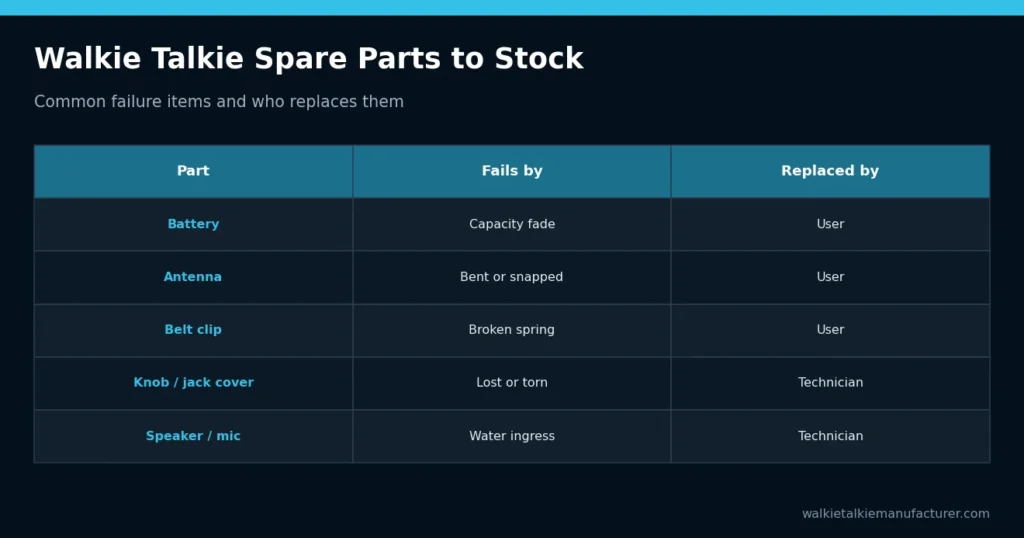
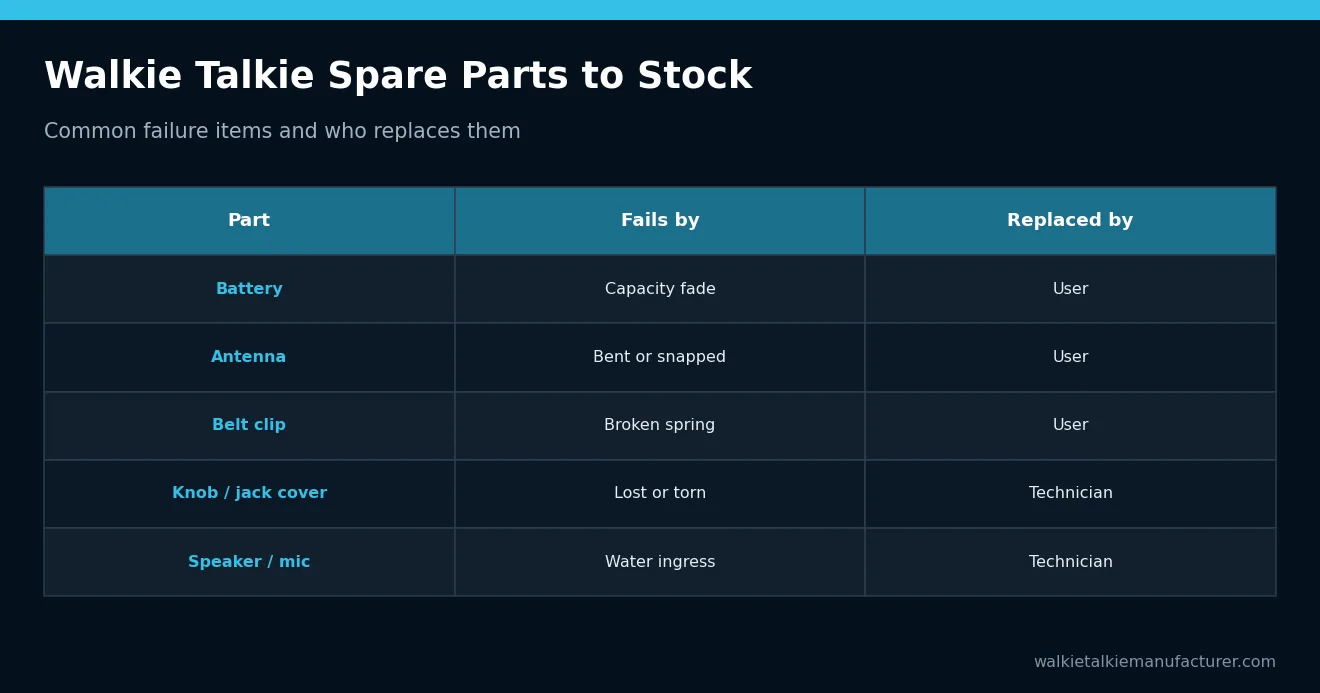
Failure patterns vary by model, duty cycle and environment, but most distributors see the same items return again and again. The table below groups common walkie talkie parts by how they usually fail.
| Part | Typical failure | Replacement type |
|---|---|---|
| Battery pack | Capacity fade, swelling, cracked latch | User-replaceable |
| Antenna | Bent or snapped whip, loose thread | User-replaceable |
| Belt clip | Snapped spring or clip arm | User-replaceable |
| Channel/volume knob | Lost cap, worn encoder feel | Technician |
| Accessory jack cover | Torn rubber, lost dust cap | Technician |
| Charger cradle | Worn contacts, cracked pocket | Swap unit |
| Speaker / PTT membrane | Water or dust ingress, torn membrane | Technician |
Environment changes the pattern. Radios used outdoors on construction sites tend to lose antennas and jack covers, while radios in hotels and retail mostly need new clips, batteries and earpieces. Cold storage and dusty plants add wear on seals and battery contacts, so compare return data by customer type rather than using one average for every account.
Batteries and antennas alone often account for a large share of service requests. Our battery and charging guide for 24/7 shifts explains how charging habits affect how quickly packs age.
Consumable Parts: The Core Spare Parts Kit
Consumables are the parts end users can replace without tools. They should always be in stock because demand is steady and predictable.
- Battery packs in the same chemistry and capacity as the original, from the same approved cell source where possible.
- Antennas matched to the radio’s band (UHF or VHF) and frequency range, not just the connector type.
- Belt clips and screws, which are cheap but among the most frequently lost items.
- Knob caps and jack dust covers, which protect the radio’s water and dust resistance.
- Earpieces and speaker mics, whose cables and plugs wear out faster than the radio itself.
Antenna mismatch is a common mistake: a wrong-band antenna fits the thread but can reduce range noticeably. Our walkie talkie antenna guide explains how to specify replacements correctly.
Repair Parts for Technicians and Service Centers
If you run a service bench, you will also need parts that require opening the radio. These are lower-volume but prevent full unit exchanges.
Mechanical and sealing parts
Front housings, rear chassis, gaskets, PTT rubber, speaker grilles and screw sets. After replacing any housing part, the radio’s water resistance should be re-checked; a technician cannot assume the original IP rating is restored without the correct gasket and torque.
Electronic parts
Speakers, microphones, battery contacts, channel switches and volume encoders. Main boards and RF modules are usually better handled as exchange assemblies from the manufacturer, since they need alignment and programming after replacement.
Tools and software
Programming cables, programming software for the specific model, and basic test equipment. Without these, even a simple board swap cannot be completed in the field.
How Much to Stock: Sizing Your Spare Parts
There is no universal ratio. The right quantity depends on fleet size, shift pattern, environment and how far you are from the factory. A useful approach is to start with a percentage of the installed base and adjust it using your own return data.
| Factor | Stock more when… | Stock less when… |
|---|---|---|
| Duty cycle | Radios run 24/7 in shifts | Single-shift use |
| Environment | Dust, rain, drops, chemicals | Offices, hotels, retail |
| Replenishment | Long sea freight lead times | Regional stock available |
| Fleet age | Radios are older | Fleet recently deployed |
| Model mix | Few models, big volumes | Many models, small volumes |
For a new fleet with no history, many distributors begin with a small buffer of batteries, antennas and clips per site, plus a few complete spare radios that can be swapped out immediately while a faulty unit is repaired. Spare radios should be pre-programmed with the customer’s channel plan so the swap takes seconds, not a technician visit.
Review usage every quarter. Parts that never move should be reduced, while fast movers such as batteries and clips should be reordered with each radio shipment to save freight.
Agree Spare Parts Terms Before the First Bulk Order
Spare parts supply is easiest to negotiate before you commit to a model. Once radios are deployed, you depend on the manufacturer for matching parts. Put the following points in writing:
- A spare parts list with part numbers, drawings or photos for each model you buy.
- How long the manufacturer plans to keep producing parts after a model is discontinued.
- Whether parts can be added to radio shipments to share freight.
- Which repairs your technicians may do without affecting after-sales terms.
- Access to service manuals, programming software and firmware files.
Our article on warranty and after-sales support covers how to structure these commitments. Exact parts availability periods and terms differ by manufacturer and model, so confirm them with the supplier.
OEM and Private Label Parts
If you sell radios under your own brand, spare parts must match your branding too. Housing colors, logo printing on front covers, battery labels and packaging for spare batteries may all need custom tooling or printing. Ask whether spare housings are produced in the same batch as the radios, because color shades can shift between production runs.
Batteries deserve extra attention. Replacement packs should carry the same markings and supporting documents as the originals, including UN38.3 test summaries where required for shipping. Support for these documents depends on the selected model and destination market.
Audio accessories are often the easiest way to add margin. Our walkie talkie accessories supply program covers earpieces, speaker mics, batteries, chargers and antennas that can be sourced with radio orders.
What to Send When Requesting a Quote
To get an accurate spare parts quotation alongside your radios, send the manufacturer a short, structured request:
- Radio models and the number of units in service or planned.
- Your list of required parts, with estimated annual quantities.
- Whether you need private label marking on housings, batteries or packaging.
- Destination market and any shipping document requirements for batteries.
- Whether you need programming software, cables and service manuals.
Send these details through our contact page and our team will reply with a parts list and options for the models you are considering.
Related Guides
Need accessories that fit your radios?
Send the radio models you use and the quantities you need. We will match earpieces, speaker mics, batteries, chargers and antennas and quote them together.
Get a Quote →View AccessoriesFrequently Asked Questions
What walkie talkie parts fail most often?
Batteries, antennas and belt clips are usually the most frequent replacements, followed by knob caps, jack covers, charger cradles and audio accessory cables. Exact failure rates depend on the model, the environment and how intensively radios are used, so track your own return data and adjust stock levels over time.
Can I use third-party batteries in a walkie talkie?
It is possible, but it carries risks. Poorly matched batteries can fit loosely, charge incorrectly or lack proper shipping documents. For a distributor, sourcing packs from the radio manufacturer or an approved source usually gives better compatibility and simpler after-sales support. Always confirm compatibility with the manufacturer before stocking.
Should distributors stock main boards?
Most distributors do not stock main boards for every model because they need alignment, programming and correct firmware after installation. Many prefer an exchange arrangement with the manufacturer for board-level faults, while keeping mechanical parts, speakers, microphones and consumables in local stock for fast repairs.
How long will spare parts be available for a model?
This depends on the manufacturer and the model’s life cycle. Ask the supplier in writing how long they plan to produce parts after a model is discontinued, and whether they will give notice before end of life so you can place a final parts order.
Does replacing a housing affect the IP rating?
It can. Water and dust resistance depends on correct gaskets, seals and screw torque. After opening a radio or replacing housing parts, a technician should use the correct seals and, ideally, test the radio before returning it to a wet or dusty environment.
Get a Factory Recommendation & Quote
Tell us your product type, quantity, target country, application, coverage, frequency or network and OEM requirements. We will review suitable options, MOQ factors, estimated lead time and the next sample step.
Prefer a direct conversation? Email lorabanzhitao@gmail.com or message WhatsApp +86 173 1689 5054.