

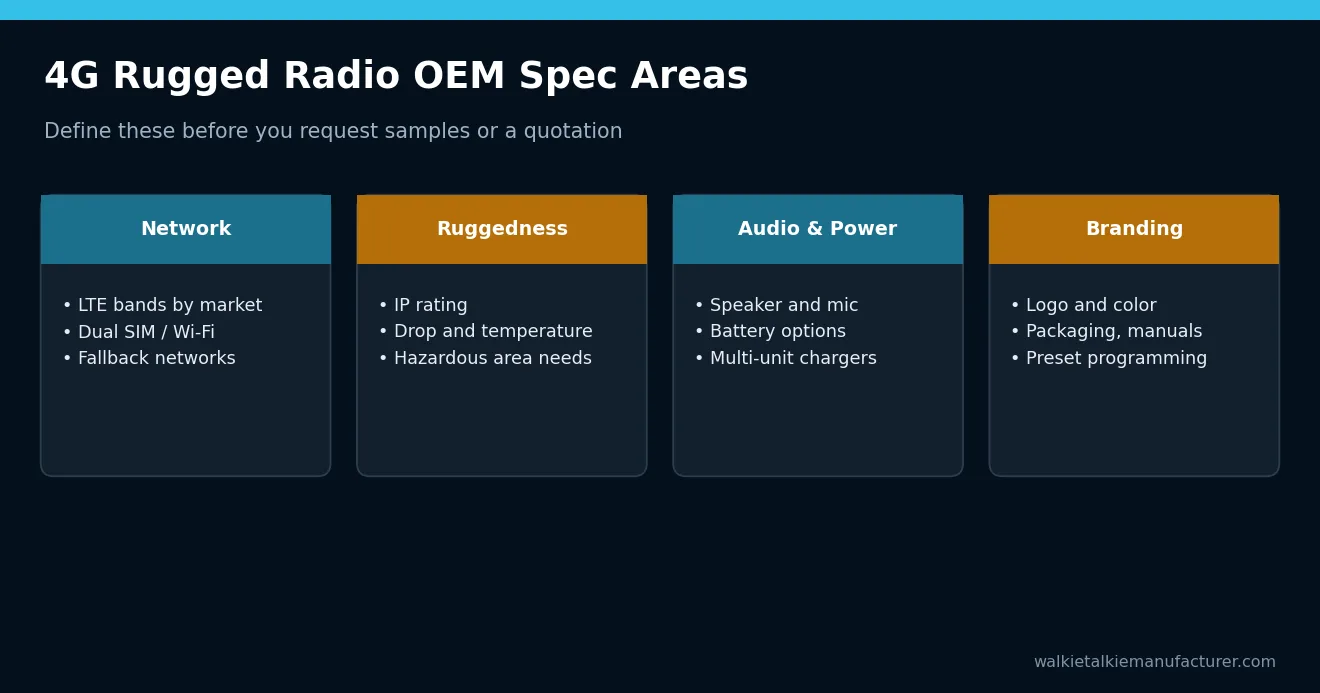
A successful 4G rugged walkie talkie OEM order starts with a clear specification, not a catalog photo. Before you request samples, define the LTE bands for your market, the level of ruggedness, audio performance, battery and charging needs, the PoC platform, accessories and branding. Clear specs let the manufacturer recommend the right base model, avoid costly changes after sampling and prepare compliance documents that match the version you actually sell.
Start With the Use Case
Every spec decision should trace back to who will carry the radio and where. A 4G LTE radio for a logistics driver has different priorities from one used by a security guard or a plant technician. Write a short profile for each user group before you look at models.
- Work environment: indoor, outdoor, dusty, wet, hot or cold
- Noise level and whether users wear hearing protection
- Shift length and how radios are charged between shifts
- Coverage: urban 4G, indoor sites, or areas with weak signal
- Who manages the fleet: your team, a distributor or the end user
This profile also helps you decide whether an LTE-only radio is enough or whether a hybrid model with conventional radio functions is needed.
If you sell to several industries, consider two or three specification tiers rather than one radio that tries to do everything. A basic tier for indoor retail or hospitality and a rugged tier for construction or logistics is a common structure for distributors, and it keeps stock and spare parts manageable.
Network and LTE Band Requirements
A walkie talkie 4G model must support the bands used by carriers in your destination countries. Band lists differ by region, so a model sold widely in one market may perform poorly in another. State every target country in your request and ask for the band list of the proposed version.
Also define fallback and connectivity options: support for older networks where they still operate, Wi-Fi for indoor coverage, dual SIM for multi-carrier fleets, and Bluetooth for wireless accessories. Our 4G walkie talkie manufacturer page shows the model families commonly used as a starting point.
Ruggedness Specs for 4G Rugged Walkie Talkies
“Rugged” is not a single standard, so put the details in writing. Ask which tests were performed on the exact model and request test reports where available.
| Spec | What to define | Notes |
|---|---|---|
| Ingress protection | Required IP rating | Rating applies to the tested configuration |
| Drop resistance | Expected drop height and surfaces | Ask how it was tested |
| Operating temperature | Lowest and highest site temperatures | Batteries are most affected by cold |
| Housing material | Impact and chemical resistance | Consider cleaning agents used on site |
| Hazardous areas | Whether intrinsic safety is required | Needs specific certified models |
If radios will be used in explosive atmospheres, a standard rugged model is not suitable. Read our guide to intrinsically safe walkie talkies (ATEX, IECEx, UL 913) before specifying.
Audio and Noise Performance
Audio is the feature users notice first. Define the noise conditions and ask for samples to be tested there. Useful specs include loudspeaker output, microphone noise reduction, and whether the radio supports remote speaker microphones or headsets through a wired connector or Bluetooth.
Where workers are exposed to high noise, hearing protection rules may apply; in the US, OSHA 29 CFR 1910.95 sets an action level at an 85 dBA eight-hour time-weighted average. In those areas, compatible headsets or noise-cancelling speaker microphones are often more important than the radio’s own speaker.
Ask the manufacturer to record or demonstrate transmit audio from a noisy location, not just receive audio in a quiet office. Also check the volume range at the lowest setting, because radios used in hotels, hospitals or offices may need to be discreet as well as loud.
Battery, Charging and Power
Battery performance on a 4G LTE radio depends on network signal, screen use, GPS reporting and how much users transmit, so avoid comparing single hour figures. Instead, define the shift pattern and test samples through a real shift.
- Standard and high-capacity battery options
- Single chargers vs multi-unit chargers for shared fleets
- USB charging support and cable type
- Vehicle charging needs for drivers
- Battery shipping documents such as UN38.3 test summaries
Spare batteries and multi-unit chargers are usually easier to source with the radios than later.
Display, Controls and Software
Decide how users will interact with the radio. Some fleets want a screenless or minimal-screen design to keep things simple, while others need a touchscreen for maps, messaging or photos. Physical controls matter for gloved hands: a large PTT button, a group selection knob and a programmable emergency or function key.
On the software side, specify the Android version or operating system if relevant, which PoC client should be pre-installed, whether apps should be locked down, and what languages the menus need. Ask how firmware updates will be delivered after shipment.
If your customers will manage radios themselves, ask whether a configuration tool or remote management option is available, and whether settings can be copied from one unit to many. This saves significant time on larger rollouts.
Comparing Base Models
Most OEM projects start from an existing platform. A simple comparison table keeps the discussion focused.
| Area | Model A | Model B |
|---|---|---|
| LTE bands for your market | Confirm list | Confirm list |
| IP rating | Confirm | Confirm |
| Screen / keypad | Describe | Describe |
| Accessory connector | Type | Type |
| PoC platforms supported | List | List |
| Compliance document support | By market | By market |
Fill in the table with the manufacturer’s answers so decisions are based on the same criteria.
Once you have narrowed the choice to one or two base models, order samples and test them against your written spec: coverage on your carriers, audio in real noise, a full shift on one battery charge, and accessory fit. Our guide on how to test walkie talkie samples provides a structured checklist. Record the results so the approved sample becomes the reference for bulk production.
Private Label and Packaging Options
OEM customization typically covers logo printing, housing color, boot screen, packaging, manuals and preset programming. Some manufacturers also support accessory branding and custom kits. Define what must be customized for the first order and what can wait, because each item adds sampling and approval steps.
Confirm whether branding changes affect compliance paperwork for your market. Our private label walkie talkie checklist explains how order size, samples and timing are usually discussed.
Approve artwork, color references and packaging proofs in writing before production, and keep a signed-off golden sample. This gives both sides a clear reference if questions arise at inspection.
What to Send When Requesting a Quote
Summarize your specification in one document and include:
- Destination countries, carriers and required LTE bands
- Use case profile and ruggedness requirements
- PoC platform and software requirements
- Audio accessories, batteries and chargers
- Branding, packaging and manual languages
- Expected quantity, sample needs and compliance documents required
Share it via our contact page. We will propose suitable base models, confirm what can be customized and explain compliance support for your destination market.
Related Guides
Planning a PoC or 4G radio fleet?
Tell us the countries, network needs and fleet size. We will recommend suitable PoC/LTE models, explain platform options and arrange samples for testing before you order.
Get a Quote →View PoC & 4G RadiosFrequently Asked Questions
What does OEM mean for a 4G rugged walkie talkie?
OEM means the manufacturer builds a radio from its existing platform and customizes it for your brand or project. Typical changes include logo, housing color, packaging, manuals, preset programming and sometimes firmware settings. Hardware changes are possible on some models but usually require more development, testing and discussion.
Which LTE bands does my 4G radio need?
It needs the LTE bands used by the carriers in each destination country. Check your carriers’ band information and compare it with the band list for the proposed model version. Manufacturers often offer regional variants, so always state the target markets when requesting a quotation or samples.
Is an IP-rated radio suitable for hazardous areas?
No. An IP rating describes protection against dust and water only. Radios used in explosive atmospheres need specific intrinsic safety certification under schemes such as ATEX, IECEx or UL 913, depending on the market. Only models certified for the relevant zone and gas or dust group should be used there.
How should I compare battery performance between models?
Avoid comparing headline hour figures, because real performance depends on network signal, transmit time, screen use and GPS reporting. Define your shift pattern, then run samples through a full shift in your actual conditions. Also compare battery capacity options, spare battery availability and charger types.
Can the PoC platform be pre-installed on OEM radios?
Often, yes. Many manufacturers can pre-install a chosen PoC client and preload settings before shipment. Whether this is possible depends on the model, the platform provider and licensing arrangements. Confirm which platforms are supported, who provides the accounts and how updates will be handled after delivery.
Get a Factory Recommendation & Quote
Tell us your product type, quantity, target country, application, coverage, frequency or network and OEM requirements. We will review suitable options, MOQ factors, estimated lead time and the next sample step.
Prefer a direct conversation? Email lorabanzhitao@gmail.com or message WhatsApp +86 173 1689 5054.