

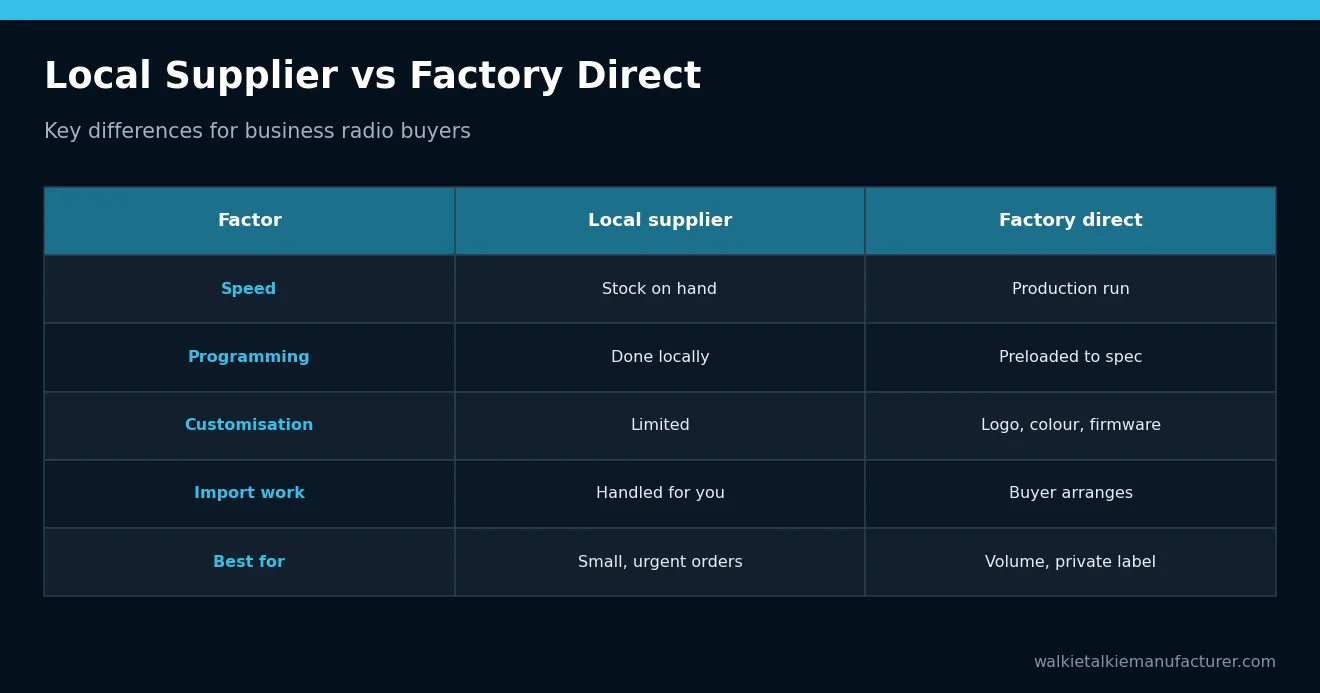
Choosing between a local walkie talkie supplier and buying direct from a factory comes down to volume, urgency and how much support you need. A supplier near you offers fast stock, local programming, licensing help and repairs, while a factory offers customisation, private label and better unit economics at scale. Many businesses searching for walkie talkie suppliers near me end up using both. This guide compares the two routes and shows when each one makes sense.
Two Routes to the Same Radio
Most professional radios sold worldwide are designed and assembled in a relatively small number of factories. A local dealer may buy from one of these factories, from a brand owner or from a regional distributor, then add stock, service and expertise on top.
Buying direct removes one or more layers, but it also removes the services those layers provide. The question is not which route is cheaper in theory, but which route delivers working radios at the lowest total cost for your situation.
What each layer adds
Between the factory and the end user, each layer usually adds something specific. An importer handles freight, customs, compliance paperwork and stock holding. A distributor adds a product range, marketing and dealer support. A local dealer adds programming, licensing help, installation and repairs. When you buy direct, you take on whichever of these tasks you still need, either with your own staff or with a service partner. Listing those tasks honestly is the fastest way to see which route really suits you.
Side-by-Side Comparison
| Factor | Local walkie talkie supplier | Direct from factory |
|---|---|---|
| Speed | Stock often available quickly | Production and shipping needed |
| Quantity | Single units to large fleets | Best for larger or repeat orders |
| Programming | Done locally, easy changes | Done before shipping to your spec |
| Licensing help | Often included | Guidance only; you apply locally |
| Repairs | Local workshop or swap service | Parts supply, returns by agreement |
| Customisation | Limited to stocked models | Logo, colour, packaging, firmware |
| Unit economics | Includes dealer margin and service | Lower per unit at volume |
| Import work | Handled by supplier | Buyer handles freight and customs |
Neither column is always better. A 10-radio restaurant and a 2,000-radio distributor have very different needs.
When a Local Supplier Is the Better Choice
A local walkie talkie supplier is usually the right choice when:
- You need radios this week, not after a production run.
- You need a licensed frequency and want someone to handle the application.
- Your team has no one to programme radios or manage firmware.
- You want on-site coverage testing or repeater installation.
- Your quantity is small and unlikely to repeat.
Local service has real value for businesses where radio downtime affects safety, such as security, healthcare or manufacturing. A dealer who can swap a failed radio the same day may be worth more than a lower unit price.
Local suppliers also know the practical conditions in your area: which frequencies are crowded, where repeaters already exist and which inspectors or regulators expect particular documentation. That knowledge can prevent expensive mistakes on a first deployment.
When Buying Direct From a Factory Makes Sense
Direct purchasing becomes attractive when volumes are high enough to justify import work, or when you want a product that is yours rather than a catalogue model.
- You are a distributor, reseller or rental company building a range.
- You want private label radios with your logo and packaging.
- You need specific firmware, channel presets or accessories bundled.
- You buy repeatedly and can hold spare stock yourself.
- You have staff or partners who can programme and support radios locally.
If you choose this route, our guide on how to choose a walkie talkie manufacturer in China explains how to shortlist and verify factories.
Total Cost of Ownership, Not Just Unit Price
Comparing a dealer’s price with a factory quotation is misleading if you ignore everything around the radio. Build a simple landed-cost model before deciding.
| Cost item | Local supplier | Factory direct |
|---|---|---|
| Radio and accessories | Included in quote | In quotation |
| Freight and insurance | Included | Buyer pays or agrees Incoterm |
| Duties and import taxes | Included | Buyer pays |
| Programming labour | Often included | Preloaded; changes done in-house |
| Spares and repairs | Service contract or per job | Spare stock you hold |
| Downtime risk | Lower with local swaps | Depends on spare stock |
Our walkie talkie wholesale pricing guide explains what drives factory pricing and which quotation details make comparisons fair.
The Hybrid Model Many Businesses Use
Many organisations combine both routes. A distributor buys private label radios direct from a factory, then acts as the local supplier for end users. A large end user may buy its main fleet direct while paying a local radio shop for programming, repeater maintenance and licensing.
This model works best when responsibilities are written down. Decide who holds programming files, who stocks batteries and earpieces, who handles failed units and how firmware updates are approved. Keep a spare pool of around five to ten percent of the fleet on site if you rely on direct supply.
Becoming the local supplier
If you are thinking about building your own dealership, read our guide on how to start a walkie talkie distribution business. It covers product range, service, licensing and margins.
Service Expectations After the Sale
Service is where the two routes differ most. A local walkie talkie supplier may offer on-site visits, loan radios during repairs and quick reprogramming when your team changes shifts or adds channels. A factory supports you remotely and through parts supply, which works well when you or your partner can do first-line diagnosis.
| Service task | Typical local supplier | Typical factory approach |
|---|---|---|
| Reprogramming | On site or in shop | Files and software support |
| Battery replacement | From local stock | Bulk spares with your order |
| Board-level repair | Local workshop or return to brand | Parts, guidance or return process |
| Firmware updates | Installed by dealer | Released after testing and approval |
Whichever route you choose, write service expectations into the agreement. Our article on walkie talkie warranty and after-sales support lists the points buyers should clarify, including who pays return freight, how faults are documented and how long spare parts remain available.
Questions to Ask Either Type of Supplier
- Which frequency bands and licence types do you support for my country?
- Who programmes the radios and how are changes handled later?
- Which compliance documents exist for this model in my market?
- What spare parts, batteries and accessories are available long term?
- How are faulty units diagnosed, repaired or replaced?
- Can you provide a sample for testing in my environment?
Clear, specific answers to these questions matter more than the supplier’s location.
What to Send When Requesting a Quote
If buying direct from a factory fits your plans, send the following so we can prepare a comparable quotation:
- Your business type: distributor, dealer, rental company or end user
- Destination country and licence or band information
- Radio type: analog, DMR, PoC/4G or accessories only
- Approximate annual quantity and first order size
- Branding and packaging needs
- Programming and after-sales expectations
See our radio and accessory products and send your requirements via the contact page.
Related Guides
Equipping a factory or plant floor?
Tell us the site size, noise level and number of users. We will recommend radios and noise-ready accessories and send samples for a shift test.
Get a Quote →Radios for ManufacturingFrequently Asked Questions
Is it cheaper to buy walkie talkies directly from a factory?
The unit price is usually lower at volume, but freight, duties, programming, spares and downtime must be added. For small or one-off orders, a local supplier can be cheaper overall. Compare total landed and support cost rather than the radio price alone before choosing a route.
How do I find walkie talkie suppliers near me?
Search for two-way radio dealers, radio communication shops and licensed installers in your city, and check whether they offer programming, licensing help and repairs. Ask which brands or factories they source from and whether they hold spare stock for the models they sell.
Can a factory sell small quantities of walkie talkies?
Some factories accept small or sample orders, but pricing, customisation and shipping efficiency improve with larger quantities. Order requirements depend on the model and level of customisation, so confirm with the manufacturer. Very small orders are often better handled by a local dealer.
Who handles licensing if I buy direct from a factory?
You or your local partner usually handle licensing, because licences are issued by national regulators to the user or operator. A factory can programme approved frequencies and share technical information, but it normally cannot apply for your licence. Check local rules before ordering.
What happens if a factory-direct radio fails?
This depends on your agreement. Common approaches include holding spare radios, receiving spare parts for local repair or returning faulty units under an agreed process. Define the procedure, documentation and costs in the contract before placing a bulk order so failures do not stall operations.
Get a Factory Recommendation & Quote
Tell us your product type, quantity, target country, application, coverage, frequency or network and OEM requirements. We will review suitable options, MOQ factors, estimated lead time and the next sample step.
Prefer a direct conversation? Email lorabanzhitao@gmail.com or message WhatsApp +86 173 1689 5054.