
DMR Tier I, II and III are three levels of the ETSI Digital Mobile Radio standard. Tier I covers low-power licence-free radios, Tier II covers licensed conventional radios and repeaters, and Tier III adds trunking for large multi-site networks. For buyers comparing DMR radio manufacturers, the tier decides what infrastructure you need, how many users a channel can support and which features are standardised. This guide explains each tier in plain terms and shows how to match DMR equipment to your operation.
What DMR Is and Why the Tiers Exist
Digital Mobile Radio (DMR) is an open digital standard published by the European Telecommunications Standards Institute (ETSI) in the TS 102 361 series. It was designed as a digital successor to analog professional radio, with clearer audio at the edge of coverage, better battery efficiency and data features such as text messages and GPS location.
Because users range from small shops to national utilities, the standard is divided into tiers. Each tier defines a different level of complexity, licensing and infrastructure. Knowing the tier helps you avoid buying radios that cannot join the network you plan to build.
For a broader comparison with analog and cellular radios, read our DMR vs analog vs PoC walkie talkie guide.
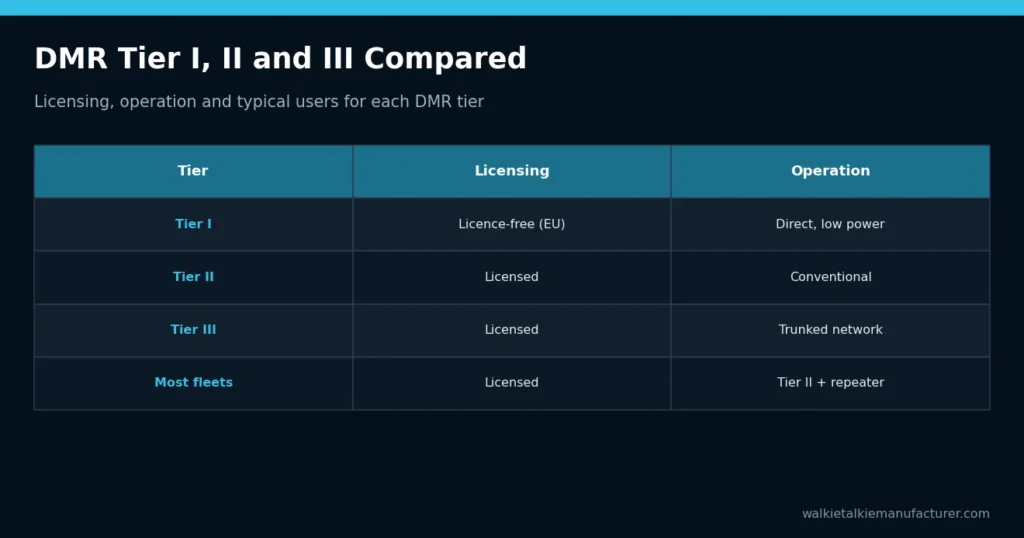
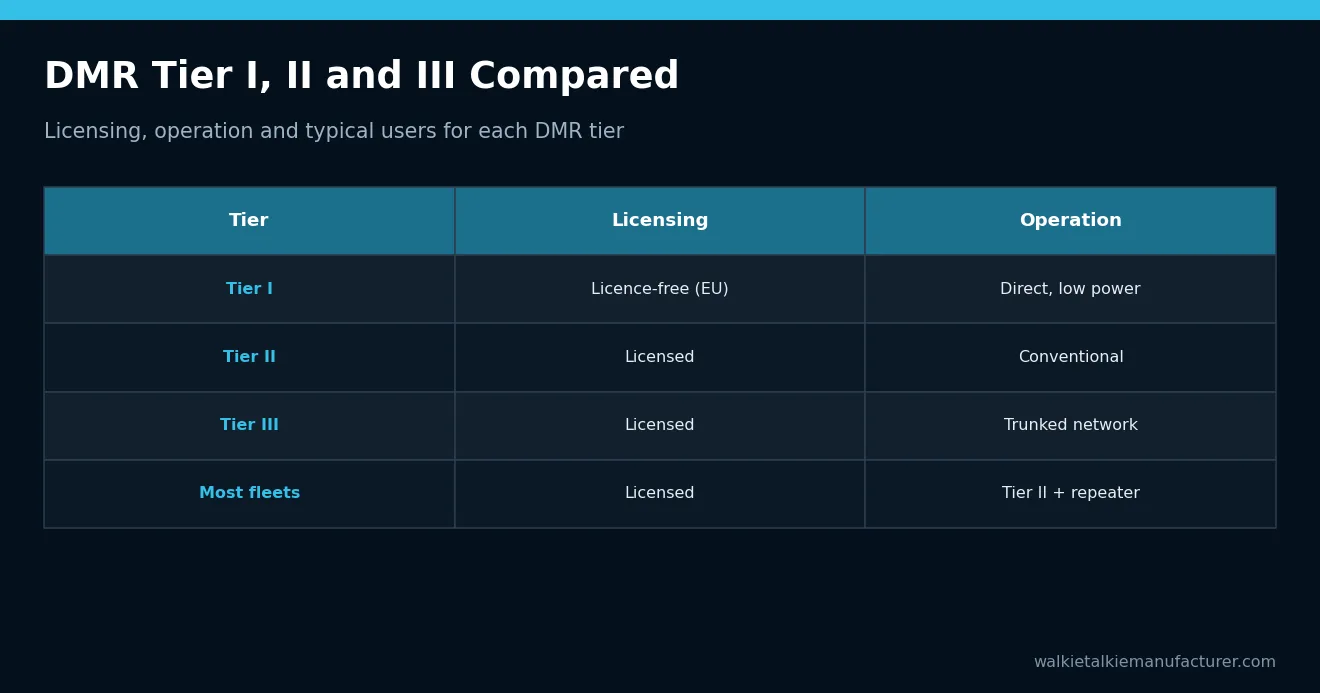
DMR Tier I, II and III at a Glance
| Tier | Licensing | Operation | Typical use |
|---|---|---|---|
| Tier I | Licence-free (PMR446 band in Europe) | Low power, fixed antenna, direct mode | Light personal or small business use |
| Tier II | Licensed | Conventional channels, direct or via repeater | Most commercial and industrial fleets |
| Tier III | Licensed | Trunked, control channel allocates capacity | Large, multi-site, high-traffic networks |
In practice, most professional DMR equipment sold today is Tier II. Tier III is used where many users share limited frequencies across wide areas. Tier I products exist but are less common than analog PMR446 radios.
DMR Tier I: Licence-Free Digital
Tier I is intended for licence-free use in the European 446 MHz PMR446 band. Radios must use low power and an integral, non-removable antenna, and they communicate directly with each other without repeaters.
Tier I can suit small teams that want digital audio without a licence, but its range and features are limited by the band rules. It is not a licence-free option outside the regions that permit it, and it should not be confused with another licence-free digital standard used in the same band.
- No repeater or infrastructure support.
- Limited power and fixed antenna by regulation.
- Useful for short-range, simple communication.
- Check local rules before selling outside Europe.
For distributors, Tier I is usually a niche product. Most customers who want licence-free radios choose analog PMR446 or FRS models, while customers who want digital features are generally better served by licensed Tier II radios with proper range and repeater support.
DMR Tier II: Conventional Licensed Radio
Tier II is the workhorse of DMR. It uses two-slot TDMA, meaning one 12.5 kHz channel carries two independent voice or data paths at the same time. With a repeater, one frequency pair can support two simultaneous conversations, which is attractive where spectrum is scarce.
Tier II radios operate on licensed frequencies, typically in VHF or UHF bands, either directly radio-to-radio or through repeaters. Features include group calls, private calls, text messages, GPS data and emergency alerts, depending on the model and configuration.
Proprietary extensions
Many manufacturers add their own features on top of Tier II, such as linking repeaters over IP networks or sharing several repeaters in a simple trunking arrangement. These are useful, but they are often vendor-specific. Confirm with the manufacturer which features follow the open standard and which only work within one product family.
DMR Tier III: Trunked Networks
Tier III adds standardised trunking. Instead of users choosing a fixed channel, a control channel automatically assigns traffic channels as calls start. This lets many talk groups share a small pool of frequencies efficiently, and it supports large networks with multiple sites and roaming.
Tier III systems suit organisations such as utilities, transport operators, large campuses and public networks where hundreds or thousands of users share coverage. They require more planning, licensing coordination, network infrastructure and specialist support than conventional systems.
- Automatic channel allocation through a control channel.
- Multi-site roaming and larger user capacity.
- More complex design, licensing and maintenance.
- Radios must support Tier III trunking to join the network.
Interoperability Between DMR Radio Manufacturers
Because DMR is an open standard, radios from different DMR radio manufacturers can usually communicate on basic functions such as group voice calls when programmed with matching frequencies, colour codes, time slots and talk group IDs. Advanced features, encryption and proprietary network modes may not interoperate.
| Function | Usually interoperable? | Check before buying |
|---|---|---|
| Group voice call (Tier II) | Often yes | Matching colour code, slot, IDs |
| Private call and text | Often, with testing | Message formats and ID plans |
| GPS and data services | Varies | Protocol and software support |
| Encryption | Frequently vendor-specific | Algorithm and key compatibility |
| Proprietary multi-site modes | Usually not | Stay within one system family |
Industry interoperability testing programmes exist, but you should still test your mix of radios. Our guide on whether different walkie talkie brands can work together explains how to plan these tests.
Key DMR Settings Every Buyer Should Understand
Whatever the tier, a few configuration terms appear in every DMR quotation and programming file. Understanding them makes conversations with suppliers and installers much easier.
- Radio ID: a unique number that identifies each radio on the network.
- Talk group: a group of users who hear each other’s calls, such as “Maintenance” or “Security”.
- Time slot: one of the two TDMA paths on a Tier II or Tier III channel.
- Colour code: a value that helps radios and repeaters ignore other DMR systems on the same frequency.
- Codeplug: the programming file that holds channels, IDs, contacts and settings.
Keeping a clean ID and talk group plan from the start makes it easier to add radios later. Licensing decides which frequencies you can put into that plan, so review our guide to licensed vs licence-free walkie talkies before finalising channels.
How to Choose the Right Tier for Your Operation
- Count users and talk groups: a few dozen users on one site rarely need Tier III.
- Map coverage: one building, a campus or a region changes repeater and network needs.
- Check licensing: Tier II and III require licensed frequencies in most countries.
- List required features: data, GPS, lone worker, encryption, dispatch.
- Plan migration: many DMR radios can also run analog channels during a transition.
Most businesses buying their first digital fleet start with Tier II, using direct mode or a single repeater. Our walkie talkie repeater buying guide explains when a repeater is needed and how to size it.
What to Send When Requesting a Quote
To recommend DMR equipment for your project, we need:
- Destination country, frequency band and licence status
- Required tier and whether you have an existing DMR network
- Number of portable and mobile radios, repeaters and spares
- Required features: GPS, text, emergency, encryption, analog mode
- Accessories and branding requirements
- Existing radios you need to work with
See our DMR radio manufacturer page for OEM options, and send your requirements through the contact page. Supported features and documents depend on the selected model and destination market.
Related Guides
Planning a DMR system or upgrade?
Share your frequency band, number of users and whether you need repeaters. We will suggest DMR models and accessories and arrange samples for evaluation.
Get a Quote →View DMR RadiosFrequently Asked Questions
What is the difference between DMR Tier II and Tier III?
Tier II uses conventional channels, where users select a channel and talk directly or through a repeater. Tier III adds trunking, in which a control channel automatically assigns traffic channels to calls. Tier III supports larger, multi-site networks but requires more planning, infrastructure and compatible radios.
Is DMR licence-free?
Only DMR Tier I is designed for licence-free use, and only in regions that allow it, mainly the European PMR446 band with low power and fixed antennas. Tier II and Tier III radios generally operate on licensed frequencies. Always check local regulations before using or selling DMR radios.
Do most businesses need Tier III DMR?
No. Most business fleets, such as factories, hotels, warehouses and security teams, work well with Tier II conventional radios in direct mode or with one or a few repeaters. Tier III usually makes sense for large organisations with many users, several sites and limited frequencies.
Can DMR radios from different manufacturers talk to each other?
Basic Tier II group voice calls usually work when frequencies, colour codes, time slots and IDs match. Features such as encryption, data services and proprietary multi-site modes may not work across manufacturers. Test samples together before committing to a mixed fleet.
Can DMR radios work with analog radios?
Many DMR radios support both digital and analog channels, so they can communicate with existing analog fleets on analog channels. Some models can also scan mixed channels. This dual-mode capability makes it easier to migrate gradually rather than replacing every radio at once.
Get a Factory Recommendation & Quote
Tell us your product type, quantity, target country, application, coverage, frequency or network and OEM requirements. We will review suitable options, MOQ factors, estimated lead time and the next sample step.
Prefer a direct conversation? Email lorabanzhitao@gmail.com or message WhatsApp +86 173 1689 5054.