
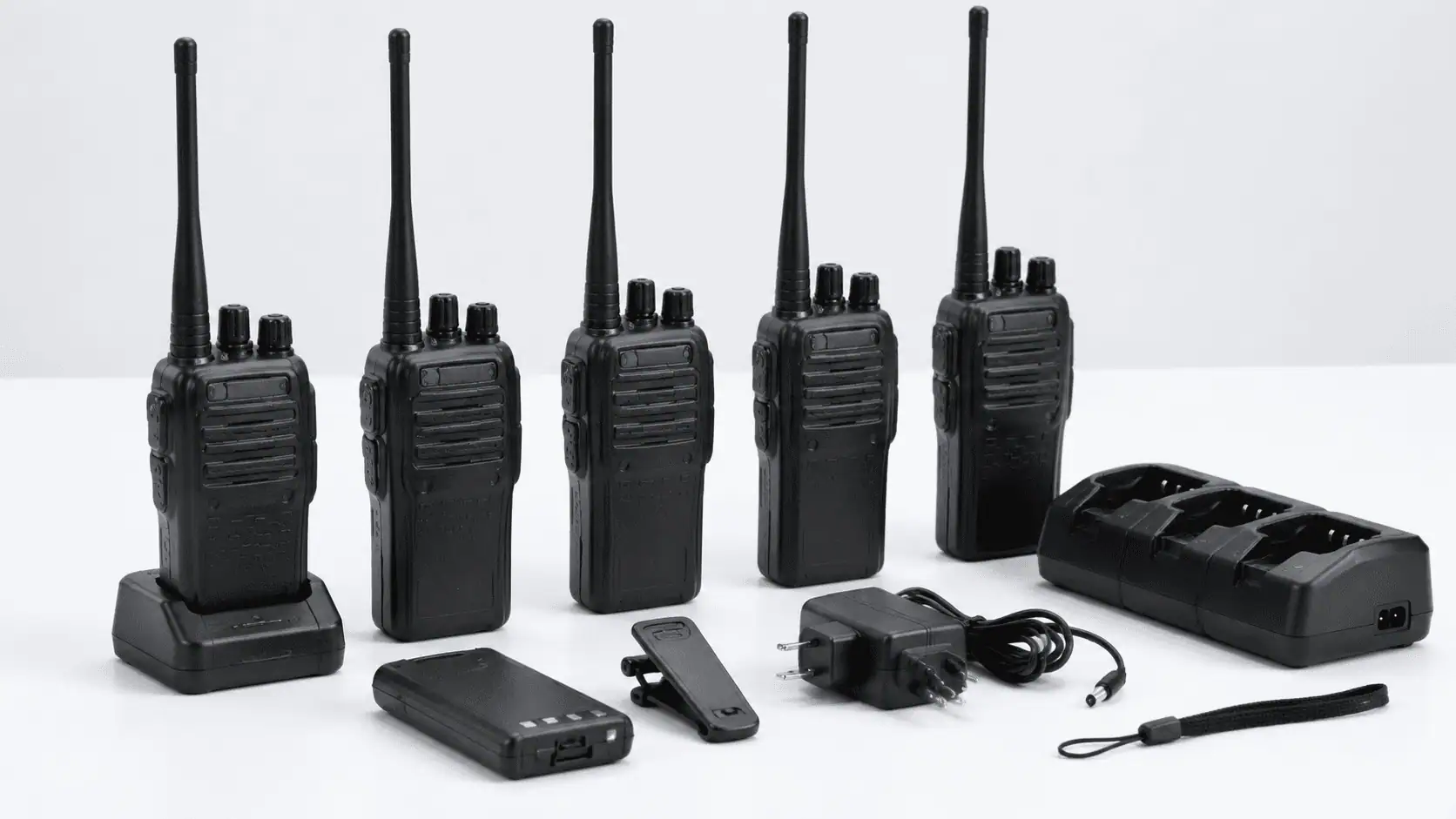
Analog Radio Manufacturer | UHF / VHF Walkie Talkie Supplier
Analog Two Way Radio Manufacturer for Simple Team Communication
OEM analog radios and UHF/VHF walkie talkies for security guards, hotels, warehouses, schools, retail teams, small factories and entry-level distributor markets.
Analog Two Way Radio | UHF Walkie Talkie | VHF Radio | Bulk Supply | OEM Support
Short Answer
What Is an Analog Two Way Radio?
An analog two way radio is a traditional push-to-talk radio that uses analog signal transmission for simple local communication. It is easy to operate, cost-effective and suitable for buyers who need reliable short-to-medium range communication without complex platform or SIM card requirements.
| Buyer Need | Analog Radio Advantage | Important Check |
|---|---|---|
| Low-cost team communication | Lower unit cost for bulk orders | Confirm quantity, accessories and packaging |
| Simple operation | Easy push-to-talk use for new teams | Confirm channel and frequency requirements |
| Local site communication | Good for hotels, shops, warehouses and small sites | Check building size and coverage expectation |
| Entry-level distribution | Suitable for price-sensitive markets | Confirm OEM logo, packaging and repeat supply |
Why Choose Analog Radios?
A Practical Choice for Basic, Local and Cost-Sensitive Communication
Analog radios are still useful because many buyers do not need GPS, dispatch, cellular networks or complex digital features. For local communication inside a hotel, school, small warehouse, retail store or basic security site, analog walkie talkies can be simple, reliable and affordable.
- No SIM card: Traditional local communication without mobile data service.
- Easy training: One-button push-to-talk operation for daily users.
- Bulk order friendly: Good for distributors and price-sensitive markets.
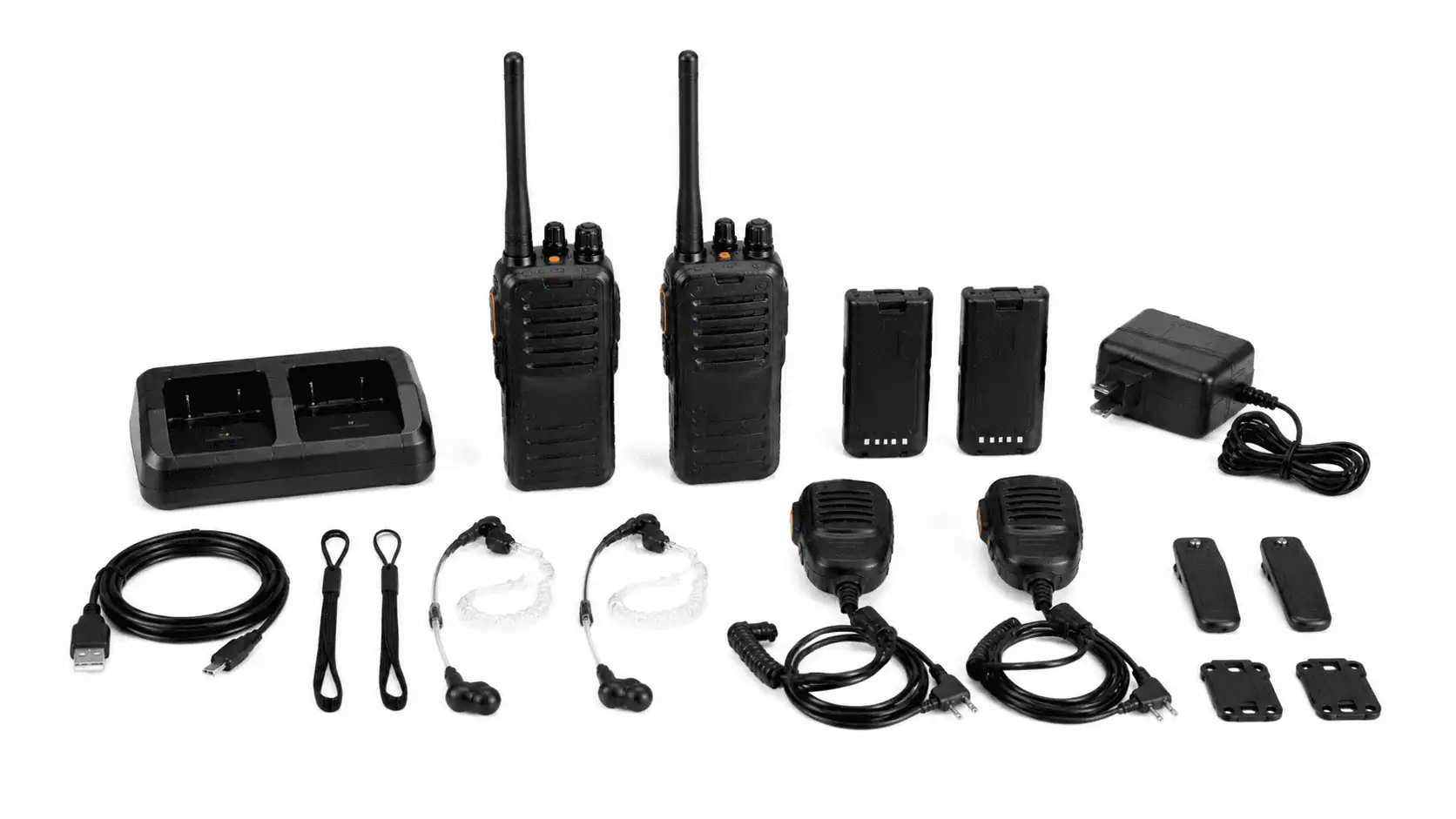
- Accessory support: Batteries, chargers, earpieces, antennas and belt clips.
Applications
Best Applications for Analog Walkie Talkies
Security Guards
Suitable for guard teams in offices, communities, schools, shopping malls and small industrial sites.
Hotel Staff
Housekeeping, front desk, maintenance, banquet and security teams can coordinate with compact analog radios.
Warehouses
Warehouse teams can use analog walkie talkies for picking, loading docks, supervisors and forklift communication.
Retail Stores
Retail staff can communicate quickly for customer service, stock checks, security and management support.
Schools and Campuses
Analog radios support campus security, maintenance, administration and event coordination.
Small Factories
Small workshops can use analog radios for supervisors, production teams, warehouse staff and maintenance support.
Comparison
Analog Radio vs DMR Radio vs PoC Radio
| Item | Analog Radio | DMR Radio | PoC Radio |
|---|---|---|---|
| Best for | Simple local communication | Professional local radio systems | Wide-area network communication |
| Network | Radio frequency | Digital radio frequency | 4G/LTE or Wi-Fi |
| SIM card | Not required | Not required | Usually required |
| Cost | Usually lower | Medium to higher | Device + possible platform/data cost |
| Typical buyers | Hotels, shops, schools, small security | Factories, warehouses, professional security | Logistics, patrol, multi-site teams |
OEM and Bulk Supply
OEM Analog Radios for Distributors and Importers
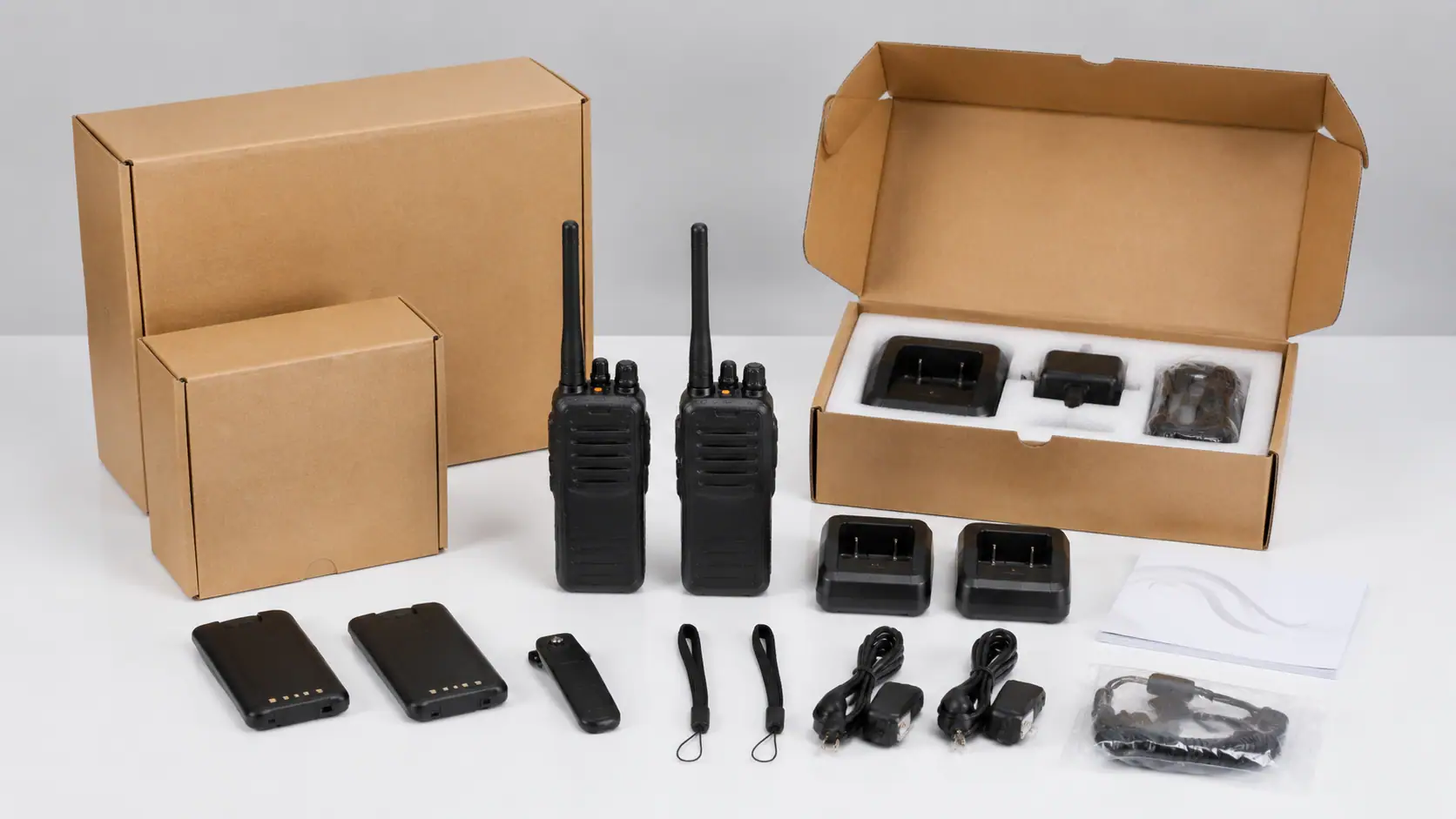
Analog radios are often a good starting point for distributors because they are easy to explain, easy to use and suitable for many entry-level customers. OEM orders can include logo, labels, packaging, manuals and accessory bundles.
- Logo printing and model labels
- Neutral box or private-label packaging
- Batteries, chargers, earpieces and antenna options
- Sample testing before bulk order
Buyer Checklist
What to Confirm Before Ordering Analog Radios
| Target Country | Helps confirm frequency range, charger plug, certification and packaging needs. |
| Quantity | Needed for price level, MOQ, logo and packaging discussion. |
| Application | Security, hotel, warehouse, retail, school, small factory or distributor market. |
| Coverage Area | Building size, floors, walls and outdoor areas affect radio recommendation. |
| OEM Needs | Logo, packaging, labels, manuals, carton marks and accessory bundles. |
Sample Testing
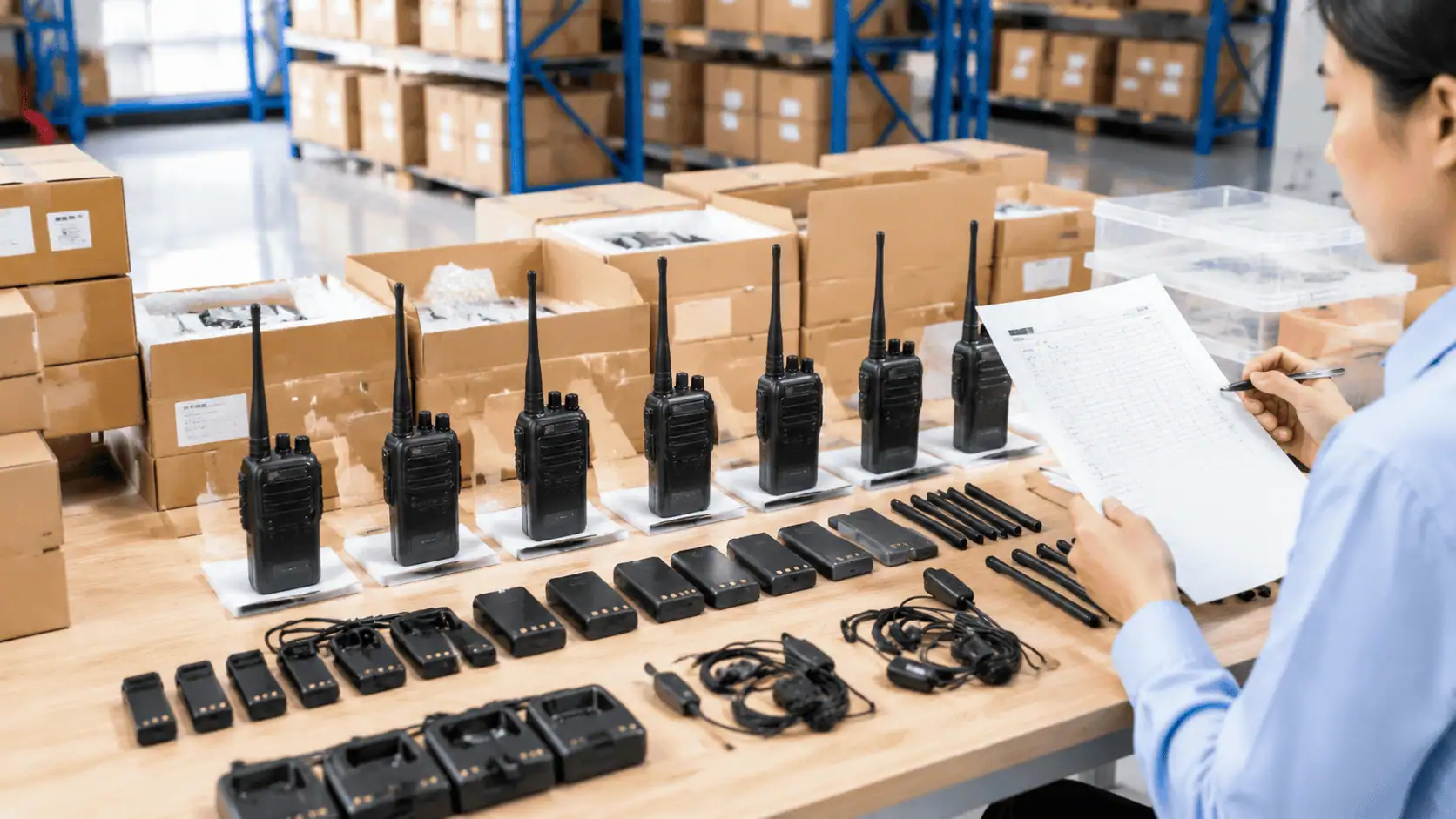
Test Analog Radios Before Bulk Orders
Sample testing helps buyers check audio, range, battery life, charger type, accessory fit, packaging and user feedback before placing larger orders.
FAQs
UHF vs VHF for Analog Radios
Most analog business radios are sold in UHF or VHF versions. The choice depends mainly on the working environment, not on which band is “better.” Actual range depends on terrain, buildings, antenna, power and local rules, so treat the table as general guidance.
| Factor | UHF (about 400–470 MHz) | VHF (about 136–174 MHz) |
|---|---|---|
| Best environments | Buildings, warehouses, hotels, urban sites | Open land, farms, forests, marine and rural areas |
| Building penetration | Generally better through walls and floors | Generally weaker inside large structures |
| Open-area range | Good | Often better over open terrain |
| Antenna size | Shorter antennas | Longer antennas for similar performance |
| Typical users | Manufacturing, security, hospitality, retail | Agriculture, outdoor works, some marine and rural services |
Frequency ranges in the table are typical examples. The exact range a model supports, and the frequencies your customer may legally use, differ by country and licence type. Always program radios to the frequencies permitted in the destination market, and confirm the supported frequency split before ordering a bulk batch.
For a closer look at indoor industrial use, see UHF vs VHF for warehouses and industrial sites.
License-Free Analog Options vs Business-Band Radios
Some analog radios can be used without an individual license, but only on specific frequencies and power limits set by each country. Business-band radios usually offer more power and channel choice, and usually require licensing. Rules change, so confirm them with the local regulator before ordering.
| Service | Region | License status (general) | Notes |
|---|---|---|---|
| PMR446 | EU and many other European countries | License-free | Low power, fixed antenna, set channels |
| FRS | United States | License-free personal service | Low power, fixed channels; not intended for high-power business use |
| GMRS | United States | Individual license required | Personal service with higher power options |
| Business band (e.g. US Part 90) | United States and similar systems elsewhere | Usually requires a license | More flexible power, channels and repeater use |
The licensed vs license-free walkie talkie guide explains how to decide which route suits a customer.
For distributors, this difference affects both the product range and the sales conversation. License-free models are easy to sell off the shelf, but customers need to understand their limits. Business-band radios require more setup, including frequency coordination and programming, but they fit professional users who need reliable coverage across a larger site.
Analog Radio Feature Checklist
Analog radios are simple, but feature sets still differ between models. These are the functions buyers most often need to specify when requesting samples or programming.
- CTCSS/DCS tones: sub-audible codes that reduce hearing unwanted users on a shared channel; they do not provide privacy.
- Channel count: from a few channels on basic models to larger banks on business radios.
- VOX: hands-free transmission when the user speaks, useful with headsets.
- Scan: monitoring several channels to catch activity.
- Power levels: high/low settings to balance range and battery use.
- Squelch, busy-channel lockout and time-out timer: practical controls for shared channels.
- Programming method: PC software and cable, or front-panel setup on some models.
When you send a sample request, list the features you need and the channel plan you expect to use. This helps the manufacturer program samples correctly and avoids testing radios with default settings that do not reflect real use.
Recommended Analog Accessory Kit
Accessories often decide how well a fleet works day to day. A standard kit for business users usually includes the items below, with quantities based on shift patterns and team size.
- Spare batteries for long or back-to-back shifts
- Single or multi-unit chargers for charging stations
- Speaker microphones for users who wear radios on the belt or vest
- Earpieces or headsets for quiet or noisy environments
- Belt clips, holsters or carry cases
- Programming cable for channel updates
In noisy areas such as production lines, heavy-duty headsets or noise-cancelling speaker mics make a real difference to message clarity. Where noise exposure reaches the OSHA 29 CFR 1910.95 action level of 85 dBA as an 8-hour time-weighted average, hearing protection with communication capability is worth discussing with the end user. For hotels and retail, discreet earpieces are usually preferred. Always check connector type and compatibility with the exact radio model before ordering accessories in volume.
Compatible options are listed on the walkie talkie accessories supplier page.
When to Upgrade from Analog to DMR
Upgrading is not always necessary. The signs below usually show up first in daily operations rather than on a specification sheet, so listen to what supervisors report.
Analog remains a sensible choice for simple, small-team use. It may be time to consider DMR when users need clearer audio at the edge of coverage, more users per channel, individual calls, text messaging, basic encryption options or longer battery life from digital operation. Many DMR radios can also operate in analog mode, which allows a gradual migration where old and new radios share channels.
A staged upgrade often works best: replace radios for supervisors or the busiest teams first, keep the analog channel plan active during the transition, and move the remaining users once the new system has been tested. Budget, licensing and whether existing repeaters can handle digital traffic should all be part of the decision.
Compare the options on the DMR radio manufacturer page before deciding.
Analog Radio Questions
Are analog radios still useful?
Yes. Analog radios are still useful for simple local communication, especially for hotels, schools, retail stores, small warehouses and cost-sensitive security teams.
Do analog radios need SIM cards?
No. Analog radios use radio frequencies for local communication and do not require SIM cards or mobile data service.
Should I choose analog radio or DMR radio?
Choose analog radios for simple, low-cost local communication. Choose DMR radios if you need clearer audio, department groups, repeater systems or more professional fleet communication.
Can you supply OEM analog radios?
Yes. OEM options can include logo, packaging, labels, manuals, accessory bundles and product recommendations depending on quantity and requirements.
Related Guides
Are CTCSS and DCS codes the same as privacy or encryption?
No. CTCSS and DCS tones only stop your radio from opening its speaker for signals without the matching code. Anyone on the same frequency can still hear your conversation with a scanner or radio set to no tone. For real privacy, consider digital radios with encryption options where local rules allow.
Can I sell PMR446 or FRS radios as business radios?
You can sell them to business users where local rules allow, but they remain low-power license-free radios with fixed channels and limits. They suit short-range, light-duty use. Customers needing more power, repeaters or more channels usually need business-band radios, which often require licensing depending on the country.
Can analog and DMR radios work together during an upgrade?
Often yes. Many DMR radios have an analog mode, so they can talk with existing analog radios on the same frequency and tone settings. This lets a customer replace radios in stages. Confirm the analog mode, frequency range and programming details of the chosen DMR model before planning the migration.
Learn More Before Buying Analog Radios
How Do Walkie Talkies Work?
Understand push-to-talk, radio channels, frequencies, range and repeaters.
DMR Radio Manufacturer Buying Guide
Compare analog radios with DMR radios for professional business use.
Two Way Radio Products
Browse analog, DMR, PoC, LTE, 4G radios, repeaters and accessories.
Need Analog Radios for Your Market?
Tell us your frequency band or network requirement and order quantity — we’ll match the right model and send pricing within 24 hours.
Email: lorabanzhitao@gmail.com
WhatsApp: +86 173 1689 5054