
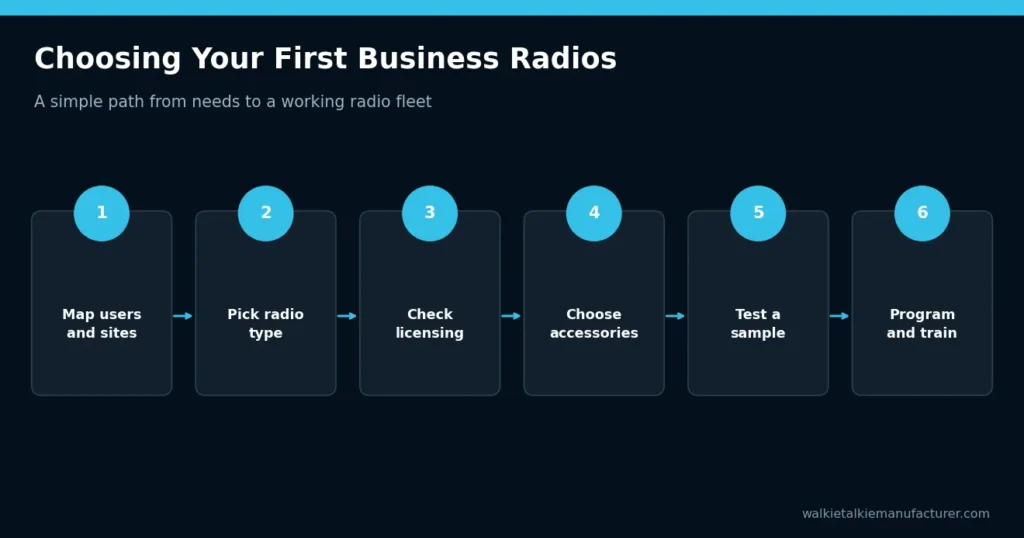
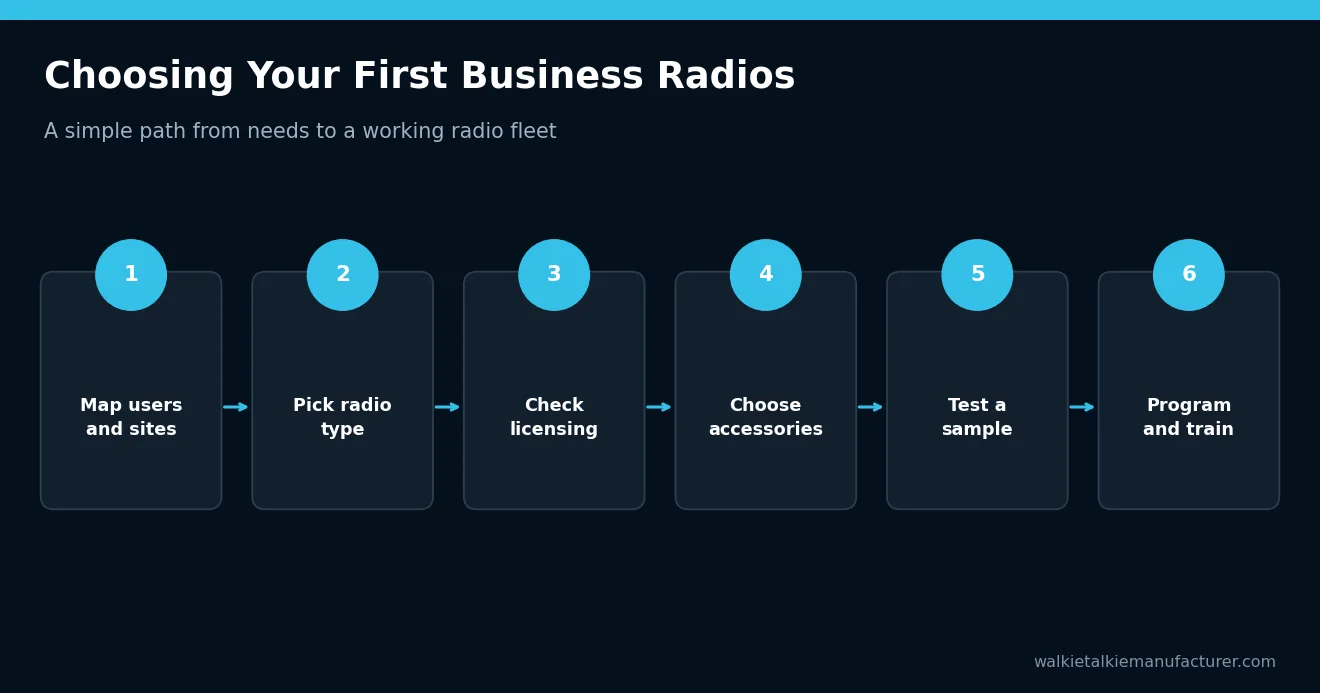
The best walkie talkie for business use in a small company is usually a simple, rugged radio that matches your site size, your local licensing rules and the noise level where staff work. For one shop, café or small warehouse, professional license-free or basic analog radios are often enough. For several sites or staff who travel, PoC radios over 4G can be a better fit. This guide walks through the choices step by step.
Start With How Your Team Actually Communicates
Before comparing models, write down who needs to talk to whom, where they work and how often. A radio that is perfect for a warehouse can be wrong for a boutique hotel or a mobile cleaning team.
- Who talks: front desk, floor staff, kitchen, drivers, managers.
- Where: one floor, several floors, basement, car park, outdoor yard, different addresses.
- How often: constant short calls, or occasional coordination during peaks.
- Noise: quiet shop floor, busy kitchen, machinery or traffic.
- Discretion: do staff need earpieces so customers do not hear radio traffic?
These answers point you to the right radio type much faster than a spec sheet.
It also helps to count peak users, not average users. A café may have three staff on a quiet morning but eight during lunch, and the radios need to cover the busiest shift. Note any outside contacts too, such as security contractors or delivery drivers, because they may need to share a channel or use a different system altogether.
The Three Main Options for a Small Business
Most small businesses choose between three types of radio. The table gives a simple comparison.
| Option | Best for | Advantages | Limitations |
|---|---|---|---|
| License-free radios (e.g. FRS, PMR446) | Single shop, café, small office | No license in their region, simple to use | Power and antenna limits; shared channels; market-specific |
| Licensed business radios (analog or DMR) | Warehouses, hotels, yards, larger sites | More power options, dedicated frequencies | License needed in many countries |
| PoC radios over 4G/LTE | Multi-site teams, drivers, field staff | Wide coverage, GPS, group management | SIM data and platform fees; needs cellular coverage |
License-free services are country-specific: FRS applies in the US and PMR446 in the EU, and radios for one market are generally not legal in the other. Our guide to licensed vs license-free walkie talkies explains the rules in more detail.
If you are unsure, start with the simplest option that is legal where you operate and covers your site. You can add licensed or PoC radios later for managers or drivers, although different systems will not talk to each other directly without a gateway or shared channel.
Choosing the Best Walkie Talkie for Business Use
Once you know the type, focus on a short list of features that make a real difference to daily use. Do not pay for features nobody will touch.
| Feature | Why it matters to a small business | What to ask |
|---|---|---|
| Rugged housing | Radios get dropped and knocked | Drop testing and housing material |
| Water and dust resistance | Kitchens, yards, cleaning work | Tested IP rating for the model |
| Battery capacity | Must last a full shift | Real-use results from sample testing |
| Audio loudness | Noisy rooms and outdoor areas | Speaker output and noise reduction |
| Accessory connector | Earpieces and speaker mics | Connector type and accessory range |
| Easy programming | You may need to change channels | Software, cable and support available |
For shop and restaurant settings specifically, see our guide to walkie talkies for restaurants and retail stores.
How Many Radios and Accessories to Buy
A good rule is one radio per person who needs to talk during a shift, not per employee on payroll. Radios can be shared between shifts if you have enough charged batteries.
Add a small reserve for breakage and charging rotation. Many small businesses keep one or two spare radios and one spare battery for each radio that is used on long or back-to-back shifts. A multi-unit charger keeps the charging area tidy and makes it obvious when a radio has not been returned.
Earpieces are important in customer-facing businesses because they keep radio traffic discreet. The walkie talkie accessories supplier page lists earpieces, speaker mics and chargers by connector type.
Thinking About Cost Without Guesswork
Radio price is only one part of the cost. Over several years, batteries, accessories, repairs and any subscription fees often add up to more than the initial purchase.
- Conventional radios: higher up-front cost per unit in some cases, but no monthly fees apart from any license.
- PoC radios: ongoing SIM data and platform fees, but no repeaters or licenses needed for wide coverage.
- Smartphone PTT apps: low entry cost, but phones are less rugged, have weaker speakers and are shared with other apps.
For a longer comparison, read walkie talkies vs PTT apps: total cost of ownership. Ask any supplier for quotes that separate radios, accessories, and recurring costs so you can compare fairly.
Setting Up Your First Radios
A simple setup makes radios useful from the first day. Keep it short and document it.
- Program the radios with a small number of channels, for example one for general staff and one for managers.
- Label each radio and charger slot with a number.
- Set the same privacy codes (CTCSS/DCS) on all radios for each channel.
- Test coverage by walking the whole site, including storerooms, stairwells and outside areas.
- Train staff on basic etiquette: press, pause, speak, release; keep messages short.
- Set a charging routine so radios are returned and charged at the end of each shift.
Write the channel plan on one page and keep it near the chargers. If a radio is lost or a new one is added, anyone can check the settings and program a replacement quickly. Many suppliers can pre-program radios before shipping if you send the channel plan with your order, which saves time on delivery day.
Common Mistakes Small Businesses Make
Most problems with first radios come from buying decisions, not from the radios themselves.
- Buying consumer radios for daily work, then replacing them because they break or run flat.
- Using radios bought for another country’s license-free service, which may be illegal locally.
- Choosing too many channels, so staff end up on different channels by mistake.
- Ignoring accessories, then finding customers can hear every call.
- Not testing coverage in basements, cold rooms or car parks before buying the full set.
Ordering a sample first and testing it in your own building avoids most of these problems.
What to Send When Requesting a Quote
Small orders get faster, more accurate quotes when you include the basics:
- Your country and whether you want license-free, licensed or PoC radios.
- Number of users per shift and number of sites.
- Working environment: indoor, outdoor, kitchen, warehouse, noise level.
- Accessories needed: earpieces, speaker mics, spare batteries, chargers.
- Whether you need logo or custom packaging, or a standard product is fine.
Send these details through our contact form. You can also browse our two-way radio products first to shortlist models.
Related Guides
Setting up radios for your team?
Tell us your venue, team size and how staff communicate today. We will recommend easy-to-use radios, discreet accessories and a simple channel plan.
Get a Quote →Browse RadiosFrequently Asked Questions
What is the best walkie talkie for a small business?
There is no single best model. For one site with a few staff, a rugged license-free or basic analog radio is often enough. For larger sites a licensed UHF or DMR radio works better, and for multiple locations a PoC radio over 4G may fit. Match the radio to site size, noise and local rules.
Do small businesses need a license for walkie talkies?
It depends on the country and the radio type. License-free services such as FRS in the US and PMR446 in the EU do not need a license, while business radios on other frequencies usually do. PoC radios use cellular networks and do not need a radio license. Check with your local regulator.
Can I use consumer walkie talkies for my business?
You can if they are legal in your country, but consumer radios are often less durable, have weaker batteries and limited accessory options. For daily shift use, business-grade radios usually last longer and cost less over time because they need fewer replacements.
How far will a small business walkie talkie reach?
Range depends on power, frequency, antenna, buildings and terrain. Inside a building, walls and floors reduce range much more than open space. The only reliable answer is to test a sample in your actual premises, including basements, stairwells and outdoor areas where staff work.
Should a small business choose radios or a PTT app?
Radios are more rugged, louder and work without mobile data, which suits single-site teams. PTT apps or PoC radios suit staff spread across different locations. Many businesses compare total cost over several years, including phones, data plans, accessories and replacements, before deciding.
Get a Factory Recommendation & Quote
Tell us your product type, quantity, target country, application, coverage, frequency or network and OEM requirements. We will review suitable options, MOQ factors, estimated lead time and the next sample step.
Prefer a direct conversation? Email lorabanzhitao@gmail.com or message WhatsApp +86 173 1689 5054.