
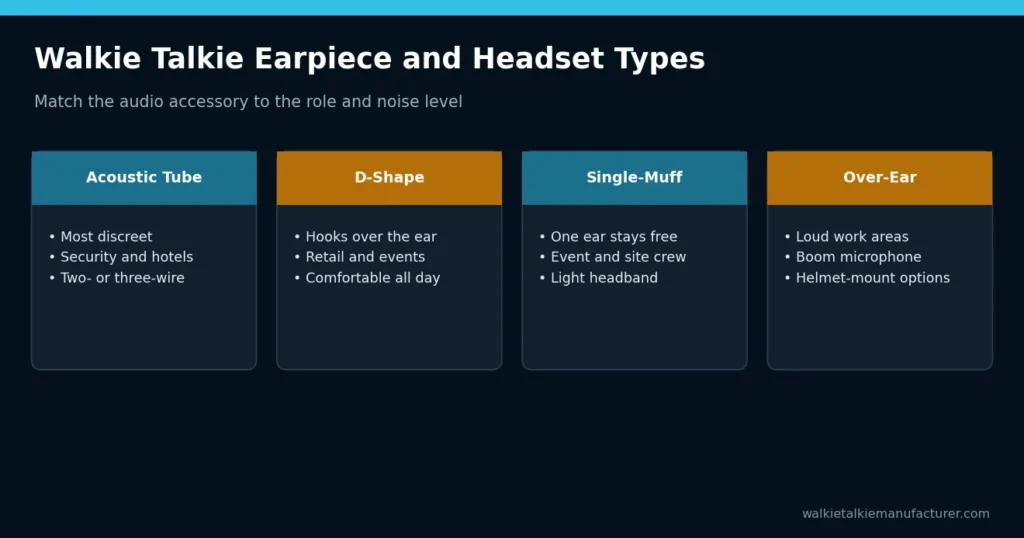
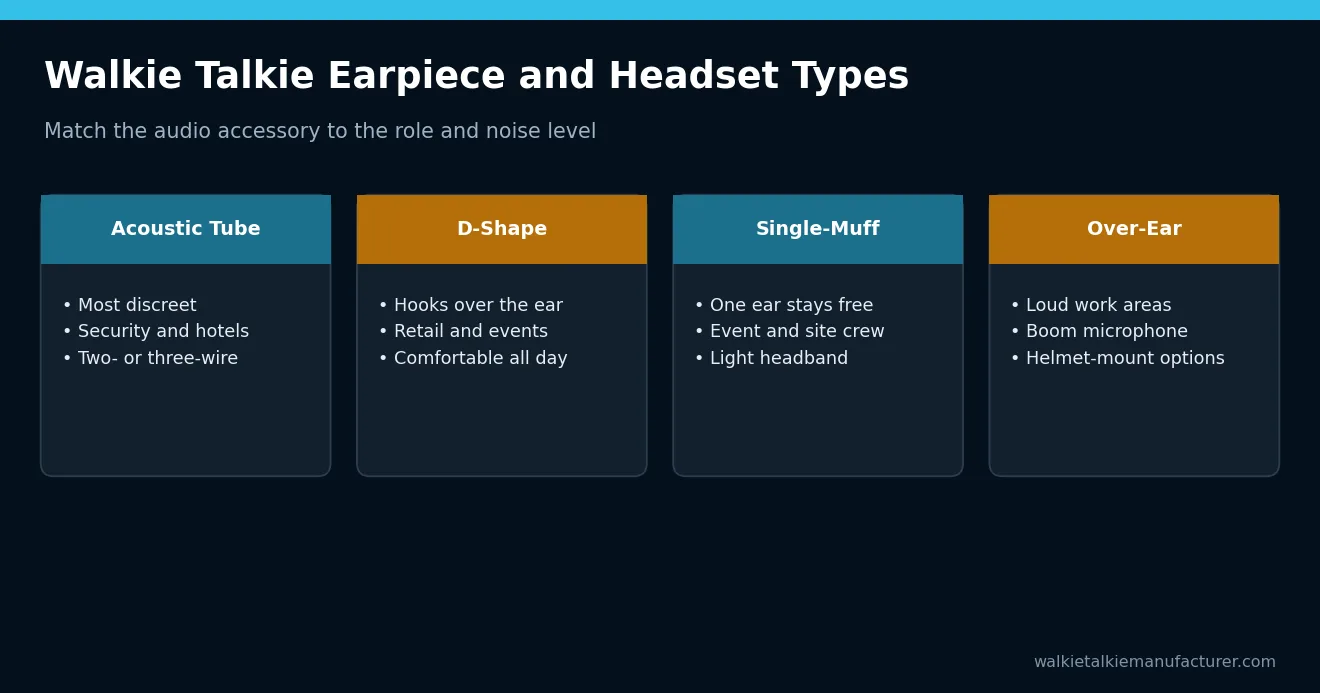
The main walkie talkie earpiece and headset types are acoustic tube earpieces, D-shape and ear-hook earpieces, in-ear earbuds, lightweight single-muff headsets, and heavy-duty over-ear headsets with ear cups. Each suits a different job: discreet listening for security and hospitality, all-day comfort for retail and events, or hearing protection for loud industrial sites. This buyer’s guide compares the types, explains wiring options, and shows how to match walkie talkie accessories to each role and radio model.
Why Earpiece Choice Matters
An earpiece or headset changes how a radio is used. Without one, every transmission is heard by guests, customers or bystanders, and users miss calls in noisy areas. With the wrong one, staff take it off after an hour because it hurts, and the radio goes back to the belt speaker.
For buyers, audio accessories are also where most complaints come from. Cables snag, plugs loosen, and cheap earpieces sound harsh at high volume. Specifying the right type per role, and testing it with the actual radio, prevents most of these problems.
Earpieces and headsets are part of our wider walkie talkie accessories range, which can be sourced together with radios for consistent compatibility.
Walkie Talkie Earpiece Types Compared
The table below summarizes the common earpiece and headset types used with portable two-way radios.
| Type | How it sits | Best for | Trade-off |
|---|---|---|---|
| Acoustic tube | Clear tube into ear canal | Security, hotels, VIP | Less loud in noise |
| D-shape / ear hook | Hook over the ear | Retail, events, warehouses | Can leak some sound |
| In-ear earbud | Bud in the ear | Short shifts, light use | Hygiene, comfort limits |
| Receive-only earpiece | Plugs into speaker mic | Listening with a lapel mic | No PTT of its own |
| Single-muff headset | Band over head, one ear | Staff who need one ear free | Bulkier than earpiece |
| Over-ear headset | Cups over both ears | Loud plants, airports | Heavier, warmer |
Comfort is as important as sound. An earpiece that is worn for eight or more hours must sit securely without pressure points, and the cable must not pull when the user turns their head. Ask for samples with different ear tip sizes, because a single standard size rarely suits a whole team.
Most earpieces are available in one-wire, two-wire and three-wire configurations, explained below.
One-Wire, Two-Wire and Three-Wire Kits
One-wire (single cable)
The microphone and PTT button sit on the same cable as the earpiece. It is simple and inexpensive, making it a common choice for retail and light hospitality use.
Two-wire
The earpiece and the microphone/PTT unit are on separate branches. The microphone clips to the collar or lapel, and the PTT can be placed on the chest. This is the most popular setup for security teams.
Three-wire
The earpiece, microphone and PTT are each on separate cables, so the PTT can be run down the sleeve for a discreet press. It is typical for close protection and plain-clothes roles; see our guide to walkie talkies for security guards for how teams deploy radios on patrol.
Headsets for Noisy and Industrial Work
Where machinery, compressors or traffic dominate, an earpiece may not be loud enough and can be unsafe if staff turn the volume very high. Over-ear headsets block background noise and put the radio audio close to the ear.
- Boom microphones sit close to the mouth, improving voice pickup in noise.
- Helmet-mount versions attach to hard hat slots for construction and plants.
- Neckband designs work with hard hats and face shields where headbands do not fit.
- Hearing-protection headsets combine attenuation with communication; check the stated attenuation rating and local rules.
In the US, OSHA 29 CFR 1910.95 sets an action level of 85 dBA as an 8-hour time-weighted average for hearing conservation. If your customers operate near that level, the headset choice is also a safety decision. For transmit-side noise, pair headsets or speaker mics with noise-cancelling microphone options.
Matching Earpieces to Roles
| Role | Suggested type | Why |
|---|---|---|
| Hotel front desk | Acoustic tube, two-wire | Discreet in guest areas |
| Security patrol | Acoustic tube or D-shape | Private and secure fit |
| Retail floor staff | D-shape, one-wire | Comfortable, low cost |
| Event crew | D-shape or single-muff | Hear crowd and radio |
| Warehouse picker | D-shape with lapel mic | Hands free, durable |
| Production line | Over-ear headset | Noise and hearing safety |
Also consider who shares the equipment. Guest-facing roles usually benefit from a personal earpiece per employee, while pooled radios on a production line may suit a headset that can be wiped down between shifts. Where staff wear glasses, hard hats or hearing protection, check that the earpiece or headband does not press uncomfortably against them during a long shift.
These are starting points. Trial two or three options with real users for at least a full shift before choosing a standard for the whole fleet.
Connectors, Compatibility and Build Quality
An earpiece must match the radio’s accessory connector. Common types include the two-pin K-type plug used by many portable radios, multi-pin side connectors, and screw-in or proprietary connectors on certain models. Two plugs that look identical can still be wired differently, so compatibility must be confirmed per radio model, not per plug shape.
When evaluating samples, check:
- Cable strain relief at the plug and at the PTT box.
- PTT button feel and whether it clicks reliably with gloves.
- Audio clarity at mid and high volume, with no distortion or hum.
- How well the plug locks in and whether it loosens with movement.
- Replacement parts such as ear tips, tubes and foam covers.
Our guide to testing walkie talkie samples before a bulk order includes a practical audio test routine.
Wireless Earpieces and Hygiene Considerations
Bluetooth earpieces and wireless PTT buttons remove the cable completely, which staff often prefer. The trade-offs are an extra battery to charge, possible pairing issues when radios are shared, and the need for a radio or adapter that supports the function. We cover this in detail in our article on Bluetooth walkie talkies and wireless earpieces.
Where earpieces are shared between shifts, hygiene matters. Acoustic tubes with replaceable mushroom or custom-fit tips are easier to keep clean than foam earbuds. Many teams issue a personal earpiece to each user while sharing the radios, which also reduces wear from constant plugging and unplugging.
Stocking Advice for Distributors
Distributors rarely need every earpiece type for every radio model. A focused range is easier to manage and simpler for customers to understand. A practical starting range for each popular radio connector usually includes:
- One acoustic tube kit (two-wire) for security and hospitality customers.
- One D-shape earpiece with inline PTT as the everyday, lower-cost option.
- One heavy-duty over-ear headset for industrial and loud-environment accounts.
- Consumables: ear tips, replacement tubes, foam covers and clothing clips.
Record which radio models each customer uses, so replacement earpieces always match the connector. Track which types each customer segment reorders and adjust stock accordingly. Because cables and tips wear faster than radios, audio accessories often generate steady repeat orders long after the original radio sale, which makes them a useful margin line for distributors and resellers.
What to Send When Requesting a Quote
To receive an accurate proposal for earpieces and headsets, send the following:
- Radio models (or connector type) the accessories must fit.
- Roles and environments: guest-facing, outdoor, loud machinery, hard hats.
- Preferred types and wiring (one-, two- or three-wire) and estimated quantities.
- Whether you need spare tips, tubes and cables for replacement stock.
- Private label needs such as logo on the PTT box, custom packaging or manuals.
Share these details through our contact page and we will recommend compatible earpiece and headset options for sampling.
Related Guides
Need accessories that fit your radios?
Send the radio models you use and the quantities you need. We will match earpieces, speaker mics, batteries, chargers and antennas and quote them together.
Get a Quote →View AccessoriesFrequently Asked Questions
What is the most discreet walkie talkie earpiece?
Acoustic tube earpieces are usually the most discreet. A clear tube carries sound from a small speaker at the collar to the ear, so there are no electronics at the ear itself. Paired with a two-wire or three-wire microphone and PTT, they are widely used by security, hotel and event teams.
Do walkie talkie earpieces fit all radios?
No. Earpieces must match the radio’s accessory connector and internal wiring. Many portable radios use a two-pin K-type plug, while others use multi-pin or model-specific connectors. Always confirm compatibility with the radio manufacturer and test a sample before buying in volume.
When should a team use a headset instead of an earpiece?
Headsets are better when background noise makes earpiece audio hard to hear, or when hearing protection is needed. Production lines, airports, workshops and loud events are typical examples. Over-ear or helmet-mounted headsets with boom microphones improve both listening and transmitted voice clarity.
What is the difference between one-wire and two-wire earpieces?
A one-wire kit has the microphone and PTT on the same cable as the earpiece. A two-wire kit separates the earpiece and the microphone/PTT, so the microphone can clip to the collar and the PTT to the chest. Two-wire is more discreet and comfortable for long shifts.
How often do earpieces need replacing?
It depends on usage, cable care and environment. Cables and plugs usually wear before the speaker does, and ear tips need regular replacement for hygiene. Distributors should keep spare tips and a buffer of complete earpieces rather than expecting them to last as long as the radio.
Get a Factory Recommendation & Quote
Tell us your product type, quantity, target country, application, coverage, frequency or network and OEM requirements. We will review suitable options, MOQ factors, estimated lead time and the next sample step.
Prefer a direct conversation? Email lorabanzhitao@gmail.com or message WhatsApp +86 173 1689 5054.