
Construction Site Walkie Talkies: Rugged Radio Buying Guide
Short answer: Construction radios need to survive drops onto concrete, exposure to dust and rain, and clear communication over noisy machinery. Look for an IP54 to IP67 rating, a drop-test spec around 1.2 to 2 meters, and a noise-cancelling microphone before comparing range or price.
Jobsites are one of the harshest environments for two-way radios. Radios get dropped from scaffolding, buried in dust from cutting and grinding, rained on, and used next to excavators, generators and power tools. A radio that works well in an office or warehouse can fail quickly on an active construction site.
This guide covers what contractors, site managers, equipment rental companies and radio distributors should confirm before ordering walkie talkies for construction use.
Why Standard Radios Fail on Construction Sites
- Drops and impact: Radios are regularly dropped from height, kicked, or crushed under materials.
- Dust and debris: Concrete dust, sawdust and sand can enter housing seams and damage internal components.
- Water and weather: Rain, mud and humidity are constant on most outdoor jobsites.
- Background noise: Excavators, saws, generators and traffic make standard microphones hard to hear clearly.
What IP Rating Do Construction Radios Need?
IP54
Protects against dust ingress and splashing water from any direction. Suitable for light outdoor use and covered work areas.
IP65 / IP66
Fully dust-tight with protection against water jets. A common choice for general construction and civil engineering sites.
IP67 / IP68
Protects against temporary or continuous submersion. Recommended for marine construction, heavy rain regions, or sites with regular flooding and washdown.
Key Features for Jobsite Radios
- Drop-test rating: Look for a published military-standard (MIL-STD-810) drop-test rating, typically 1.2 to 2 meters onto concrete.
- Noise-cancelling microphone: Reduces background noise from machinery so voices stay clear.
- Long battery life: A full 10 to 12 hour shift on a single charge, with spare battery options for extended shifts.
- Loud, clear speaker: High output volume that can be heard over heavy equipment.
- Simple, glove-friendly controls: Large buttons and channel knobs that work with work gloves on.
Analog or DMR Radios for Construction Sites?
Basic analog UHF radios remain popular on smaller sites for their low cost and simplicity. DMR digital radios are increasingly used on larger or multi-contractor sites because they support separate talkgroups for different crews or subcontractors, clearer audio at distance, and better battery efficiency. For very large or multi-site projects, a DMR repeater or PoC radios can connect crews across a wider area or between site office and field teams.
How to Choose the Best Construction Radios
- Confirm the required IP rating based on typical site weather and dust conditions
- Check the drop-test rating and housing material, not just the marketing description
- Estimate radio count per crew, and whether subcontractors need separate channels
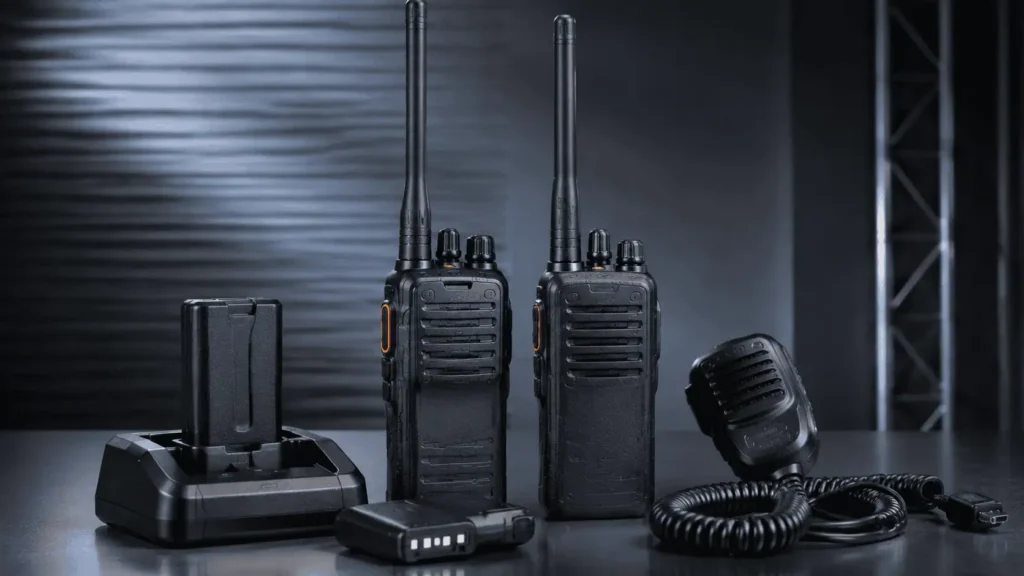
- Ask about accessory options: heavy-duty carry cases, remote speaker microphones, and multi-unit chargers for site offices
- Request a sample unit and test it on an actual site before committing to a bulk order
Common Mistakes When Buying Construction Radios
- Choosing on price alone: A cheaper radio that fails after one site season costs more in replacements than a properly rated unit.
- Ignoring the microphone spec: A radio with a standard microphone will be hard to understand over heavy machinery.
- Not planning for battery replacement: Jobsite batteries degrade faster due to heat, dust and rough handling.
- Skipping a real-site test: Showroom testing does not reflect a jobsite’s noise and interference conditions.
Can You Order OEM Construction Radios?
Yes. Equipment rental companies, construction radio distributors and contractor supply businesses can order private-label rugged radios with custom color, logo, packaging and channel presets tailored to typical construction crew structures. Sample testing before bulk ordering is recommended given the demanding jobsite environment.
Ready to source? See our construction walkie talkie supply page for models, OEM options and quotation details.
Construction Radio FAQs
What IP rating is enough for most construction sites?
IP65 or IP66 is sufficient for most general construction and civil work. IP67 or higher is recommended for marine, flood-prone or heavy rain regions.
Do construction radios need a license?
This depends on the frequency band and country. Many license-free UHF radios are available for construction use, while higher-power or wide-area systems may require a local license.
How long should a construction radio battery last?
Most rugged DMR radios provide 10 to 14 hours of typical use on a full charge, though heavy dust and cold weather can reduce battery performance.
Can radios cover a large multi-building construction site?
Yes, with a DMR repeater positioned on site, or with PoC radios that use cellular coverage to connect crews across a large or scattered site.
Request a Construction Radio Recommendation
To get an accurate recommendation and quote, please tell us:
- Site type and typical weather or dust conditions
- Number of crews or subcontractors needing separate channels
- Approximate radio quantity and shift length
- OEM, branding or accessory requirements
- Target delivery timeline
We can recommend a suitable rugged radio model, accessory package and OEM option for your jobsite.