
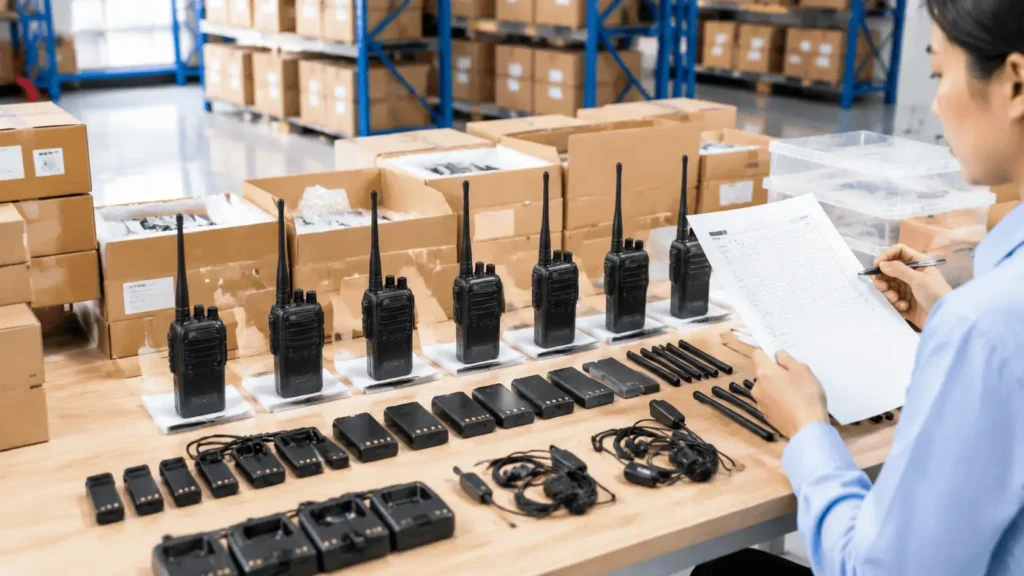
OEM sourcing guide for brands and bulk buyers
Private Label Walkie Talkie MOQ, Samples and Lead Time: A Buyer’s Checklist
Before you request a custom radio quotation, define the product, quantity, branding, packaging, destination market and approval path. This checklist helps buyers turn a broad private label idea into a comparable OEM brief.
The short answer
There Is No Single MOQ or Lead Time for Every Private Label Radio
A useful OEM quotation needs more than a requested quantity. The selected model, SKU split, accessories, logo treatment, packaging, market requirements and approval method all change what can be quoted and how the project should be planned.
Private label walkie talkie MOQ, sample availability and production timing should be confirmed for the exact radio and customization scope. Start with a controlled product brief, then ask the supplier to state included items, assumptions, approval steps and any separate requirements before you compare offers.
MOQ planning
Choose the Right Private Label Route Before Asking for MOQ
These are project routes, not universal MOQ promises. The supplier should confirm availability and commercial terms against the actual product, branding and packaging requested.
| Project route | Typical buyer objective | What can change the MOQ discussion | Ask before you proceed |
|---|---|---|---|
| STOCK CONFIGURATION | Validate product fit, open a sales channel or support a focused deployment. | Selected model, battery, charger, plug type, frequency version, accessory mix and neutral or standard packaging. | Which configurations are available and what is included in each unit pack? |
| BRANDED UNIT | Add a logo, product label, model naming or approved brand presentation. | Artwork method, placement, label content, serial or barcode plan, language and approval proof. | What artwork files and approvals are needed, and which items are project-specific? |
| PRIVATE LABEL PACK | Launch a retail, distributor or e-commerce product under your own brand. | Color box, manual, barcode, inserts, carton marks, pack-out, accessory bundle and product variants. | What is the MOQ for each box version, language, SKU and accessory bundle? |
| CUSTOM PROJECT | Meet a defined technical, system or market requirement. | Hardware configuration, approved software assets where applicable, frequency or network compatibility, requested documents and inspection scope. | Which requirements need feasibility review before a final quotation is issued? |
A lower entry quantity can be useful for a first order, but creating many small variants may increase cost and make packaging, approval and replacement-stock planning more difficult.
Scope control
SKU Splitting Is a Hidden MOQ Decision
Buyers often state a total quantity but leave the split across models, colors, bands, plug types, accessories and packaging versions undefined. Each split can change the project economics and approval workload.
Keep the Core Model Clear
Specify the radio platform and key requirements before deciding on branding.
- Analog, DMR or PoC / LTE
- Frequency or mobile network requirement
- Display, keypad, GPS or Bluetooth needs
- Battery, charger and plug type
Control Brand Variants
Define the exact branded elements rather than asking for a vague custom logo.
- Logo placement and color
- Label, model name and barcode
- Manual language and insert
- Retail box and carton marks
Plan the Final Pack
Buy the complete user kit, not only the radio body, when comparing project options.
- Speaker microphone or earpiece
- Spare battery and charging layout
- Clip, case, antenna and spares
- Master-carton and delivery requirement
Sample and approval flow
Use Samples to Confirm the Agreed Scope, Not Just the Radio Body
A sample review is most useful when the buyer evaluates the same configuration that will be quoted for the bulk project. Availability, cost and timing should be confirmed for the selected model and customization level.
Use case, country, radio type, quantity, features, accessories and brand scope.
Confirm the product route, assumptions, requested documents and available options.
Decide whether the review covers product fit, accessories, branding or packaging.
Lock logo files, labels, manual content, packaging and carton marks where applicable.
Confirm model, SKU quantities, included items, inspection and delivery terms.
Review pack-out, documentation, freight method and destination handover.
What to Check During a Sample Review
- Audio, controls, display and user workflow
- Battery, charger, plug and accessory compatibility
- Frequency, network or system assumptions
- Logo placement, labels and printed information
- Packaging dimensions and included items
- Documents needed for the intended market
What a Sample Does Not Automatically Confirm
- Final MOQ for every brand or packaging variant
- Applicability of documents to a different configuration
- Final mass-production schedule before all approvals
- Coverage performance in an undefined environment
- System, frequency or carrier permissions in your country
- Final landed cost after freight, import and local delivery
Production planning
Lead Time Is a Project Schedule, Not Just a Production Date
Ask for a schedule that shows the dependencies before production, not only the final shipping estimate. This makes it easier to identify which buyer approvals can delay the project.
| Schedule stage | What needs to be ready | Common buyer-side dependency | Question to include in the RFQ |
|---|---|---|---|
| Product selection | Exact model, configuration, destination and intended use. | Changing the product after quoting or testing a different version. | Which model and configuration will be used for the quote? |
| Artwork and packaging | Approved logo, labels, manual, box, barcode and carton mark files. | Late artwork, unapproved translations or multiple packaging versions. | What files are required and when must they be approved? |
| Sample and approval | Clear review criteria and decision maker for the selected scope. | Sample changes that are not added to the written bulk specification. | What exactly is being approved before the bulk order is released? |
| Production and inspection | Confirmed quantity by SKU, included items, quality criteria and packing method. | SKU changes, added accessories, added inspection scope or incomplete payment terms. | Which production and inspection assumptions apply to this quotation? |
| Freight and arrival | Destination, shipping term, consignee details and required transport documents. | Waiting until goods are finished to choose the freight method or consignee. | Where does supplier responsibility end and which shipping term is quoted? |
Avoid costly changes
Six Questions to Resolve Before You Place the Bulk Order
Document the answers in the purchase order, approved artwork and product specification. A clear record is more useful than an informal promise in a message thread.
Which radio is being supplied?
State the selected model, configuration, frequency or network condition, included battery and charger, and each accessory.
What is the quantity by SKU?
Separate model, color, band, plug type, accessory kit and packaging version rather than relying on one total quantity.
What has been approved?
Identify the product sample, artwork proof, manual, label, box and carton mark that form the approved version.
What documents apply?
Ask for documentation relevant to the exact model, configuration, brand and destination market. Requirements vary by country.
What is included in the quotation?
Separate unit product, accessories, OEM work, packaging, testing or inspection, and shipping assumptions.
What happens after production?
Confirm pack-out, final inspection, freight terms, delivery point, import responsibilities and replacement-parts planning.
Copyable buyer template
Send a Complete Private Label Walkie Talkie RFQ
Use this brief for every supplier you compare. It gives each party the same scope, making MOQ, samples, lead time and commercial assumptions easier to evaluate.
PRIVATE LABEL WALKIE TALKIE RFQ

Company:
Contact person:
Email / WhatsApp:
Destination country:
Buyer type / sales channel:

Application and operating environment:
Radio type: Analog / DMR / PoC-LTE / Not sure
Required quantity by model / color / band:
Frequency band or mobile network requirement:
Existing radio, repeater or platform compatibility:
Required functions:

Battery and charger configuration:
Accessories per radio:
Spare batteries / spare accessories:

Logo and label requirement:
Manual language and content:
Retail box / multipack / project kit:
Barcode / carton mark requirement:
Requested documents for destination market:

Sample required: Yes / No
Sample review criteria:
Inspection requirement:
Target delivery date:
Delivery city / port and preferred shipping term:

Please show separately:
1. Exact included configuration
2. MOQ for each model and branded item
3. Sample and approval steps
4. Assumptions and exclusions
5. Packaging, inspection and shipping scope
Private label radio FAQ
Questions Buyers Ask Before Their First OEM Order
Use these answers to prepare a stronger inquiry and reduce avoidable changes after the quotation stage.
What is the MOQ for a private label walkie talkie?
MOQ depends on the selected radio model, quantity by SKU, branding method, packaging, accessories, destination-market requirements and whether stock or custom components are used. Confirm the MOQ against the exact approved configuration.
Can I begin with a stock walkie talkie model?
A stock-style model may be a practical starting point for an initial project. Ask which labels, packaging, manuals, accessories and product options can be customized for the selected model and order scope.
Should I approve a sample before a bulk private label order?
For a new model, configuration or brand presentation, a sample or controlled review can help confirm the agreed radio, accessory bundle, artwork, packaging and user experience before the bulk specification is locked.
How long does private label walkie talkie production take?
Timing depends on product availability, custom components, artwork readiness, sample approval, packaging, production scheduling, inspection scope and shipping plan. Request a project-specific schedule after the configuration is defined.
What can be customized on a private label walkie talkie?
Possible discussion areas include logo placement, labels, model naming, manuals, retail packaging, carton marks, accessory bundles and approved software or startup assets where applicable. Options depend on the selected product and project scope.
What information is needed for an OEM quotation?
Provide the application, destination country, radio type, quantity by SKU, frequency or network requirement, accessories, brand and packaging needs, sample requirement, requested documents, target delivery date and delivery location.
Ready to define your private label project?
Request an MOQ, Sample and Production Plan for One Clear Radio Configuration
Send the product type, country, quantity by SKU, branding scope, packaging needs and target date. A complete brief gives you a more useful OEM response than an undefined request for a custom radio.